

Flatbed trailer vs lowbed trailer comes down to which limit the load hits first, and for tall machinery that limit is the loaded cargo height against the route’s height limit. Rated payloads of the two types overlap, so tonnage alone rarely settles the choice. A lowbed drops its deck between the gooseneck and the rear axles. On typical US lowboy dimensions, that leaves roughly 0.9–1.1 m more cargo height under the same limit than a standard flatbed. For dense, low cargo, axle loads, width and loading method decide instead.
Flatbed trailers or lowbed trailers are two common types of transport; flatbed trailers are the most common type, while lowbed trailers are designed and built to accommodate special transport needs. The construction, manufacturing, engineering, transport, and other industries play an essential role. Truckman Automobile often meets customers who will ask, what is the difference between a flatbed truck and a low-bed trailer? Let’s take a look at what the specific differences are.
Flatbed and Lowbed Trailer Concepts
Flatbed and lowbed trailers are important freight carriers in everyday life, and their design features allow them to meet the needs of transporting different goods.
Flatbed trailers
A flatbed trailer is a fenceless freight carrier developed with a relatively flat area. Non-standard-sized cargo, such as in various sizes and shapes, can be quickly loaded. The relatively flat loading area provides a convenient and flexible transport solution for many goods. It is a widely used type of trailer today. To ensure that every transport is safe and efficient, see our guide on how to load a flatbed semi-trailer safely!
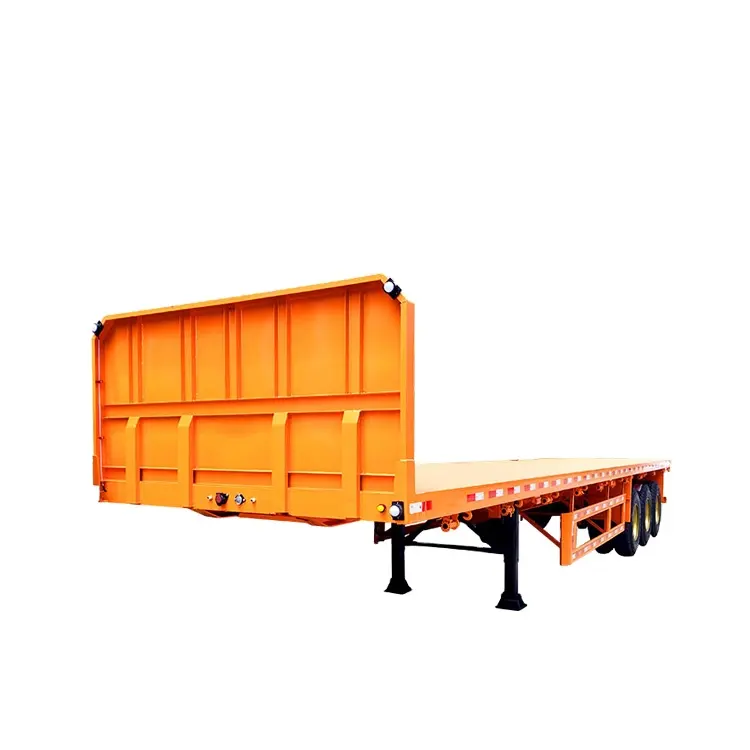
Low-bed trailer
The low flatbed trailer is an upgrade of the flatbed trailer, with a stronger chassis whose deck drops between the gooseneck and the rear axles. It dramatically reduces the transport height of the whole vehicle. It is suitable for the logistics transport of unique goods such as ultra-high.
Low Flatbed, Lowbed and Lowboy: Names for the Same Dropped Deck
Low flatbed, lowbed, lowboy and low loader are trade names for drop-deck trailers, and their meanings overlap from market to market. The deck height on the drawing is a better guide than the name on the quotation.
| Term | Where it usually appears | Spec action |
|---|---|---|
| Low flatbed | Direct translation of the Chinese catalog term for a drop-deck lowbed | Confirm the deck actually drops; a “low flatbed” with a straight deck is a flatbed |
| Lowbed / low bed | Enquiries from Asian, African and Middle Eastern buyers | Ask for the loaded deck height in mm on the drawing |
| Lowboy / low loader | North American listings (lowboy); British and Australian listings (low loader) | Ask whether the gooseneck is fixed or detachable before comparing prices |
| Semi-lowbed / step deck | Some markets use both names for a single drop behind the gooseneck; not every product labelled either way is built the same | Compare the lower-deck height with the cargo’s transport height |
| “80-ton” in a model name | The factory structural rating | Ask for the legal payload under your route’s axle-load limits |

Load Capacity
Load capacity overlaps between flatbed and lowbed trailers, and on both types the rated tonnage depends on axle count and beam design more than on the trailer name. Truckman’s flatbed semi trailer range is rated at 40 tons for the 2-axle version and 50 tons for the 3-axle version, with heavier builds listed up to 100 tons.
Lowbed trailers are built for tall and heavy equipment such as excavators, bulldozers and building structures. Truckman’s lowbed range is commonly rated from 50 to 100 tons, depending on axle count and how the main beams and gooseneck are reinforced.
A 3-axle flatbed rated at 50 tons and a 3-axle lowbed rated at 80 tons sit in overlapping bands. Payload rarely separates the two types. For tall cargo, height does: a flatbed strong enough for the weight can still put a machine over the route limit. Factory ratings are structural figures. The legal payload depends on gross combination weight, axle-group and kingpin loads, tyre ratings and each country’s axle-load limits. It can sit below the rating.
Matching axle count and tonnage to one specific machine is a separate sizing step, covered in Truckman’s low bed semi-trailer capacity guide.
Flatbed Trailer vs Lowbed Trailer Deck Height and Route Height Limits
Deck height is the measurement that separates a flatbed trailer from a lowbed trailer, and its practical effect is the cargo height left under a route’s legal height limit. A lower deck does not make a load lighter or narrower; it only buys vertical room, which is why it matters most for tall machinery.
Usable cargo height can be approximated as the route height limit minus the loaded deck height. A measured loaded deck height already includes static tyre and suspension compression, while cribbing, securing hardware and attachments standing above the machine come on top. On US-spec equipment, a standard flatbed deck sits at about 5 ft (about 1.5 m), as noted in Truckman’s guide to flatbed deck heights. Dealer figures for a loaded lowboy well run 18–24 in (457–610 mm), as listed in its lowboy size guide. Those are reference dimensions for US lowboy configurations rather than specifications for every export lowbed, and they apply only to cargo that sits in the well.
Under the 4.00 m maximum vehicle height in EU Council Directive 96/53/EC, that arithmetic gives about 2.5 m of cargo height on the flatbed. The lowbed well leaves about 3.4–3.5 m, roughly 0.9–1.1 m more. Take a machine standing 3.0 m in transport position. On a 1.52 m flatbed deck it reaches about 4.5 m; in a 0.61 m well it reaches about 3.6 m. Only the lowbed passes this first check. Run the same addition with your own machine height and the deck height on the trailer drawing. Then check bridges and tunnels separately, because a legal limit is not the clearance of every structure on the route.
In 2024, Kenya’s highway authority enforced a 4.3 m overall height under the EAC Vehicle Load Control Act, and transporters asked for that limit to be reviewed (The Star, March 2024). At 4.3 m, the same decks leave about 2.8 m and 3.7–3.8 m. Confirm the current limit with the road authority of each country on the route before loading.
| Variable | Figure or rule | What it depends on |
|---|---|---|
| Route height limit | EU: 4.00 m; EAC: 4.3 m as enforced in Kenya in 2024; US: set by each state | The strictest country, bridge or tunnel on the route |
| Vehicle width | EU: 2.55 m; US: 102 in (2.6 m) on the National Network under 23 CFR 658.15 | Over-width needs a permit on either trailer; some export lowbeds have a 3,000 mm platform, wider than both |
| Flatbed deck height | About 1.5 m on standard US-spec decks | Tyre size, main-beam depth, suspension type |
| Lowbed well height (loaded) | 457–610 mm on US lowboy dealer specs | Tyre size, gooseneck design, well depth on the drawing |
| Usable cargo height | Route limit minus loaded deck height (approximate) | Cribbing, securing hardware, attachments above the machine |
Of these variables, the loaded height and the route limit should be confirmed first for tall cargo, because deck height is built into the frame and cannot be changed economically after manufacture. Axle count and suspension can then be matched to the weight within the deck height already chosen.
Limitations
Limitations of flatbed and lowbed trailers fall on different variables: cargo type and loaded height for a flatbed, and ground clearance, towing power and route access for a lowbed.
Standard open flatbed trailers are not designed to contain unpackaged liquids or loose bulk materials, though they can carry tanks, IBCs or bagged bulk cargo that is properly secured. In adverse weather, the cargo is exposed and may need covers or additional protection.
Low-bed trailers are usually larger and need more powerful tractors. Their maneuverability is limited, so check the road conditions on the route before purchase.

Ground Clearance and Gooseneck Stress on Unpaved Roads
Ground clearance under a lowbed well is the price of its lower deck, and on unpaved roads the well is the first part to meet the ground. A well that clears a highway can still strike on road crests, rail crossings and steep site entrances. The checks include at least the clearance under the well and the approach angle at the gooseneck, plus the ramp angle the machine has to climb.
Load stress also concentrates at the gooseneck on rough roads. In a Truckman customer case from the Democratic Republic of the Congo, a mining contractor ordered two 3-axle 80-ton lowbeds to move excavators on unpaved access roads. The build used reinforced gooseneck points, a double-layer bottom plate and mechanical suspension to address gooseneck bending and chassis warping under repeated shocks (case details).

Areas of application
Areas of application for flatbed and lowbed trailers split by cargo height and loading method more than by industry. Flatbeds handle building materials, components and other crane- or forklift-loaded cargo that stays under the height limit, while lowbeds handle tall machinery that drives on and heavy structures.
Flatbed trailer applications
Construction: Flatbed trailers carry steel, concrete slabs, timber and other building components of mixed shapes and sizes, loaded from the side or from above.
Manufacturing: Machines, components and finished products move between factories on flatbeds, and add-ons such as guardrails and extra tie-down points widen the cargo mix a flatbed can carry.
Lowbed trailer applications
Engineering: Excavators and bulldozers are the typical lowbed load, because their transport height on a flatbed deck often exceeds the route limit.
Heavy Equipment Transport: Steel structures, bridge members and other heavy components sit close to ground level on a lowbed, which reduces loading and unloading risk. The same layout suits non-standard engineering structures.
| Cargo scenario | Usual fit | What would change the choice |
|---|---|---|
| Steel coils, containers, bagged cement, timber | Flatbed | Width or weight over the limit, which a lower deck leaves unchanged |
| Machine slightly over the flatbed height allowance | Step deck | Height still over the limit on the lower deck, which points to a lowbed |
| Tracked excavator or bulldozer that drives on | Lowbed with ramps | A machine low enough to stay under the limit on a flatbed deck, with a crane or dock at both ends |
| Long steel structures or bridge members | Flatbed | Pieces tall enough to exceed the limit on a flatbed deck |
| Transformers or tall single-piece equipment | Lowbed | Total weight beyond the trailer’s axle rating, which calls for more axles rather than a lower deck |
Permit, Escort and Tare Costs: Flatbed vs Lowbed
Permit, escort and tare costs separate flatbed and lowbed hauls more than the trailer price does, and each one follows from the cargo’s height, width and weight. A machine that is over the height limit on a flatbed deck but under it in a lowbed well may avoid an over-height permit. Depending on each country’s rules, it may also avoid an escort vehicle and a route survey for that dimension. Over-width or overweight permits can still apply, including when the trailer itself is wider than the standard limit.
In comparable tractor and trailer configurations, a lowbed’s gooseneck and deeper main beams usually add tare weight. Under a fixed gross vehicle limit, every extra tonne of tare is a tonne less legal payload. Compare the tare weights on both drawings before assuming the lowbed is cheaper to run.
If the cargo is dense, crane-loaded and under the height limit on a flatbed deck, a standard flatbed is enough. A lowbed in that job adds tare and purchase cost without removing any constraint. Loading method is the other cost variable. Tracked machines drive onto a lowbed over its rear ramps, or over the front on a removable-gooseneck (RGN) lowbed. On a flatbed, the same machine may need a crane or loading dock at both ends. Securement work stays the same on a lower deck: tie-down points and working load limits need the same check on either trailer.
Deciding Between Flatbed and Lowbed Trailers by Loaded Height
Flatbed trailer vs lowbed trailer turns on which constraint governs the haul: loaded height for tall machinery, and axle loads, width, deck length and loading method for dense or long cargo.
If the cargo plus a flatbed deck stays under the strictest height limit on the route and is crane-loaded, a flatbed is the lighter choice. If a machine is only slightly over the flatbed allowance, a step deck may be enough. If it would still be over the limit there, a lowbed keeps it under. If the route includes unpaved access roads, check the clearance under the well and the gooseneck reinforcement before settling on a lowbed.
We compare the machine’s transport height and the route limit against the deck height on our drawings before quoting either trailer. For machinery that needs the dropped deck, the Low Bed Semi Trailer range lists Truckman’s axle and tonnage options. For wide or long loads, Truckman’s guide Can Flatbed Semi-Trailers Carry Oversized Cargo covers the flatbed side of the decision.
FAQ
Can a flatbed trailer carry an excavator?
A flatbed can carry an excavator when the machine’s transport height plus the deck height stays under the route limit, and a crane, ramp or dock is available at both ends. Compact excavators often meet both conditions; larger machines usually exceed the height first, which is when a lowbed becomes necessary.
Does a lowbed trailer always avoid an oversize permit?
No. A lowbed only lowers the deck; width, gross weight, axle loads or a load that is still too tall in the well can each require a permit.
Can a flatbed trailer be converted into a lowbed later?
Not economically. Deck height is set by the frame, gooseneck and axle layout, so a lower deck means a different trailer rather than a modification.
Which trailer is more stable with a tall load?
A lowbed carries a tall load with a lower centre of gravity, which reduces roll-over risk on curves and road camber. Load position, track width and road surface also count. On rough routes, a flatbed carrying a load that fits under the limit can be the steadier option.
Related Posts
- What Is A LowBoy Trailer? — the lowboy name and double-drop frame behind the term table above
- How to Transport Excavators on a Low Bed Trailer? — the loading steps once the excavator height check points to a lowbed
- What’s The Difference Between RGN VS Lowboy? — front loading on a removable gooseneck, mentioned under loading method
- What Can You Haul On A Flatbed Trailer? — the cargo behind the flatbed rows in the application table