

US lowboy trailer size centers on the well, typically 24 to 29 feet long and 18 to 24 inches off the ground, on a 102-inch-wide trailer about 48 to 53 feet long. Under a 13 ft 6 in height limit, that well fits machines about 11.5 to 12 feet tall. Beyond those ranges, what a particular lowboy can carry without permits depends on the route’s height limit and on whether the machine’s tall section fits inside the well, with axle spacing setting the legal weight. On the National Network, width is the one dimension federal rules fix; states set height limits and, above a federal minimum, trailer length limits.
Is There a Standard Lowboy Trailer Size?
No federal rule defines a standard lowboy trailer size: federal law fixes width at 102 inches on the National Network, requires states to allow semitrailers of at least 48 feet, and leaves height to each state, according to FHWA’s summary of federal size regulations. Every other figure quoted for lowboys is a builder or industry range. For a buyer, the range that decides whether a machine fits is the well, the low deck between the two drops. Freight references from DSV and We Will Transport It publish nearly identical working figures, converted here to metric:
| Measurement | Typical US figure | Varies with | What it limits |
|---|---|---|---|
| Overall trailer length | 48–53 ft (14.6–16.2 m) | Gooseneck and rear-section length | Turning room and state length rules |
| Well length | 24–29 ft (7.3–8.8 m) | Builder and neck type | Footprint of the machine’s tallest section |
| Loaded well height | 18–24 in (457–610 mm) | Frame design and suspension ride height | Machine height allowed under the route limit |
| Width | 102 in (2.59 m); 108 in in Hawaii | Federal rule on the National Network | Width without an over-width permit |
Overall length and well length are easy to confuse. A “53-foot lowboy” describes the whole trailer, while the machine rides low only on the well. Two trailers with the same overall length can therefore differ by several feet of usable low deck. Comparing lowboys well length against well length, and keeping overall length for route planning, avoids ordering a trailer that is long enough only on paper.
Which Part of a Lowboy Deck Actually Sits Low?
On a lowboy, only the well between the two drops rides at 18 to 24 inches, while the gooseneck deck ahead of it and the section over the rear axles sit higher, so the length available to a tall machine equals the well length. The rear section is lower than the gooseneck but still above the well, which gives a lowboy three deck heights along its length.
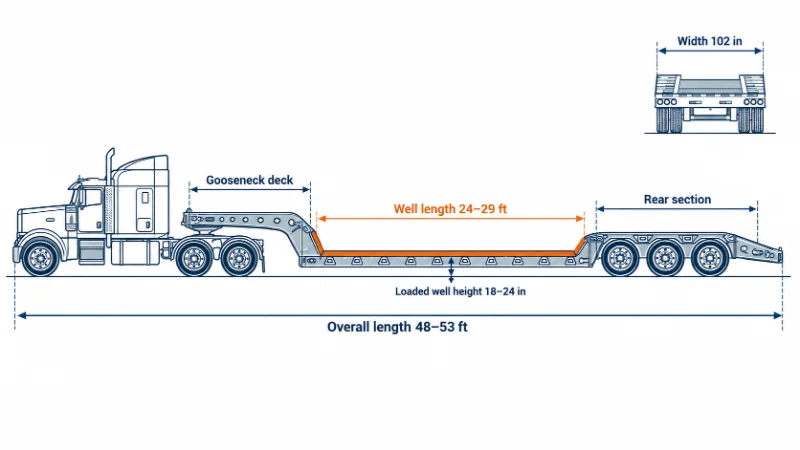
The two-drop layout splits a machine’s length into two checks: its tallest section has to sit entirely inside the well, and anything that extends past either end rides on a higher deck. A boom, blade or attachment that looks harmless at the well can then set the load’s overall height. The height check runs at every section the machine touches. The well is only the first.
When a load is planned from the machine’s overall transport length and the trailer’s overall length, the usual result is a load that fits on paper. On the trailer it then rides partly on the rear section, over height at the one point nobody measured. Measuring the length of the machine’s tall section, and asking for the well length as its own figure, closes that gap.
How Tall Can a Machine Be on a Lowboy Before It Needs a Permit?
The tallest machine a lowboy can carry without an over-height permit can be approximated as the route’s legal height limit minus the loaded well height and any blocking under the machine. FHWA puts most state limits between 13 feet 6 inches and 14 feet, and some states go higher: Colorado allows 14.5 feet on National Highway System routes. Because the limit can change at a state line, the same machine on the same trailer can be legal on one leg of a trip and over height on the next.
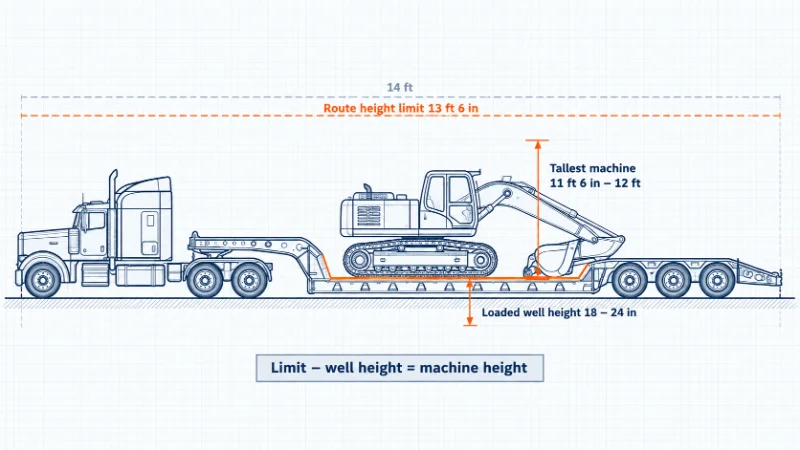
| Route height limit | Where it applies | Tallest machine on an 18 in well | Tallest machine on a 24 in well |
|---|---|---|---|
| 13 ft 6 in (4.11 m) | Low end of most state limits | 12 ft 0 in (3.66 m) | 11 ft 6 in (3.51 m) |
| 14 ft (4.27 m) | High end of most state limits | 12 ft 6 in (3.81 m) | 12 ft 0 in (3.66 m) |
| 14 ft 6 in (4.42 m) | Colorado, National Highway System routes | 13 ft 0 in (3.96 m) | 12 ft 6 in (3.81 m) |
Figures assume no blocking under the machine and a well height measured under load; lower posted clearances on a route still govern.
A 12-foot machine on a 24-inch well stands 14 feet overall: legal where the limit is 14 feet, six inches over in a 13-foot-6 state. Planning around 14 feet as a national figure produces exactly that overrun. To check your own load, subtract the trailer’s measured loaded well height and any blocking from your route’s limit, then compare the result with the machine’s height in transport position.
Above the route limit minus 18 inches, no well in the typical 18- to 24-inch range brings a machine under the limit. Picking between standard lowboys stops helping. The options that remain include at least a mini-deck lowboy with a lower well and an over-height permit, and lowering or removing the tallest component is worth checking where the machine’s design allows it. How a permit is applied for and escorted is a state process outside this sizing check, and the arithmetic only tells you whether one will be needed.
The same subtraction shows when height alone does not call for a lowboy. A step deck’s lower deck typically sits 36 to 42 inches up, according to We Will Transport It, which leaves roughly 10 to 10.5 feet under a 13-foot-6 limit. A machine within that height can ride a step deck if the deck’s rating and axle loading also work. A lowboy earns its place when the machine is taller, or when a concentrated load or drive-on loading calls for its frame or detachable neck.
How Does Axle Spacing Tie a Lowboy’s Length to Its Legal Weight?
On the Interstate System, the weight a lowboy combination may carry without a permit depends on how many axles it has and how far apart they sit, under the Bridge Formula in 23 CFR 658.17, the federal weight rule for Interstate highways. Axle spread is a length, so a lowboy’s size is also part of its legal capacity.
The formula is W = 500 × [LN ÷ (N − 1) + 12N + 36]. W is the maximum weight on a group of consecutive axles, rounded to the nearest 500 pounds. L is the distance in feet between the group’s outer axles, and N is the number of axles in it. Every such group has to pass, alongside the 80,000-pound gross cap, 20,000 pounds per single axle and 34,000 per tandem.
A three-axle tractor pulling a two-axle lowboy runs on five axles, and for that five-axle group to reach 80,000 pounds its outer axles must be roughly 51 feet apart: 500 × (51 × 5 ÷ 4 + 60 + 36) = 79,875, which rounds to 80,000. That span is necessary but does not make the load legal on its own. The drive tandem and the trailer tandem form a four-axle group, and at 35 feet apart it may carry only 500 × (35 × 4 ÷ 3 + 48 + 36) = 65,333, rounded to 65,500 pounds, short of the 68,000 two full tandems carry. Section 658.17(e) allows 34,000 pounds on each tandem once they are at least 36 feet apart.
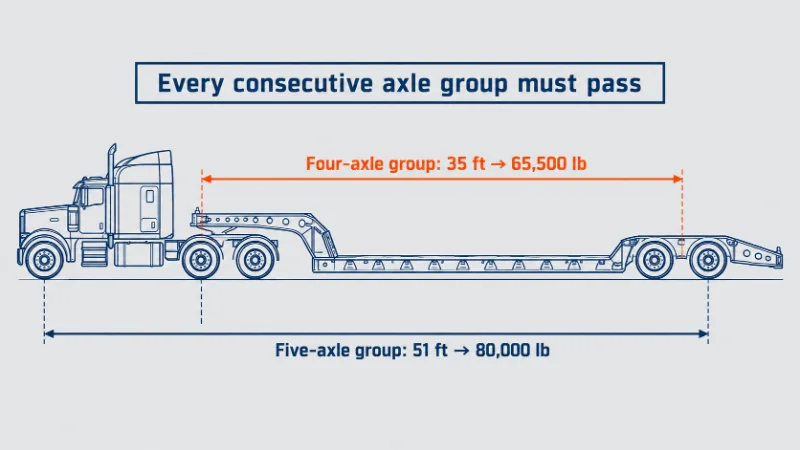
Adding a third trailer axle lets the six-axle group reach 80,000 pounds at about 43 feet, since 500 × (43 × 6 ÷ 5 + 72 + 36) = 79,800. Both ways of adding legal weight, an extra axle or a longer spread, usually lengthen the combination. Freight references such as DSV plan a two-axle lowboy at about 40,000 pounds of freight, a working figure distinct from the trailer’s structural rating and from these legal limits. Loads beyond the limits move under state permits, which 658.17(h) lets states issue for nondivisible loads without regard to the Bridge Formula.
How Do RGN, Extendable, and Mini-Deck Lowboys Change Usable Size?
Neck type and deck options change a lowboy’s usable size in different directions: a removable gooseneck changes how the machine gets on, an extendable deck adds length, and a mini-deck build lowers the well. The dimension the load exceeds decides which of the three is worth paying for.
An RGN (removable gooseneck) lowboy has a neck that detaches so the machine can drive on from the front. The detach mechanism adds hardware at the front of the trailer, and its effect on well length depends on the design. An RGN’s well length is therefore worth confirming on its own drawing before it is compared with a fixed-neck trailer of the same overall length.
Extendable lowboys stretch the well itself, to 50 feet or more. We Will Transport It lists their loaded deck height at 20 to 26 inches, a little above a fixed well. For a load that is both long and close to the height limit, those extra inches come straight off the machine height that the subtraction allows.
Mini-deck builds lower the well further. XL Specialized’s 2015 announcement of its XL 60 Mini-Deck lists a 12-inch loaded deck height with 4 inches of ground clearance on a three-beam main deck, and a 33-foot well on a 53-foot trailer. Against a standard well that buys 6 to 12 inches of machine height, while the smaller clearance makes the route’s crossings and approaches the next check. Outriggers and widening decks carry wider machines, but any load or deck wider than 102 inches is an over-width load on the National Network.
How Do Export Low Bed Semi-Trailer Sizes Compare in Metric?
Outside North America the lowboy is commonly sold as a low bed and specified in millimetres, and whether a given size is legal depends on the destination’s metric height and width limits. The US ranges convert to a well of about 7.3 to 8.8 m and a loaded well height of about 460 to 610 mm, on a trailer 2.59 m wide.
Directive 96/53/EC, the EU framework for maximum vehicle weights and dimensions, sets 2.55 m of width for most vehicles in national and international traffic and a 4.0 m height for international traffic. On a 457 mm well, a 4.0 m limit leaves about 3.54 m for the machine, some 11 cm less than the 3.66 m (12 ft) the same well allows under a US 13 ft 6 in limit. A machine that clears US routes on a standard lowboy can therefore be over height in Europe.
Width can run the other way on export builds: Truckman’s 3-axle low bed listing, like the rest of its low bed range, quotes a 3,000 mm loading platform, wider than both 2.55 m and 102 inches. On EU roads and the US National Network such a trailer is an over-width vehicle whether or not it is loaded. The destination’s width rule or permit terms then decide whether that platform suits a market. A quoted platform length is also worth confirming as the length of the low section before a machine is matched to it.
For West African corridors, timing matters as well. As of April 2026, Ghana’s implementation of the ECOWAS Supplementary Act on axle load control, which also harmonizes vehicle dimensions, had been deferred from its January 2026 start for stakeholder engagement, according to the Ghana Shippers’ Authority. The width and height a platform must meet are therefore worth confirming with the destination’s highway authority at the time of order.
Does Your Machine Fit the Lowboy Well, or Just the Trailer?
Lowboy trailer size comes down to whether the machine’s tall section fits the well at a height the route allows, and two numbers settle the height half of that question before any trailer is compared: the route’s legal height limit and the machine’s measured height in transport position. They come first because they decide whether a standard 18- to 24-inch well can work at all, and so which trailers are worth comparing. Well length and axle spread are fabricated into the trailer too, so they come next, before anything goes on order.
Unplanned permits usually trace back to a catalog machine height and a trailer’s overall length, which is why we verify a measured machine height against the destination’s height and width limits before we draw up a platform size. Where the route limit is 13 feet 6 inches and the machine measures more than 12 feet, compare a mini-deck build with a permit plan before looking at standard trailers. Where the destination works to metric limits, check its width rule against the 3,000 mm platforms of our Low Bed Semi Trailer range before choosing a width.
FAQ
Is a lowboy the same as a low bed or a low loader?
Yes. NTS Logistics lists low bed, double drop, floater and low loader as regional names for the same two-drop trailer.
Is an RGN deck higher than a standard lowboy deck?
No. An RGN is a lowboy with a detachable neck on the same two-drop deck, and Loyalty Logistics puts most construction-class lowboy wells at 18 to 22 inches.
Is a 53-foot lowboy legal in every state?
Not automatically. FHWA’s size rules require states to allow semitrailers of at least 48 feet, or a longer grandfathered length, on the National Network, so a 53-foot lowboy’s legality turns on the state and the route, especially off the Network.
Can a lowboy carry a 40-foot container?
A standard US lowboy is a poor fit, because a 40-foot box is longer than a 24- to 29-foot well and cannot sit flat in the low section. Export low beds with longer platforms are laid out for containers: Truckman’s 40 ft low bed quotes a 12,400 mm platform for one 40 ft high-cube or two 20 ft containers.
Related Posts
- Where to Customize a Low Bed Semi-Trailer? — for specifying a platform width against the destination limits covered in the metric section
- How to Transport Excavators on a Low Bed Trailer? — measures laden deck height, the figure the height subtraction depends on
- How Does a Removable Gooseneck Work? — explains the detach mechanism whose effect on well length should be checked on the drawing
- 18 Wheeler Trailer Size Guide & Specifications — sets out the federal width, length and weight rules behind the dimensions table
- Flatbed Trailer VS. Lowbed Trailer — covers the higher-deck option for loads that clear the height check without a well