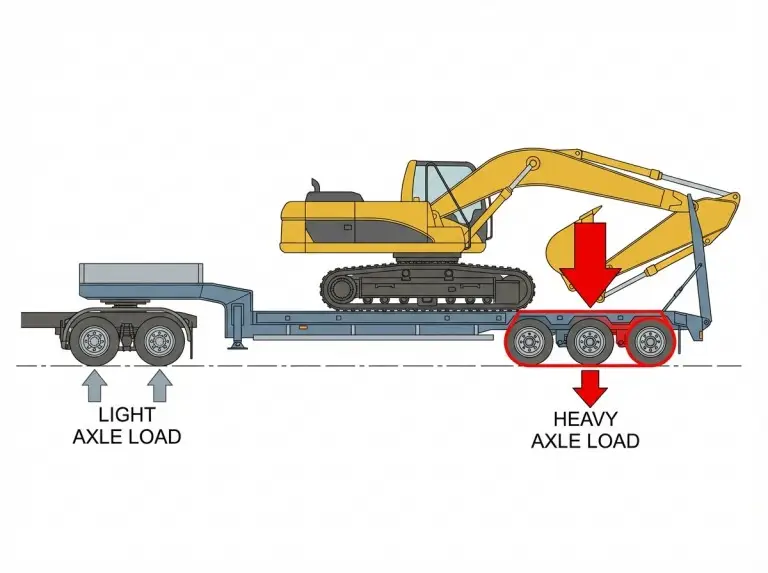

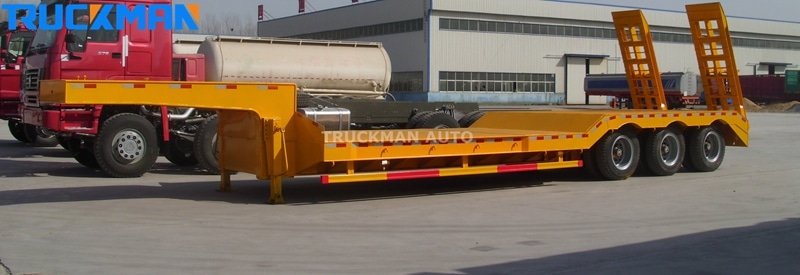
A lowboy trailer is a semi-trailer whose deck drops twice, once behind the gooseneck and once ahead of the rear axles, so tall machinery can ride low enough to clear bridges and overhead lines. Deck height is what makes it an option; payload is what makes it work. Rated tonnage and legal payload are different quantities. The rating is structural; the payload is what the weight rules on your route leave over. For ordinary US Interstate operation the federal baseline is 80,000 lb gross, and state limits differ off the Interstate System. Multi-axle 60 to 100 metric tonne low beds serve permit and export work, where that ceiling never applied.
| Specification | Figure |
|---|---|
| Deck profile | Two drops: one behind the gooseneck, one ahead of the rear axles |
| Loaded deck height | US dealer listings commonly quote 18 to 24 in; the figure follows tire radius, main beam depth and running clearance, so the approved drawing controls |
| Capacity notation | A tonnage concentrated over a stated span, for example tons in 12 ft or in 16 ft, usually alongside a separate distributed figure |
| Width, US National Network | 102 in (8.5 ft) under 23 CFR 658.15, the federal truck width rule; Hawaii keeps 108 in |
| Weight, US Interstate, no permit | 80,000 lb gross, 20,000 lb single axle, 34,000 lb tandem, subject to the Bridge Formula, under 23 CFR 658.17; grandfathered state exceptions exist, and non-Interstate roads follow state rules |
| Height, US | No federal limit exists; each state sets its own, commonly 13 ft 6 in to 14 ft |
| Axle count | 2 to 8 or more, set by which limit binds first on the governing route |
| Oversize or overweight operation | By state permit for nondivisible loads, under 23 CFR 658.17(h) |
What Is a Lowboy Trailer, and Why Does the Deck Drop Twice?
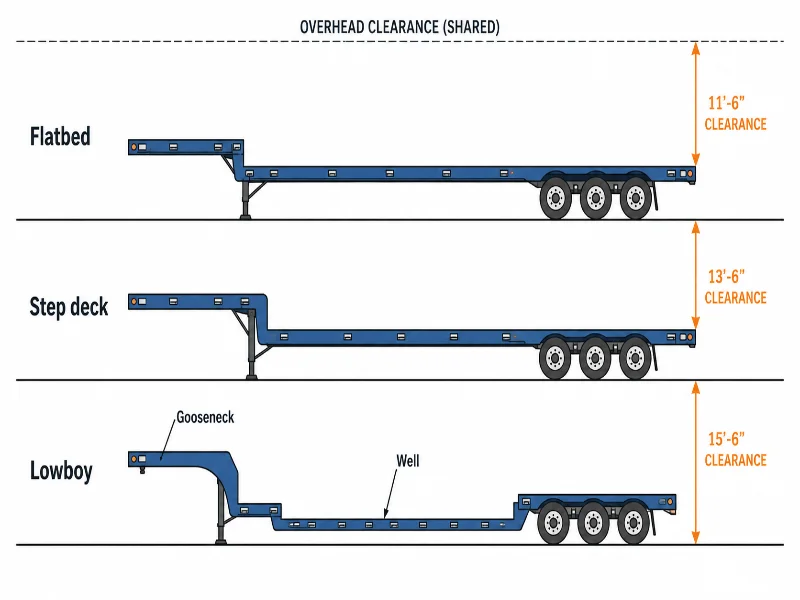
A lowboy trailer takes its name from the well between the gooseneck and the rear axles, and how low that well sits decides whether an over-height machine travels legally or needs a permit. The first drop occurs immediately behind the gooseneck, where the neck hands its share of the load to the tractor’s fifth wheel. The second occurs just ahead of the rear axles. Between them sits the well, the section that provides most of a lowboy’s vertical clearance advantage. Overall travelling height still depends on where the machine’s highest point falls. A boom, cab or exhaust stack can sit over the rear deck or the neck.
Regional naming causes more confusion than the geometry does. The same trailer is a lowboy in North America, a low bed or low bed semi trailer across much of Asia, the Middle East and Africa, a low loader in the UK, and a float in Australia and eastern Canada. A double drop names the same two-drop architecture from the deck’s point of view. None of these words tells you anything about capacity, axle count or how the machine gets on board.
What Does a 50-Ton Lowboy Rating Actually Guarantee?
A tonnage rating on a lowboy states what the structure carries under one defined loading condition, and it becomes legal payload only after the trailer’s component ratings and the route’s weight limits are applied. Capacity on a spec sheet is a layered claim, and the layers answer different questions.
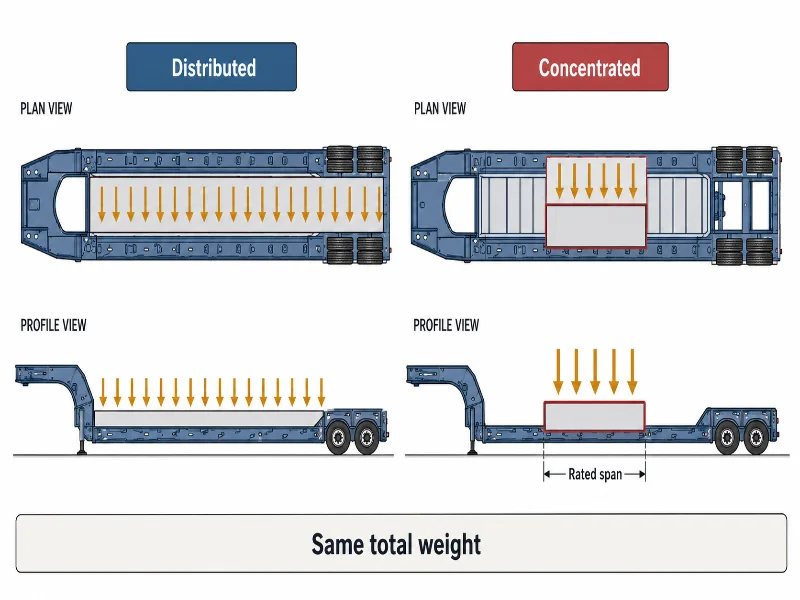
The first layer is the structural rating, and it comes with a span attached. Builders publish lowboy capacity as a tonnage concentrated within a stated length of the well, typically 12 or 16 ft. A separate distributed figure usually sits beside it for load spread across the full deck. A trailer sold as 50-ton carries a rating of 100,000 lb concentrated in that span, since a US short ton is 2,000 lb. Export specifications quoted in tonnes use the 1,000 kg metric tonne. Put the same total weight on a shorter footprint than the rated span and you are outside the rating. Same weight, different footprint, different answer.
The second layer is the component ratings. 49 CFR 571.3, the federal definitions section for motor vehicle safety standards, defines gross axle weight rating as the manufacturer’s stated load-carrying capacity of one axle system at the tire-ground interface. Gross vehicle weight rating is the manufacturer’s stated loaded weight of the vehicle. Tire load ratings, kingpin and fifth-wheel capacity and brake capability sit at the same level. Any one of them can bind before the frame does.
The third layer is the route. Under 23 CFR 658.17, an unpermitted Interstate combination gets 80,000 lb of gross weight to divide between tractor, trailer and cargo. Weigh the empty combination and subtract that figure from 80,000 lb. The remainder is approximately your legal payload, and the Bridge Formula can cut it further where axle spacing is short. Substitute your own weighed tractor and trailer, and the same subtraction gives you your own number.
Run that subtraction and a familiar figure loses its authority. The 40,000 lb often attached to two-axle lowboys is not a universal structural or legal rating of every two-axle trailer. The figure is largely what remains of 80,000 lb once a tractor and a lowboy have weighed themselves. That is why the same trailer appears with different capacities in different places. What varies between those quotes is the tractor and the tare weight.
The same reasoning explains the trailers that confuse buyers arriving from the US market. Section 658.17(h) allows states to permit nondivisible loads without regard to the axle, gross or Bridge Formula limits. Markets running on permits, or on different national weight regimes, size the trailer to the machine and let the permit set the ceiling. A 100 tonne low bed answers a different constraint set. It is built for jurisdictions where 80,000 lb was never the binding number.
Where this goes wrong is upstream of the trailer. Specify a trailer against a machine’s shipping weight instead of its transport-ready weight, and the shortfall appears at the first weighbridge rather than in the yard. Transport-ready means installed attachments, counterweights and the fluid condition the machine will travel in. The correction is a permit application or a second trip.
How Are Lowboy Trailers Classified, by Neck or by Deck?
Lowboy designs sort along two independent axes, neck type and deck profile, and treating them as one list is the fastest way to buy a trailer that cannot load its intended machine. Terminology varies between manufacturers, so read a spec sheet by what the neck physically does and treat the label as secondary.
| Neck configuration | How the machine gets on | Suits | Where it stops working |
|---|---|---|---|
| Fixed neck | Over the rear, via ramps or a beavertail | Machines that can climb a ramp or be winched; lowest tare for a given rating | Anything that cannot manage the ramp angle, or that must be loaded from the front |
| Fixed gooseneck (adjustable but non-detachable; some suppliers call this fixed neck) | Rear loading, neck set and then left in position | Long decks and repeat hauls within one machine family | Front loading; the neck does not come off |
| Mechanically detachable gooseneck | Front, after the neck is released by mechanical or spring linkage | Long hauls where the load stays on for days and every pound of tare counts | Frequent detach cycles; slower and more manual |
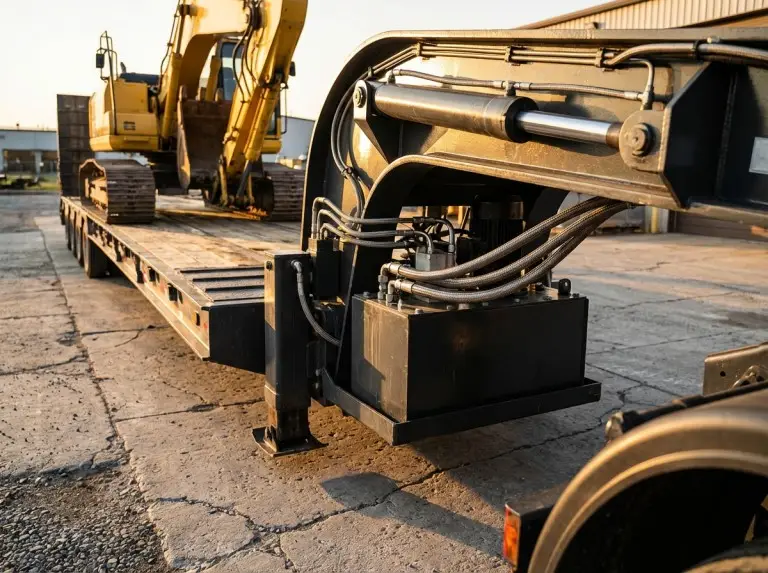
| Hydraulically detachable gooseneck (RGN) | Front, after the hydraulic system lowers the deck to ground level | Machines driven or rolled straight on, and frequent load and unload cycles | Weight-critical work; hydraulics and a heavier neck cost payload |
Deck profile runs across all four. A shallow well keeps tare down and suits equipment that is heavy without being especially tall. A deeply recessed well buys clearance, and it is common wherever low pedestrian bridges and overhead lines set the ceiling before national height law does. Extendable decks add length for long items and add tare permanently. These axes combine freely. An RGN with a shallow well and a fixed-neck trailer with a deep well are both ordinary specifications.
When Does a Lowboy Beat a Flatbed or a Step Deck?
A lowboy earns its cost only when deck height is the constraint that is binding, which depends on the tallest machine you move and the lowest clearance on your route. Flatbed trailers sit highest and are cheapest to buy and lightest to pull. Step decks drop once and recover some clearance. Lowboys drop twice and recover the most, paying for it in tare weight, purchase price and a deck that is harder to load from the side.
The comparison collapses into one measurement. Measure your tallest machine as it will travel, add the loaded deck height of each candidate trailer, and compare the total against the lowest clearance you must pass. Whichever trailer clears with margin and weighs least is the answer. It is not always the lowboy.
Which Lowboy Variables Should You Lock First?
A lowboy specification settles in a fixed order, with the route’s weight regime and the machine’s loading method locking ahead of everything else. The weight regime sets axle count and main beam section. The loading method sets neck type. Both are fabricated into the trailer, so neither can be revised economically once it is built. The remaining choices converge with them, and they can converge later.
The distinction between adjustable settings and physical decisions matters more than it sounds. Kingpin position on trailers built with two settings can be changed, and removable accessories come and go. Main beam grade, neck type, axle count, well length and deck material cannot.
Ride height is the setting most often misplaced in that list. Air suspension can be raised, lowered or dumped temporarily where the design allows it. Its normal operating ride height is an OEM setting that keeps axle loads equalized, and running away from it degrades load sharing and accelerates suspension wear. Deck height on a lowboy is therefore settled at design, and a load that turns out too tall becomes a routing problem or a different trailer.
Axle count is where buyers most often over-specify, and the usual rule of thumb is too blunt. Extra axles do not raise the 80,000 lb Interstate gross ceiling. What they can do is improve compliance with the single-axle, tandem and Bridge Formula limits. Whether an added axle buys usable payload therefore depends on which limit was binding before it went on. Which limit binds is the whole question. On a short-coupled lowboy the Bridge Formula frequently binds first, and an extra axle or wider spacing helps. Once gross weight is the binding limit, the same axle only adds tare. That is why the answer differs between legal US work and permit or export operation, where the ceiling itself moves.
If your tallest machine already clears every bridge on your route sitting on a step deck, buy the step deck. It costs less, weighs less and resells more easily, and a lowboy is the wrong purchase however capable it is. Before we quote a low bed semi trailer, we compare the heaviest machine’s transport-ready weight against the axle limits on the destination route. That comparison sets axle count and neck type.
In mixed highway and unimproved-site duty, the gooseneck-to-deck transition and the rear beavertail hinge are where the beam section changes fastest. Both belong in a walk-around routine alongside the manufacturer’s inspection schedule.
Most lowboy quoting errors trace back to a handful of words that each carry more than one meaning, so the useful reply is a question.
| Word on the spec sheet | What it can mean | Ask this instead |
|---|---|---|
| Capacity | A structural rating, a GVWR, or what the route leaves for cargo | Which of the three, and over what span |
| Deck height | The well floor, the rear deck, or the fifth-wheel height | Loaded well-floor height, and the tire size it assumes |
| Extendable | The deck extends in length, or side plates widen it | Length, width or both, and by how much |
| Heavy duty, reinforced | Nothing defined | Main beam steel grade and deck plate thickness |
| Low bed, low loader, double drop, float | The same two-drop architecture, named by region | Neck type and well dimensions; the name carries no spec |
Which Lowboy Question Are You Answering, Booking or Buying?
Two numbers decide most of what follows. Weigh the combination you will actually run, and measure your tallest machine as it sits ready to load. The first tells you what the law leaves for cargo. The second tells you whether a lowboy trailer is required at all or merely convenient. Rated tonnage, concentrated span, axle count and neck type all follow from those two. Every one of them depends on the jurisdiction whose limits govern the route, which is why a specification that is correct in one country is oversized or illegal in another.
Where one trailer has to serve several machines, set the specification from the heaviest unit at its worst load distribution, since that is the case that decides whether the trailer is legal on a given day. Where a project needs it, we verify the governing axle load limit for the destination market before fixing axle count, since that figure changes the frame, not just the paperwork.
Your next step depends on which decision you are making. If you are arranging a single move, weigh the machine in transport-ready condition and obtain the lowest clearance on the route before you request a trailer. If you are adding a trailer to a fleet inside legal limits, weigh your existing tractor and work backwards from the 80,000 lb Interstate baseline. That figure sets the useful capacity of anything you buy. If you are buying for permit work or an export market, confirm the destination’s axle load limit and permit practice in writing with the responsible road authority before axle count is fixed.
FAQ
What are typical lowboy trailer dimensions?
Four figures get quoted, and only the last is fixed by law. Loaded deck height commonly falls between 18 and 24 in on US dealer listings. Usable well length commonly falls between 24 and 30 ft, and extendable models go further. Overall length usually sits near 48 to 53 ft. Width caps at the 102 in US federal baseline for the National Network. Everything except the width varies by model and axle configuration, so treat published ranges as orientation and the approved drawing as the specification.
Is an RGN a type of lowboy, or a different trailer?
An RGN is one neck configuration of a lowboy, not a separate category. Comparisons written as “RGN vs lowboy” are usually asking whether front loading is worth the extra tare and hydraulics, which depends on whether your machine can climb a ramp under its own power.
Can a lowboy’s well be lengthened after it is built?
Only if it was ordered as an extendable design. Retrofitting length into a fixed well means re-engineering the main beams and the load path, which normally costs more than specifying the extension at order time and carrying its tare from day one.
How do I find a trailer’s real empty weight?
Weigh it. Brochure tare figures describe a base configuration, and ramps, outriggers, extendable sections and toolboxes all add weight that no published range accounts for.
Do I need a permit every time I use a lowboy?
No. A lowboy operating inside the width, height, length and weight limits that apply on its route needs no permit at all. Permits become necessary once any one of those is exceeded, and trailer choice decides how often that happens. Permit thresholds, escort rules and route approval sit outside this article and with the road authority governing your route.
Related Posts
Low Bed Trailer Ultimate Guide — Structure, production and whole-life detail behind the definitions above.
How To Choose The Right Low Bed Semi Trailer For Oversized Loads — Carries the lock-first variable order through to a specific oversized load.
How to Transport Excavators on a Low Bed Trailer — Front loading versus rear ramp climbing, taken from decision to procedure.
Where To Buy Low Bed Semi Trailers — The next step for the buying branch of the conclusion.