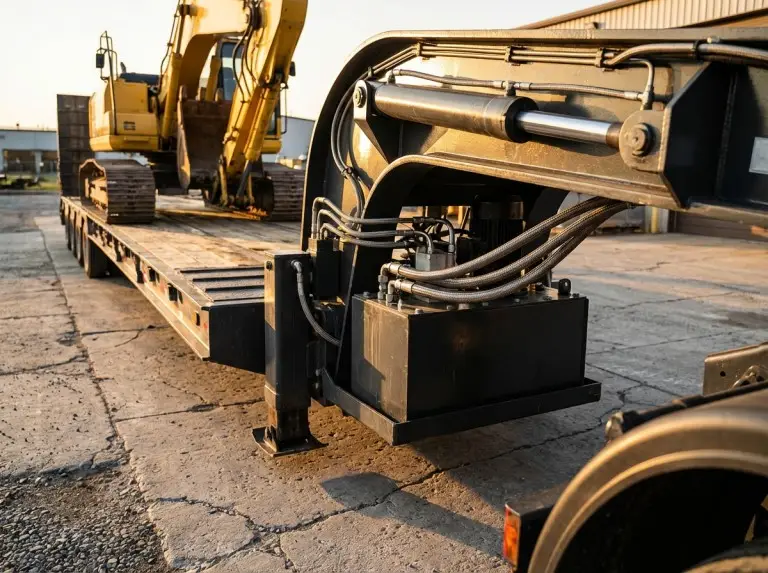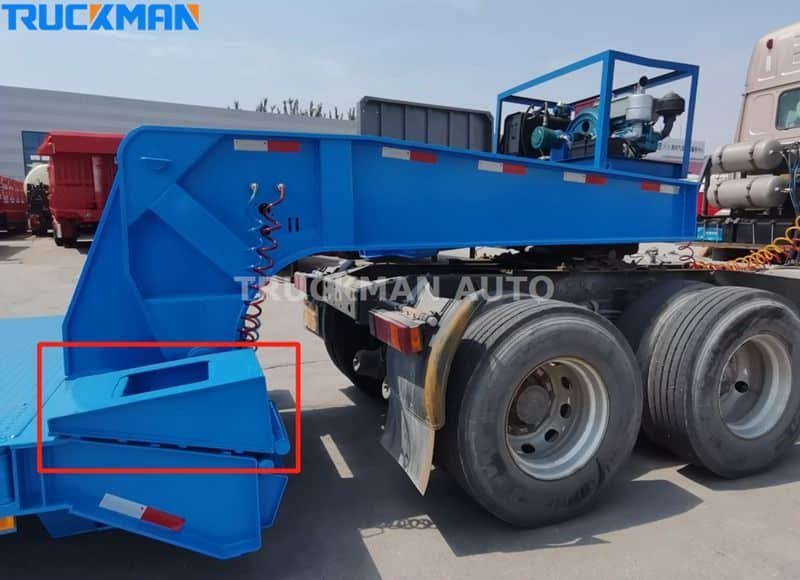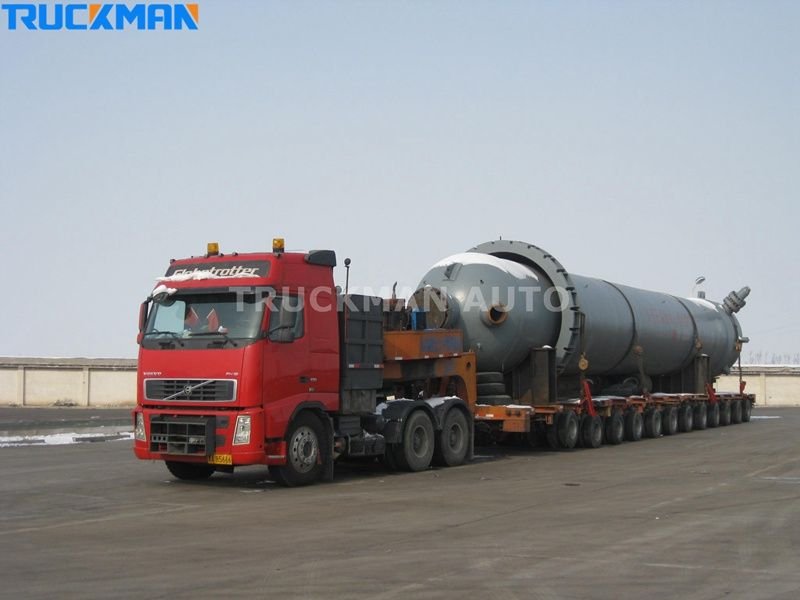
A low bed trailer uses a dropped-deck platform to keep transport height within legal limits when hauling excavators. The right configuration depends on four variables: gross transport weight including attachments, laden deck height against route clearances, axle-weight distribution for the planned route, and the loading method at the job site. Selecting by payload rating alone causes most mismatches.
Permit thresholds, axle-load rules, and cargo-securing requirements vary by jurisdiction. All figures here are illustrative. Verify them against your operating market before planning any haul. If you are still comparing options, the low bed trailer types and configurations guide covers the full range before you commit to a specification.
Why Tonnage Rating Is the Wrong Starting Point
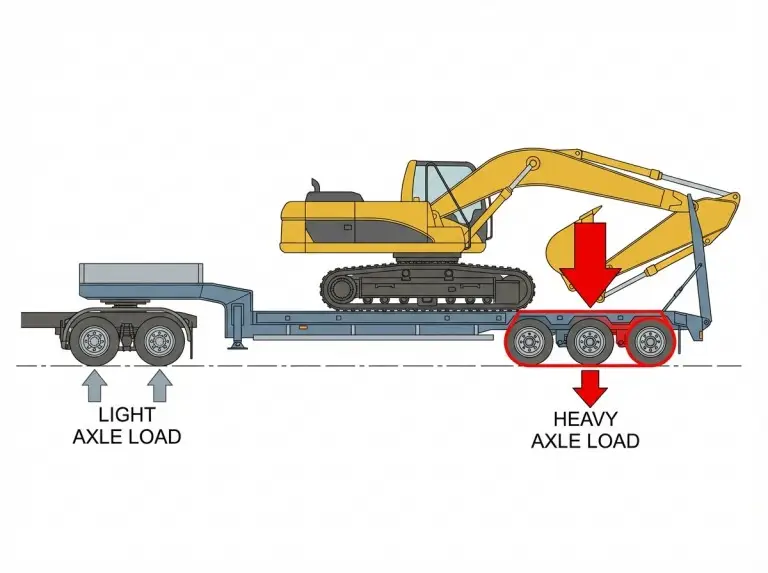
Payload rating tells you the maximum load a trailer frame can carry. It does not confirm that load is legally distributable across the axle groups for your route.
An excavator’s counterweight concentrates mass at the rear of the machine. This pushes load onto the trailer’s rear axle group. A 50-ton excavator on a 50-ton two-axle trailer will often exceed the per-axle limit for the jurisdiction. The problem shows up at the weigh station, not during loading.
The correct sequence: calculate axle loads using the tractor-trailer configuration, the excavator’s weight distribution, and the axle-load rules for the route. Then confirm axle count and spacing. For a detailed walkthrough, see how to assess low bed semi trailer load capacity.
Most jurisdictions regulate both Gross Combination Weight (GCW) and each vehicle’s Gross Vehicle Weight Rating (GVWR). A haul can exceed the per-unit GVWR even when GCW appears within range. Check both.
Laden Deck Height vs. Spec-Sheet Deck Height
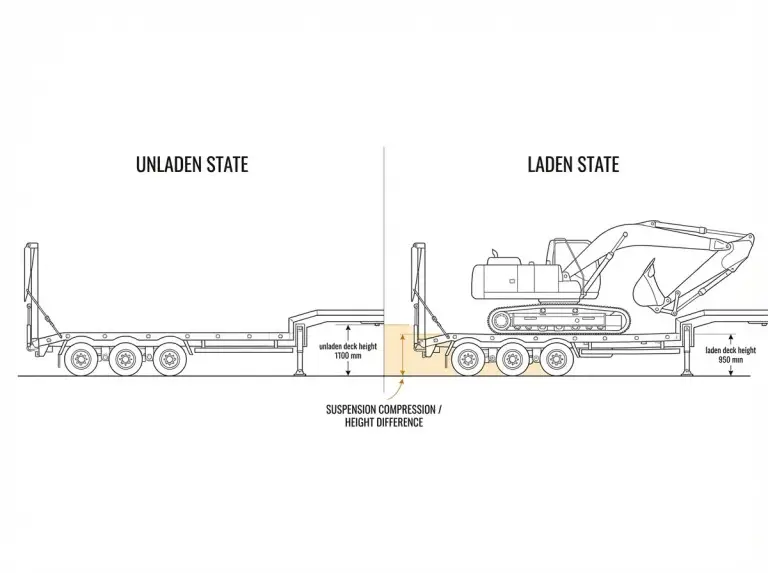
Spec-sheet deck height is measured with the trailer empty. Do not use it for transport height calculations.
Under full load, suspension compression lowers the deck. How much depends on suspension type — air, mechanical leaf spring, and hydraulic behave differently — plus axle configuration and payload. Confirm laden deck height for your actual trailer and load.
To calculate total transport height: take laden deck height at maximum payload, add the excavator’s tallest point measured from the deck surface, then compare against the clearance limit for each route segment. Restricted bridges may be lower than the national standard. Check segment by segment.
Axle Load, Loading Position, and Attachment Weight
Loading position on the deck shifts weight between the trailer’s rear axle group and the tractor’s drive axles. The effect depends on the specific tractor-trailer-excavator combination. Verify that the planned position produces compliant axle loads before securing the machine. Low bed semi trailer capacity is one of several variables that feed directly into this calculation.
Hydraulic attachments — shears, breakers, high-reach arms — add to both total weight and rear axle concentration. A large attachment can push rear axle loads above the per-axle limit even when gross capacity is not exceeded. Check the axle-weight impact of any attachment before deciding whether to remove it.
A large arm that cannot fold into the standard transport profile may also push height or width beyond a permit threshold. This is a dimensional issue, separate from weight. Check both.
When teams skip the axle-weight calculation for attachments, the result is usually a failed weigh-station inspection or forced unloading. A pre-transport check prevents both.
Ramp Selection and Site Loading Conditions
Ramp angle and site grade together determine whether rear-ramp loading is practical. A ramp designed for flat ground becomes steeper on a downhill approach. At a certain point, the excavator’s undercarriage hits the breakover transition before the tracks fully engage the deck. Whether this happens depends on the machine’s actual undercarriage clearance and approach geometry. Confirm ramp compatibility against the specific excavator’s dimensions.
Where site access consistently involves slopes or uneven ground, a detachable gooseneck configuration removes the ramp-angle problem by enabling front-loading. The differences between RGN and lowboy trailers affect this choice more than most buyers expect.
Load Securement and Applicable Standards
Chain grade, tie-down point rating, and tensioning sequence keep the excavator in position through braking, cornering, and road impacts. Do not carry over a securement plan from a previous haul without re-verifying it for the current machine.
Tie-down anchor points must handle emergency braking forces, not just static load. Match the working load limit (WLL) of chains and binders to transport weight by calculation. If the excavator is offset from its standard position to manage axle load, re-evaluate the securement plan for that position.
Identify the excavator’s designated tiedown points from the machine documentation. ISO 15818:2017 covers tying-down attachment points for earth-moving machinery during road transport. Using non-designated points — bucket pins, boom cylinders — is a common error. These are not rated for transport forces.
Cargo-securing requirements vary by jurisdiction:
- USA: 49 CFR 393.130 applies to wheeled and tracked vehicles at or above 4,536 kg. It sets minimum tiedown count and requires implements of service to be lowered and secured.
- EU: Directive 2014/47/EU Annex III references EN 12195-1 (lashing force calculation), EN 12640 (lashing points), and EN 12195-2/-3/-4 (lashing equipment) for roadside inspection.
- Other markets: Confirm the applicable standard with the local transport authority.
Permit Frameworks by Jurisdiction
Permit requirements are triggered when the load exceeds the jurisdiction’s thresholds for height, width, total weight, or train length. Rules differ significantly across markets. Do not assume one market’s thresholds apply to another.
United States: The federal interstate baseline is 80,000 lb gross, 20,000 lb single axle, 34,000 lb tandem axle. Allowable weight also depends on axle spacing under the Federal Bridge Formula (FHWA). Oversize and overweight permits are issued by individual states. Conditions, routing, and escort rules vary by state.
European Union: Directive 96/53/EC sets maximum dimensions and weights for standard vehicles. Loads beyond these limits require a special permit and must qualify as an indivisible load. Member states may impose stricter limits on specific roads.
United Kingdom: The Special Types General Order (STGO) classifies abnormal loads into three categories by weight. Each has different axle-load limits, minimum axle counts, and notification requirements.
Africa, Southeast Asia, Middle East: Permit frameworks are managed at the national level. Variation between countries is significant. Standard European or North American thresholds do not apply. Obtain local transport authority requirements directly for each country.
When a haul enters the abnormal-load class for the jurisdiction, route surveys and bridge-clearance reviews are required before dispatch. Treat these as separate compliance projects.
Pre-Transport Verification Checklist
Confirm each item before dispatch. Do not carry over assumptions from previous hauls.
- Excavator transport weight including all attachments, from the equipment manufacturer
- GCW checked against the gross combination limit and each vehicle unit’s GVWR
- Axle-weight distribution at the planned loading position, verified against per-axle limits and the applicable spacing formula
- Laden deck height at maximum payload compared against each route segment’s clearance limit
- Ramp angle at the loading site confirmed against the excavator’s undercarriage clearance and breakover geometry
- Designated tiedown points confirmed per ISO 15818, with WLL matched to transport weight
- Deck surface confirmed as appropriate for the excavator’s track type — rubber or steel
- Permit status verified for each route segment under current jurisdiction rules
- Route survey completed for abnormal-load class moves, with bridge clearance review done before dispatch
Configure Your Excavator Transport Trailer with Truckman Automobile
The selection variables for an excavator transport trailer — laden deck height, axle configuration, ramp compatibility, and load securement — are connected. Confirming one without checking the others produces configurations that pass structural review but fail in the field. The low bed semi trailer selection guide covers the broader decision framework if you are still working through the options.
At Truckman Automobile, we run drawing review and scope confirmation before finalizing any low bed trailer for excavator transport. Where axle-weight distribution is a governing constraint — larger excavators, heavy rear attachments, or markets with strict per-axle limits — we align the trailer design to the jurisdiction’s regulatory requirements, not just the structural payload rating.
To start, share three inputs with our team: the excavator’s full transport weight including attachments, the target market’s axle and height regulations, and the loading conditions at your primary job sites. Browse the full range of low bed trailer models and custom configurations to find a starting point.
FAQ
How do U.S. and EU tie-down requirements differ?
In the U.S., 49 CFR 393.130 sets a minimum tiedown count for tracked vehicles at 10,000 lb or above. In the EU, EN 12195-1 governs lashing force calculation and EN 12640 covers lashing point ratings — the required chain count depends on excavator weight and lashing point strength. The U.S. specifies a minimum count. The EU is calculation-based. In both markets, start with the machine’s designated tiedown points per ISO 15818.
How do axle-weight limits interact with payload rating?
Payload rating is a structural limit on the frame. Per-axle limits are legal limits set by the jurisdiction for a given road class. A trailer can be within its structural rating while an axle group exceeds the legal limit — common with asymmetric loads like excavators. Check both independently for every haul.
When does attachment removal become a permit issue?
When a large attachment cannot fold into the standard transport profile, it may push height or width beyond a permit threshold regardless of weight. Assess attachment removal against both dimensional thresholds and axle-weight calculations — not weight alone.
Do permits from one haul apply to the next?
No. Permits cover a specific load, route, and time. Changes in dimensions, weight, axle configuration, or route conditions require a new permit. Even with an annual oversize permit, verify the specific route and load fall within its current scope before each dispatch.