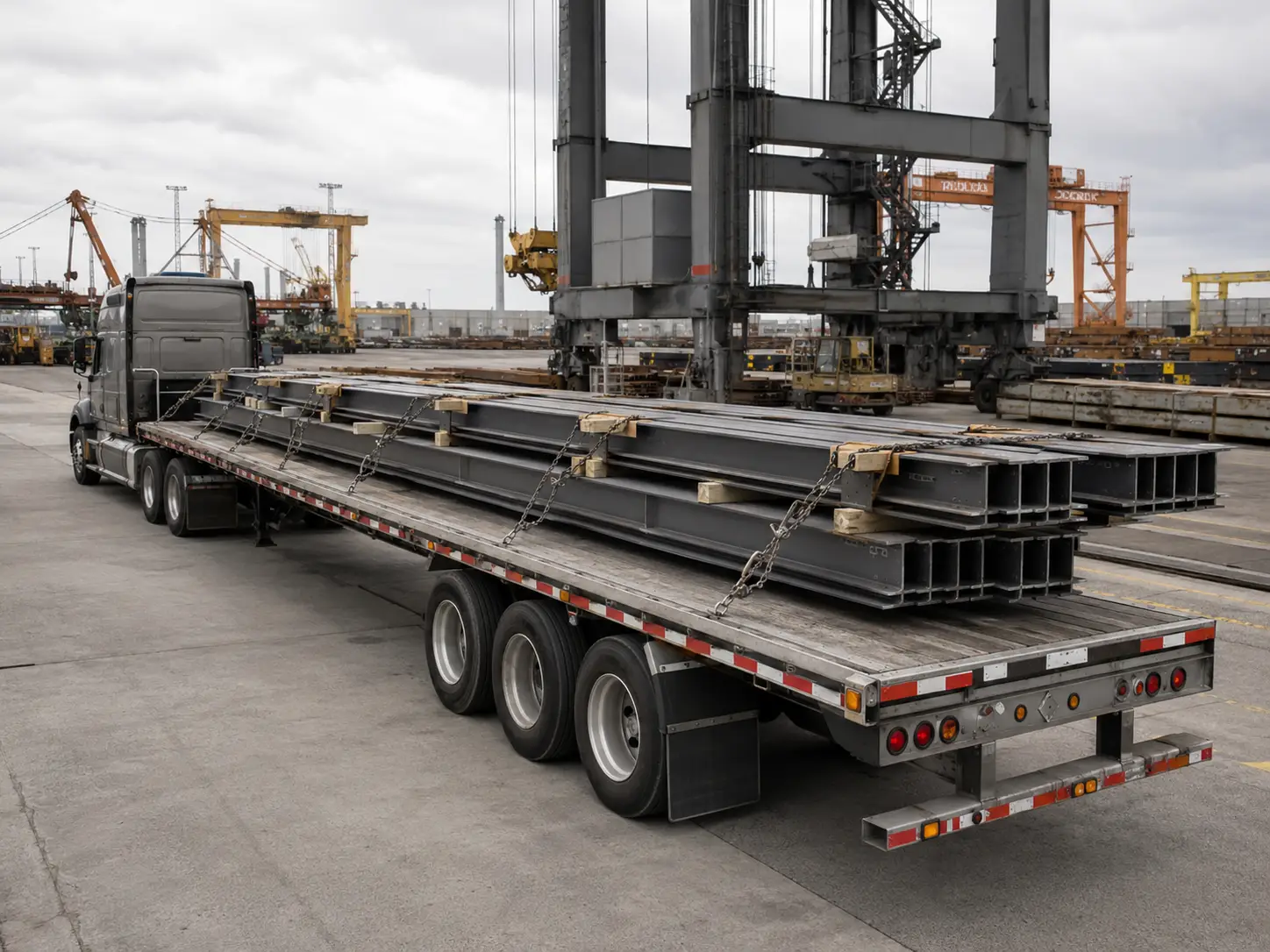

The main types of flatbed trailers (standard, step deck, double drop, lowboy, removable gooseneck, extendable, and covered decks such as Conestoga and side kit) differ mostly in deck height, and the right one depends on your freight’s loaded height, weight, and length. Deck height is the variable to resolve first. It sets how much cargo height is left under the legal overall-height limit on your route. That is why identical cargo can be legal on one deck and over-height on another. Clearing every structure on the route is a second check, separate from that legal limit. Published payload figures are starting points to confirm against structural rating, axle count, and state weight law.
What Separates a Flatbed Deck From Every Other Trailer
A flatbed trailer is an open loading deck with no sides or roof, built for freight whose shape or dimensions rule out an enclosed van, and what it can legally carry depends on how high that deck sits. Loading happens from either side, from the rear, or from overhead with a crane. That access is the whole point of the format, and the price of it is no weather protection and nothing holding loose material in. Two other open decks sit outside this set: hotshot trailers, which run short and light behind medium-duty trucks, and log trailers, which use a skeletal frame for a single commodity.
Width behaves differently from height in this category. Most highway flatbeds are built around a 102-inch deck, though narrower configurations exist. The 102-inch figure is a limit states must apply to commercial vehicles on the National Network rather than a required build dimension. The Federal Highway Administration publishes that rule, along with the federal axle and gross weight standards, in its size and weight program overview and at 23 CFR 658.15.
Two consequences follow that most trailer comparisons skip. Width rarely separates one deck type from another, since these deck families all sit inside the same regulatory envelope. Width problems get solved with permits; deck selection turns on height. And the overwidth test applies to the total legal width of vehicle plus cargo. A 100-inch load overhanging a 96-inch deck still sits inside the envelope, while anything past 102 inches needs a permit even on a full-width trailer.
Legal Height and Route Clearance Are Two Separate Checks
Permit-free cargo height on a flatbed starts from the legal overall-height limit that applies where you are running, minus the trailer’s loaded deck height and any dunnage under the load. There is no federal height limit for commercial vehicles the way there is for width. FHWA publishes state standards as ranging from 13.6 feet to 14.6 feet, and 13 ft 6 in is a common planning figure rather than a national rule.
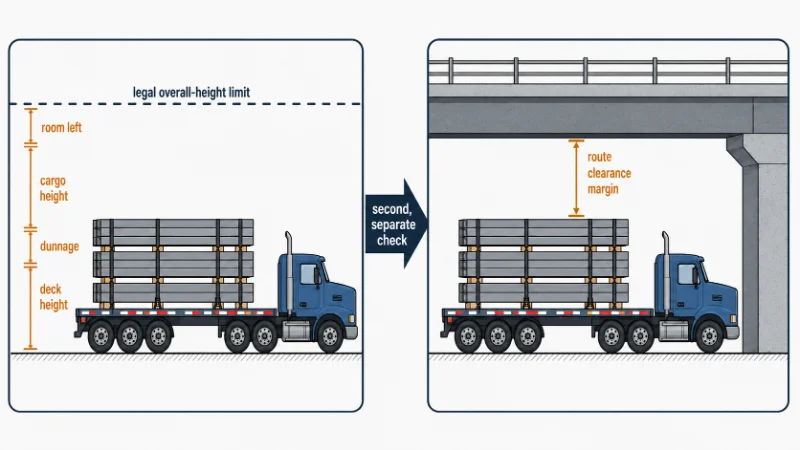
Run that subtraction against a 13 ft 6 in limit and the numbers quoted throughout this industry fall out of it. A standard deck near 5 ft leaves roughly 8 ft 6 in of cargo height, the figure most flatbed articles print. A lower deck around 40 in leaves close to 10 ft. A well in the 18 to 24 in range leaves somewhere near 11 ft 6 in to 12 ft. These are arithmetic on nominal published deck heights rather than measurements of any particular trailer, and they hold only with no dunnage under the load, at a stated ride height, and on the height limit that applies to your route.
Route clearance is the second check, and it does not replace the first. A load that sits inside the legal envelope must still clear every structure on the approved routing with whatever margin the carrier or the permitting authority requires. The reverse fails too. A bridge with 14 ft 6 in of clearance does not raise your legal height to 14 ft 6 in if the state limit is lower.
Put your own numbers through both. Your applicable height limit minus your measured loaded deck height gives the legal room you have for cargo. The lowest structure on your actual route tells you whether that height gets through. Where a spec starts from a published deck height that nobody measured, the usual outcome is a route replan at the first low bridge. The trailer type was never the thing that failed.
Main Types of Flatbed Trailers and What Each Deck Buys You
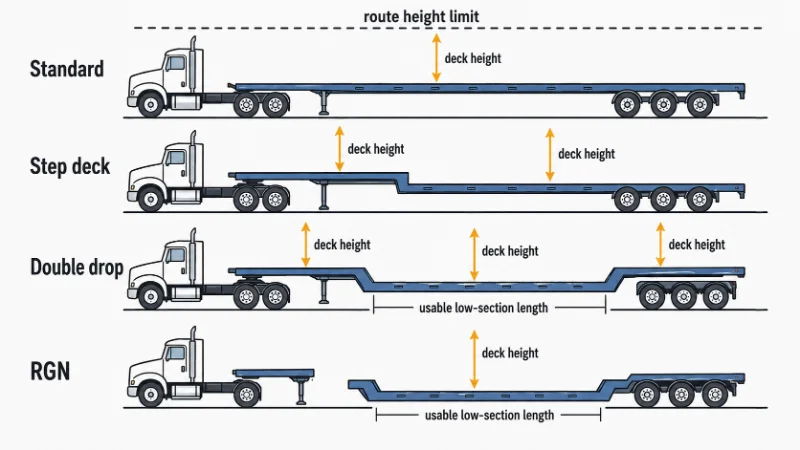
The main types of flatbed trailers step down in deck height in a fixed order, and every step down buys cargo height by giving up usable low-section length, changing how the load gets aboard, or adding tare. One distinction almost no comparison makes: these names describe four different design axes. Double drop describes deck geometry, RGN describes the neck and loading mechanism, extendable describes length capability, and Conestoga describes a covering system. One trailer can belong to several of those categories at once, which is why the list reads as if the options overlap.
| Type | Typical deck or well height | Cargo height that usually clears a 13 ft 6 in limit | Usable length at that low height | How it loads | Where it fits |
|---|---|---|---|---|---|
| Standard flatbed | About 5 ft | About 8 ft 6 in | Full deck, commonly 48–53 ft | Side, rear, or overhead | Steel, lumber, pipe, crated machinery |
| Step deck (drop deck) | Lower deck about 38–42 in | About 10 ft | Lower deck only | Side or overhead; ramps on some builds | Machinery just over legal height |
| Double drop | Well about 18–24 in | About 11 ft 6 in to 12 ft | Well only, commonly 24–29 ft | Overhead into the well | Tall, top-heavy equipment |
| Lowboy | Low deck, neck fixed or detachable | About 11 ft 6 in to 12 ft | Low section only | Rear or overhead; drive-on if the neck detaches | Heavy equipment near the height limit |
| RGN | Low well plus detachable neck | About 11 ft 6 in to 12 ft | Well only | Neck detaches and the deck front lowers to the ground as a drive-on approach | Tracked or wheeled equipment that must roll on |
| Extendable | Follows the base deck | Follows the base deck | Extends past the fixed deck | Side or overhead | Long beams, poles, blades |
| Covered deck (Conestoga, side kit) | Base deck, less the frame | Less than the base deck | Full deck | Side or overhead with the cover retracted | Freight needing weather cover or lateral containment |
Ranges in the table are figures commonly published across dealer and carrier spec sheets, not ratings for any particular build. Deck widths in this class run at or below 102 inches depending on the configuration. Two capacity numbers matter and they are not the same: a distributed rating across the full deck, and a concentrated rating over a stated length. Ask for both, along with axle count and suspension, before treating any payload figure as usable.
Standard flatbed
The standard deck is the reference point, and every other type is a departure from it that costs something. It gives you full length at a single height, the easiest side access, and the simplest load planning. What it withholds is headroom.
Step deck (drop deck)
A step deck buys roughly a foot and a half of cargo height by dropping the deck behind the tractor. The cost is length, because only the lower deck carries the extra height.
Double drop
The well is the only part of a double drop that is actually low, and the raised sections at each end sit back near standard height. That geometry, more than the height rating, is what catches people out.
Lowboy
A lowboy is built around weight as much as height, with a heavy frame and a low section sized for equipment. The word carries the most inconsistent meaning in this category, which is why a lowboy spec should be written as a well height in inches plus a neck type.

RGN
What an RGN sells is the loading method more than the height. The gooseneck detaches and the front of the main deck lowers to the ground, so equipment can drive aboard where a crane would otherwise lift it. That matters only when the load moves under its own power.

Extendable
An extendable deck solves length and leaves height where it was. The base deck still sets clearance, and a long load has to be self-supporting across the extension.
Covered decks: Conestoga and side kit
Covered decks buy protection with the two things an open deck was chosen for. The rolling frame or the side panels add tare that comes out of payload, and the structure over the deck reduces the cargo height that fits under the same limit. Side kit panels normally come off when they are not needed, so their weight penalty applies only on the runs where they are fitted.
Same Deck, Different Name: What to Say So You Get the Right Trailer
Flatbed deck names overlap between suppliers, so a specification written in trailer names alone can return a trailer that satisfies the word and misses the load. The same three published sources will call one configuration a lowboy, a low-bed, and a double drop. We clarify which of these a buyer means before quoting, because two of those words map to different well heights depending on who is speaking.
| Term you hear | Design axis it actually describes | What to specify instead |
|---|---|---|
| Lowboy | Deck geometry, sometimes used as a family name covering double drop and RGN | Well height in inches, and whether the neck detaches |
| Low-bed | Deck geometry; used interchangeably with lowboy and double drop | Well height and well length as two separate figures |
| Drop deck, step deck, single drop | Deck geometry: one configuration under three names | Upper and lower deck heights; the name sets neither |
| Double drop | Deck geometry, occasionally used for any low deck | Well length, since the tall part of the load must fit inside it |
| RGN, removable gooseneck, detachable gooseneck | Neck and loading mechanism, not deck height | Whether you need drive-on loading, which is all the neck decides |
| Extendable, stretch | Length mechanism, fitted over several base decks | Maximum extended length and the base deck type |
| Deck height | A measurement taken two different ways | Loaded or unladen, measured rather than quoted |
Matching a Deck to the Binding Constraint
Flatbed deck selection starts from whichever of height, weight, and length crosses a limit first, because that variable narrows the deck family and the others choose inside it. The three converge on one build, and working them in strict sequence hides the interactions. Height is normally settled early because deck geometry is designed into the trailer. Some air-ride and detachable-gooseneck builds allow a limited adjustment of operating ride height, but that range is for working clearance and does not substitute for picking the right deck class.
Work the variables in that order, with one exception: where the freight cannot be exposed at all, weather protection stops being a last consideration and ranks alongside height.
| Binding constraint | Deck it points to | Where that breaks down | Verify before committing |
|---|---|---|---|
| Loaded height past ~8 ft 6 in | Step down: step deck, then double drop or lowboy | The tall section has to sit inside the low well, not merely on the trailer | Measured deck height plus cargo and dunnage, against both the legal limit and the route |
| Load must roll aboard under its own power | RGN | Liftable freight of the same weight needs no detachable neck | Approach angle and ground conditions at both ends |
| Length past the fixed deck | Extendable, over whichever base deck the height calls for | The base deck still sets clearance, and the load must be self-supporting across the extension | Maximum extended length and support points |
| Freight cannot be exposed | Conestoga or side kit | Cover costs payload and cargo height, so it competes with an over-height load | Which of cover and clearance is the harder constraint |
| Weight only, height inside limits | Standard deck with the right axle configuration | Concentrated load over a short footprint can bind before gross weight does | Distributed and concentrated ratings, axle loads, bridge formula |
Weight deserves its own separation, because rated capacity and legal payload are different numbers. A trailer’s structural rating and its concentrated-load rating come from the frame and beams. Axle, suspension, tire, and wheel ratings are separate again. On the road, the binding figure is the lowest of those and the applicable weight law. FHWA’s federal Interstate standards are 20,000 lb on a single axle, 34,000 lb on a tandem, and 80,000 lb gross, with the bridge formula able to require less depending on axle count and spacing. Actual cargo payload is whatever survives all of that after subtracting the real tare weight of the tractor and trailer.
The first row of that table hides a trap worth spelling out. On a double drop or an RGN, the low well is a fraction of the trailer’s overall length, because the raised sections have to clear the axle group at the back and the coupling at the front. Whatever extends past the well returns to standard deck height at the raised ends, so a load that is both tall and long can pass the height check and still fail.
A point against our own interest: if your freight clears about 8 ft 6 in loaded and stays inside a standard deck’s ratings, the specialized decks buy nothing and cost more to buy and to run. Where an over-height load appears two or three times a year, renting that deck for those runs usually beats owning one that sits.
Deck height also drifts on trailers that have been re-decked, re-tired, or refitted with different suspension. Settled air bags and worn tires lower the deck, dunnage raises the load, and both change the number you are working from. On any refitted trailer, measure the deck height on the trailer you will actually use.
Verifying Loaded Height, Axle Rating, and Route Before Committing
Verification of a flatbed specification comes down to seven checks, all completable before a trailer is built or booked, and each depends on numbers only the shipper can supply. We verify loaded deck height, structural and axle ratings, and the lowest structure on the route before specifying a deck type.
- Measure deck height on the loaded trailer at operating ride height; the spec sheet figure is nominal.
- Add cargo height plus any dunnage or blocking to get the true loaded height.
- Compare that total against the legal overall-height limit for every state and road class you cross.
- Compare it again against the lowest actual structure on the routing, which is a separate check from the legal limit.
- Confirm the tall portion of the load fits within the low section’s length, separately from overall deck length.
- Confirm both the distributed and the concentrated load ratings for the trailer, then confirm axle loads and gross weight against the bridge formula for your route.
- Confirm the securement system’s aggregate working load limit, which on US interstate operations must be at least one-half the weight of the article or group of articles secured under 49 CFR 393.106. The commodity-specific rules in 393.116 through 393.136 add further requirements and take precedence where they apply.
Clearing that threshold is not the same as having a compliant securement plan. Choosing tie-down count and pattern for a specific load is a separate exercise, and this guide stops at deck selection.
Deck Height First, Then Length and Loading
Among the types of flatbed trailers, deck height is normally the first variable to settle, because it is designed into the trailer and it feeds into the legal height check. Length available at that height comes second, since a well that clears the limit but runs shorter than the tall section of the load solves nothing. Loading method comes third and decides only whether the neck has to detach.
The loads that cause trouble are seldom the obviously oversized ones. They are the ones assumed to fit a standard deck because nobody measured the loaded height against both the legal limit and the route. That assumption costs a replan.
If your loaded height clears about 8 ft 6 in and your weight sits inside a standard deck’s ratings, a flatbed semi trailer is the whole answer and the rest of this list is expense. If it crosses that line, measure the deck and the cargo separately, then bring both figures, your route’s applicable height limit, and its lowest structure to the specification conversation. We align the deck to whichever constraint binds first, then confirm ratings, axle configuration, and permit-sensitive dimensions against the build.
FAQ
Does a step deck carry less weight than a standard flatbed?
Not inherently. Payload on either follows the frame’s distributed and concentrated ratings, the running gear, and the legal weight limits on the route. The published gap usually reflects how buyers tend to order each one.
Does a Conestoga or side kit reduce what I can haul?
Yes, and how much depends on which system. A side kit’s panels come off between runs, so the tare only counts on the trips where they are fitted, while a Conestoga’s rolling frame stays on the trailer year-round. Decide by how often the freight genuinely needs cover.
Do over-height loads always require a permit?
Only when the loaded height crosses the limit for the states and roads you actually run. Individual structures sit lower than the state figure, so routing decides it as much as the load does.
Can one trailer handle both over-height and over-length freight?
Within limits, on an extendable built over a drop deck or double drop base. The practical cost is paperwork and availability rather than engineering: a load that is both over-height and over-length opens two permit tracks in every state it crosses, and that trailer is a harder one to source at short notice.
Related Posts
Types of Semi Trailers: Dimensions, Loading & Cargo Fit — Widens the frame beyond open decks, for readers whose freight may not need a flatbed at all.
What Size Is A Semi Flat Bed Trailer? — Expands the length and width dimensions this guide only summarises in the comparison table.
Can a Flatbed Semi Trailer Carry Oversized Loads? — Takes over where the permit question in the FAQ stops.
Removable Gooseneck Trailer — The equipment page for the drive-on branch of the loading-method decision.
Low Bed Semi Trailer — The equipment page for loads that cross a standard deck’s height ceiling.