
Dump trailer hydraulic system maintenance covers fluid, cylinder and hoist pivots, hoses and fittings, the breather and strainer, and the pump drive. Intervals run on whichever limit arrives first: the manual’s calendar figure, accumulated operating hours, or a duty trigger such as dust, water, or heat. A 12 V power unit and a PTO wet-kit hoist carry different reservoir volumes and different failure paths, so one schedule does not cover both. Fluid level readings are only meaningful with the cylinder fully retracted.
What Dump Trailer Hydraulic System Maintenance Covers
Routine maintenance on a dump trailer hydraulic system runs across five areas, and how often each needs attention depends on duty cycle and power source: fluid and contamination control, cylinder and hoist pivots, hoses and fittings, the breather and strainer, and either the battery supply or the PTO pump drive. Relief valves, check valves, and couplers sit outside that list. They fail on their own often enough that a symptom pointing at one still deserves its own diagnosis.
Circuit type changes what you inspect. A single-acting power-up, gravity-down unit has no actively pressurised rod-end circuit. The weight of the body still generates pressure in the cylinder and the return path as it comes down, so the circuit has to be depressurised before service. On end dump semi-trailers the hoist is normally front-mounted, which brings the cylinder, its mounting brackets, and its bleed behaviour into scope alongside the pump. Published clearances between telescopic stages run as tight as 0.07 mm on some ranges, so a swollen or bent stage binds long before it looks damaged.
Seal material decides which fluids the unit tolerates, and the answer is model-specific. KTI Hydraulics’ installation instructions permit biodegradable fluid only with an optional Viton seal configuration and prohibit it with Buna seals. The same manufacturer’s 2024 catalog states flatly that biodegradable fluid should not be used. Both documents are current and both are theirs. Fluid approval therefore belongs to a specific model and seal compound. A conversion needs written confirmation against your unit’s model and serial number, and the compound options are not limited to Buna and Viton alone.
Before any inspection below, shut off and isolate the power source, lower the body fully or set it on a positive mechanical support, and depressurise the circuit. OSHA’s bulletin on unintended dump body movement cites 29 CFR 1926.600(a)(3)(i) and 1926.601(b)(10). Together these require dump bodies to be lowered or blocked during repair, and require a permanently attached positive support that locks in position. The bulletin also documents wooden blocks and unattached I-beams turning up as substitutes when the factory prop will not raise the bed far enough. The rear of the body is exactly where hoses and lines get serviced. Never search for a pinhole leak by hand. Use cardboard or another approved method, and treat any fluid injection as an emergency requiring immediate medical attention. SAE J1273_202110 covers selection, routing, installation, replacement, maintenance, and storage of hydraulic hose assemblies, and its safety section addresses injection, hose whip, and burns.
Check Voltage Under Load Before Condemning the Pump
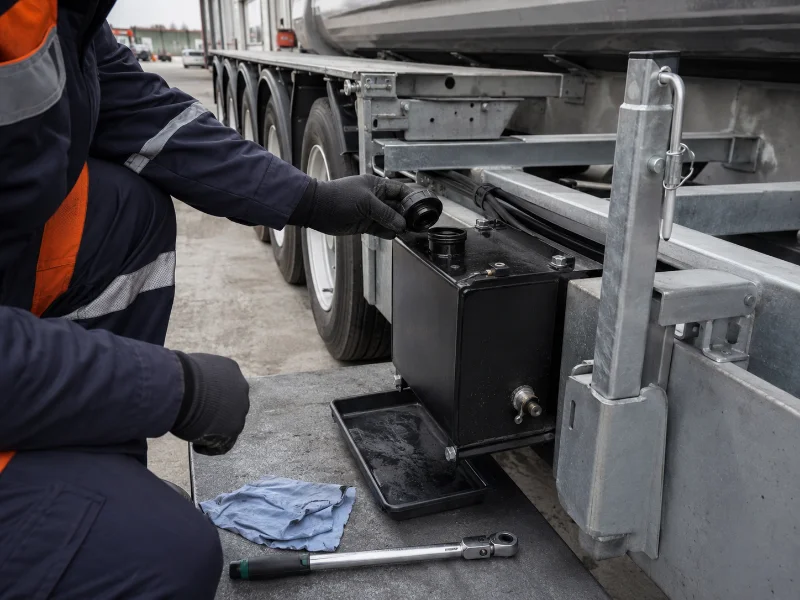
A pump that runs but will not lift can be either an electrical or a hydraulic fault, and supply voltage measured under load is the reading that separates them. A battery reading healthy at rest can collapse the moment the motor draws current.
The damage runs in one direction. The power-unit catalog lists low voltage among the conditions its warranty excludes: an undercharged battery causes high amp draw, and high amps burn solenoids, coils, motors, and the contacts in the hand control. The same document lists improper fluid viscosity as a separate route to the identical outcome, because a grade too heavy makes the pump and motor bog down and draw the same high amps. Two unrelated maintenance failures therefore converge on one symptom and one set of burnt parts. Fitting a replacement pump without correcting cable gauge, ground quality, or fluid grade tends to consume the replacement the same way. Cable gauge is specified against run length for exactly this reason.
Cold starts expose both at once. After an overnight soak, the first full cycle of the day is where a marginal supply and an over-thick grade each declare themselves, before warm oil masks either. We verify cable gauge and ground condition against the actual run length before accepting a hydraulic complaint as a pump fault.
Fluid Grade, Fill Level, and Cleanliness
Hydraulic fluid decisions on a dump trailer are set by the ambient range the trailer actually works in, by the seal compound in the unit, and by a cleanliness target. Every figure in this article carries the manufacturer named beside it, and each belongs to that manufacturer’s range rather than to the category. Your own unit’s manual overrides every example below. The rows here come from the 12 V power-unit catalog and from the Crysteel Turbo telescopic hoist manual.
| Operating condition | Published specification | Do not infer |
|---|---|---|
| −20°F to +32°F (−29°C to 0°C), 12 V unit | ISO VG 15 | Not a year-round grade for the same trailer |
| Roughly +14°F to +120°F (−10°C to +49°C), 12 V unit | ISO VG 22 or 32, or ATF | ATF acceptance is unit-specific |
| Prolonged extreme cold | MIL-H 5606 aviation-type fluid | Not a general cold-weather substitute |
| PTO-driven telescopic hoist circuit | About 150 SSU at 100°F, near SAE 10W or lighter, with rust and oxidation inhibitors and a foam depressant | Does not transfer to 12 V units |
| System cleanliness | No more than 125 particles above 10 µm per millilitre, stated as SAE Class 4 / ISO 16/13 | A target for the system in service, not a claim about oil in the drum |
Temperature ceilings differ by component, and the lowest one in the circuit governs. The power-unit catalog caps fluid temperature at 150°F for service life. Binotto’s data for one front-end telescopic cylinder allows an oil range of −40°F to 212°F for the cylinder itself. Find the lowest published ceiling in your own circuit.
The cleanliness row is the one worth acting on. ISO 4406:2021 defines the code stating how many solid particles of given sizes a hydraulic fluid contains. The component manual then sets the actual target the system is meant to hold in service.
The level reading is the habit worth changing. The published fill procedure is carried out with the cylinder fully retracted, and the reservoir sits at roughly half full at full extension. The hoist manual likewise refills to the sight glass with the body down. A low reading taken with the bed up is therefore not a low reading at all. Top up in that state and the system pushes fluid out of the breather on the way down, aerating it as it goes. Of everything on this page, the fill-state rule is the cheapest to adopt and the most likely to overturn a reading you already trust.
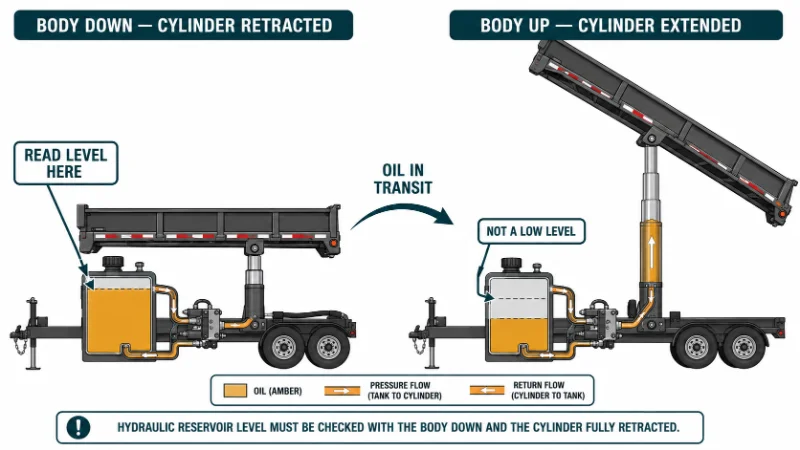
The swing is measurable on your own trailer. Displaced volume is bore area times stroke, so a single-acting cylinder with a 5-inch bore and a 40-inch stroke moves about 785 cubic inches, roughly 3.4 US gallons. Put your own bore and stroke into the same expression to see how much of your tank is in motion during a cycle. A telescopic hoist does not collapse to one bore, since each stage has its own effective area, so use the cylinder manufacturer’s published displacement instead. The 3.4-gallon result above comes from an assumed bore and stroke, so treat it as a worked example and quote your own.
Service Intervals Split by Power Source: 12 V Units and PTO Wet Kits
Service intervals diverge between a battery-powered unit and a PTO wet kit because the two carry different reservoir volumes, different contamination paths, and different consequences when a step is skipped.
| Service item | 12 V electric power unit | PTO wet kit and telescopic hoist | Trigger to shorten |
|---|---|---|---|
| Fluid change | Every 4,000 operating hours or once a year, whichever comes first | Annually under normal use and working conditions | Heavy duty, dust, or water in the fluid |
| Breather and suction strainer | Replace or thoroughly clean on the same hours-or-annual limit | Clean the breather at every fluid change | Any aeration or overflow event |
| Reservoir interior | Drain, wipe out, and check the magnet for metal particles at the same limit | Keep fluid clean; do not overfill | Metal on the magnet, or dark or cloudy fluid |
| Pivots and brackets | Grease per the trailer manual | Depends on bracket version fitted; see below | Binding, or an uneven lift |
| Relief pressure | Factory pre-set; field adjustment voids warranty and can burn coils and motors | Confirm rated pressure, rated flow, and circuit type match the trailer before coupling | Change of trailer behind the same tractor |
| Drive and controls | Cable gauge matched to run length; ground condition | PTO engagement and kick-out function | Repeat coil or motor failures |
The pivots row hides a decision that is easy to get backwards. Hyva’s hydraulic tipping catalogue lists its front-end cylinders with cast brackets in maintenance-free or greased versions, and in two duty grades: standard for construction work and heavy duty for mining and difficult conditions. Which version sits on your trailer decides whether the brackets belong on the grease round at all. Greasing a maintenance-free bracket builds a grit trap; skipping a greased one wears it. The bracket version is an order-time configuration, so it comes off the build sheet.
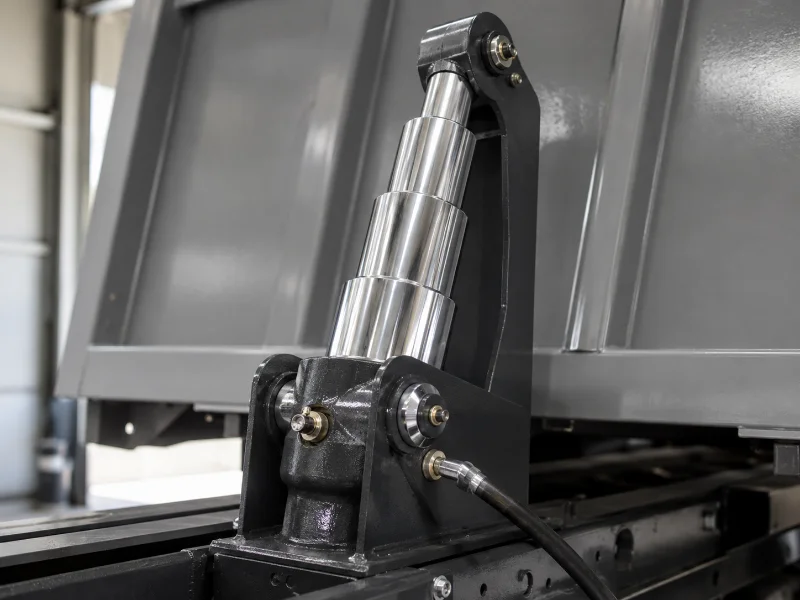
The relief row is where mixed fleets get caught. One published end-dump wet-kit specification sets its relief at 2,000 psi and warns against running that trailer on a 3,000 psi belt-trailer circuit. The same sheet pairs the two applications with different tank sizes: around 50 to 70 gallons for end dump service against 15 to 30 for a belt trailer. Those are that product’s figures. Hyva rates its Alpha front-end cylinders and its wet-kit gear pumps at 250 bar, roughly 3,626 psi. Binotto lists one front-end cylinder at a maximum 2,750 psi because of its NPT ports, even though the barrel is rated at 2,900. In that case a fitting sets the ceiling, not the cylinder. Front-end cylinders on end dump semi-trailers span a wide band, and the number that applies to yours is on your cylinder and your wet kit.
Pressure is only half of the coupling check. The Binotto data sheet also publishes a maximum extension speed of 0.656 ft/s, which is a flow limit expressed as a speed. A wet kit delivering more flow than the trailer’s cylinder was sized for drives the body up faster than that limit, and no pressure gauge will show it happening. Confirm rated pressure, rated flow, and circuit type together. Leave a factory-sealed relief valve alone: the power-unit warranty documentation is explicit that field adjustment burns solenoids, motors, and coils, and that tampering can cause severe injury.
A second consequence follows from the same arrangement. Two trailers sharing one tractor circuit means two fluid histories meeting in one reservoir, which turns “do not mix oils” from a fill-time caution into a fleet-level specification. On a tractor that pulls more than one trailer type, compatibility becomes a per-coupling check instead of an annual one.
Symptom-to-Cause Checks Before Any Part Comes Off
A hoist symptom rarely points to one subsystem. Most have both an electrical and a hydraulic candidate, so the verification action matters more than the symptom name, and the order in which you test decides how much you spend.
| Symptom | Likely causes (not exhaustive) | Verification action |
|---|---|---|
| Motor runs, bed will not lift | Low voltage under load; low fluid; relief bypassing; clogged strainer | Measure at the motor terminals with the button held, then read level with the bed down |
| Bed lifts, then stalls partway | Level falling below half tank during extension; overloaded bed | Watch the reservoir through a full raise; compare load against rated capacity |
| Bed will not lower | Down coil unpowered; spool stuck; mechanical binding | Measure voltage at the coil terminals with the down button held; magnetic pull on a steel tool confirms a field only, so verify spool movement separately |
| Jerky or noisy operation | Air in the circuit; blocked breather; grade too heavy for temperature; inlet restriction | Run the manufacturer’s bleed procedure, then inspect the breather |
| Fluid forced out of the breather | Including filling with the cylinder extended, aerated fluid, low voltage, poor ground, and an undersized reservoir | Drain to correct level with the bed fully down, then re-run the bleed procedure |
| Slow only on cold mornings | Viscosity grade too heavy for the lowest working temperature | Compare the grade in the tank against the ambient range in the manual |
Two variables settle before the rest become readable: supply voltage under load, and fluid grade and condition. Voltage first, because a marginal supply damages the parts you would otherwise be replacing. Fluid next, because grade and contamination feed seal, valve, and pump wear alike, and a wrong grade reaches the electrical side too. The remaining variables still have to converge together instead of in a chain.
Bleeding is not one procedure. A single-acting power unit’s published cycle runs the cylinder out while the level is watched to stay above half tank, holds over the relief for several seconds at full extension, then retracts and repeats until operation is smooth. A double-acting unit repeats it in both directions, a cylinder with a manual bleed valve uses that valve instead, and several front-end telescopic ranges are published as self-bleeding designs that need no separate step. Repeated full-stroke cycling is not a substitute for a specified manual bleed.
Verifying the System Before Your Next Loaded Cycle
Dump trailer hydraulic system maintenance is mostly a scheduling problem, and the schedule that fits depends on duty. A trailer cycling a few times a week on one 12 V unit is well served by the manual’s hours-or-calendar interval plus a pre-use level and leak check, alongside the rest of the end dump maintenance routine. Scheduled oil analysis or an inline particle counter will usually cost more at that duty than the failure it would catch.
Tighter monitoring earns its keep at high cycle counts, on dusty or wet sites, and on tractors that swap between trailer types. Our end dump product pages specify HYVA front-end telescopic cylinders on the end dump trailers we supply. That single detail is worth carrying into any service conversation: once the cylinder range is named, the bracket version, duty grade, and pressure rating that govern your intervals become lookups. Reservoir sizing, duty cycle, and climate stay project-specific, and plumbing the wet kit itself is a separate job with its own drawings and sign-off.
Before the next loaded cycle:
- Read reservoir level with the body fully down and the cylinder fully retracted, then read again at full height and note the difference.
- Measure supply voltage at the motor terminals while the raise button is held, not at the battery at rest.
- Compare the cable gauge on the run you actually have against the length table in your unit’s manual.
- Match the fluid grade in the tank to your lowest expected working temperature rather than to the season you filled it.
- Check the build sheet for the bracket version and duty grade before setting the grease round.
- Clean or replace the breather and suction strainer on whichever limit arrives first, hours or calendar.
- Confirm the wet kit’s rated pressure, rated flow, and circuit type all match the trailer behind it today, and leave sealed relief valves untouched.
- Set a permanently attached positive support before anyone goes under a raised body, and keep everyone clear of a loaded one.
FAQ
Can I run ATF instead of hydraulic oil?
Sometimes, and only where your unit’s manual lists it. The larger risk is topping up with a fluid different from what is already in the tank, because the same manuals that permit ATF also prohibit mixing. A top-up from the wrong bottle is an unplanned fluid change.
When does a hose need replacing rather than watching?
Replace when the cover is cracked, chafed into the reinforcement, or blistered, when reinforcement wire shows rust, or when the assembly has been kinked or twisted in service. Road salt spray attacks the cover first and the wire beneath it second. SAE J1273 covers replacement and maintenance practice for hose assemblies.
Should I grease the cylinder rod?
No. Grease the brackets, and only if yours are the greased version. Telescopic stages carry a thin hard chrome layer, published at around 20 μm on the smallest stage of one front-end range, and grease on that surface holds grit against the seal.
When is it worth stopping and calling a shop?
When leaks persist after seal replacement, when the unit will not build pressure after electrical checks come back clean, when a telescopic stage is bent or swollen, or when the only remaining fix means opening a factory-sealed relief valve. Internal rebuild work needs bench testing that a yard cannot provide.
Does new oil from a sealed drum meet the cleanliness target?
Not reliably. New fluid is often dirtier than the in-service target, so filtration and a clean transfer matter more than the label on the drum.