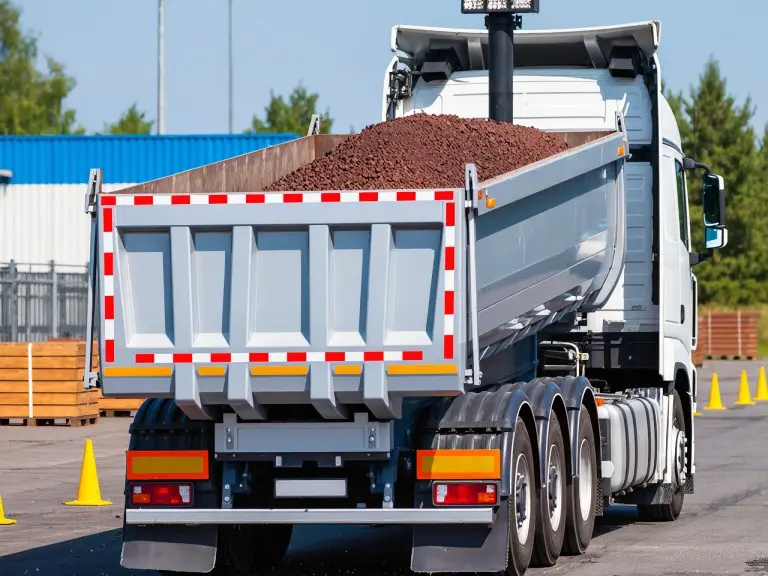
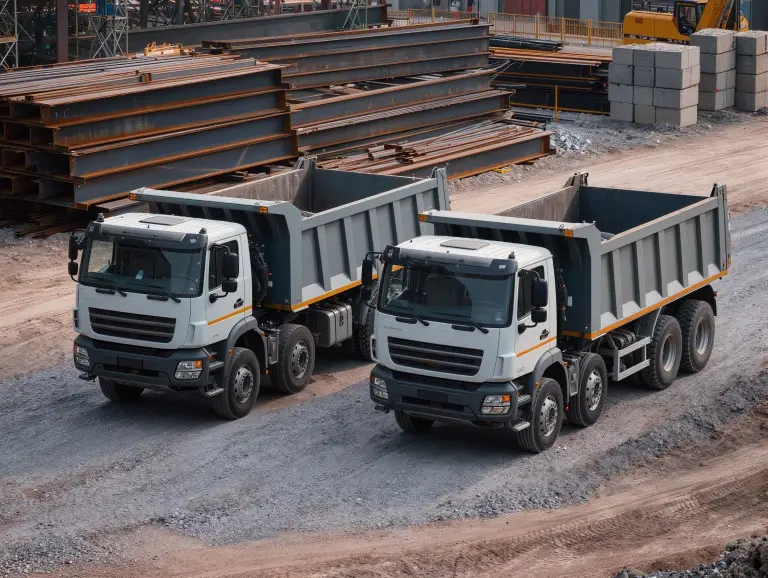
The choice between a 6×4 and an 8×4 dump truck is not a performance ranking — it is a load regime decision, shaped by three variables: how much you need to carry, what your routes allow, and what your operating market’s axle load regulations actually permit. A 6×4 uses a three-axle, two-drive-axle arrangement, typically rated within a 25–35 tonne GVW class depending on market regulations. An 8×4 uses a four-axle, two-drive-axle arrangement, typically rated within a 35–50 tonne GVW class — with significant variation across markets.
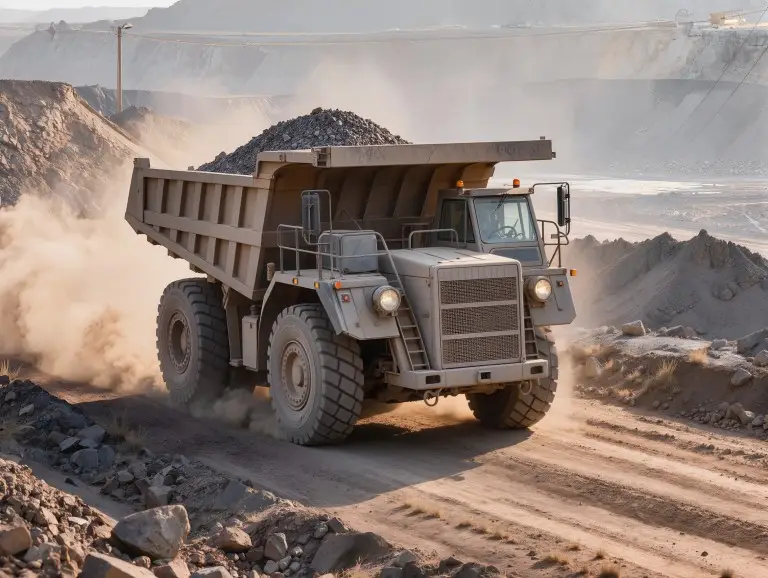
This article does not apply to articulated off-highway dump trucks or rigid mining haul trucks operating outside public road weight regulations — those vehicles follow site-specific load rules, not the national axle load frameworks discussed here.
Both configurations appear across the export markets we serve: China, Sub-Saharan Africa, and the Middle East. In all three, rear-tipping applications involving End Dump Trailers and standard dump trucks reveal the same mismatch patterns — and those mismatches are among the more common sources of avoidable procurement cost in our experience. As a starting point: 6×4 fits when payload stays within the 25–35 tonne range and site geometry is tight; 8×4 is the appropriate choice when payload consistently exceeds the 6×4 ceiling or when routes involve sustained soft-base terrain at payloads above 30 tonnes.
What Is a 6×4 Dump Truck?
A 6×4 dump truck is a three-axle rigid vehicle with one front steering axle and two rear drive axles, typically carrying 10 to 12 wheel positions. The notation tells you there are six wheel positions in total, four of which are driven. Under most national axle load frameworks, a 6×4 falls within a 25–35 tonne GVW class, though the enforceable ceiling in any given market is set by local regulation rather than manufacturer rating.
This configuration is well suited to urban construction sites, sealed highway routes carrying sub-30 tonne payloads, and mixed-use operations where site access geometry limits vehicle length. Its shorter wheelbase and three-axle layout allow a tighter turning circle than a four-axle equivalent — a practical advantage on confined sites and narrow loading bays. For operations where payload stays within the rated range and route space is a daily constraint, the 6×4 delivers lower purchase cost, fewer tire positions to replace, and a simpler drivetrain to maintain.
What Is an 8×4 Dump Truck?
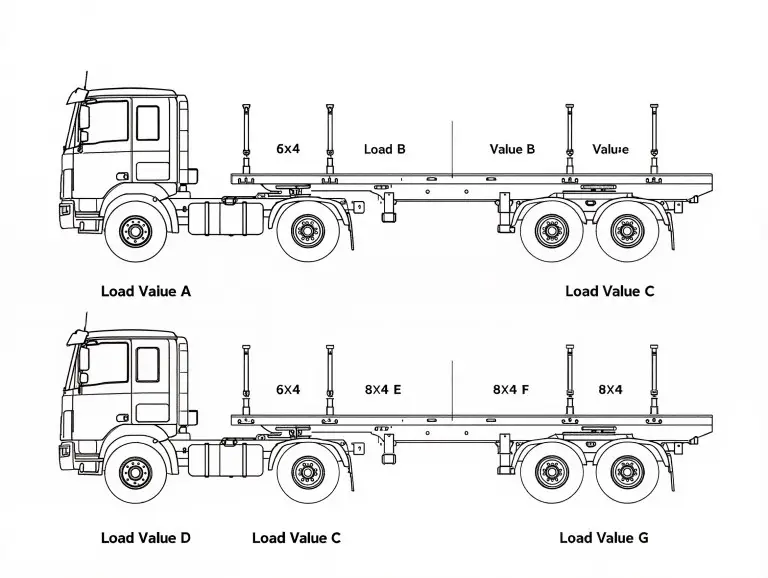
An 8×4 dump truck is a four-axle rigid vehicle — typically two front steering axles and two rear drive axles — carrying 12 to 16 wheel positions. The critical distinction from a 6×4 is that the additional axle is a load-bearing axle, not a drive axle. Drive force output is comparable between the two configurations, but payload ceiling and axle load distribution differ meaningfully.
Under most national frameworks, an 8×4 falls within a 35–50 tonne GVW class, with variation across markets. Its longer frame and four-axle load distribution make it the standard configuration for heavy bulk mineral haulage, mine-site short-haul, and any route where payloads consistently exceed the 6×4’s rated ceiling. The trade-off is a higher purchase price, greater tire count, and a wider swept path on tight corners — factors that eliminate the 8×4 from certain applications regardless of payload requirements.
Reading the Axle Notation — and Why GVW Class Must Accompany It
The 8×4 adds a load-bearing axle, not a drive axle — that changes payload ceiling and axle load distribution, but not drive force output. Procurement specifications and regulatory filings in most markets require both the axle notation and the applicable GVW class figure. Stating only the notation without the GVW class creates a compliance gap that typically surfaces during registration and route permit applications.
Understanding what the notation means at a technical level sets the stage for the more common mistake in specification work: treating one configuration as inherently superior rather than situationally appropriate.
Why 8×4 Is Not a Universal Upgrade Over 6×4
Configuration fit is not a performance ranking. The 8×4 suits specific operating conditions; the 6×4 suits others — and the determining variables are load regime, route type, and the regulatory environment in your market.
The misconception that 8×4 is simply “better” is behind many of the avoidable procurement losses we see across export markets. An operator running 28-tonne payloads on sealed urban construction routes and purchasing an 8×4 carries excess axle capacity daily. That excess shows up as higher fuel burn, higher tire wear across four axle positions, and a purchase premium that never generates a return.
The reverse error is equally costly. A fleet running 40-tonne bulk mineral payloads on a 6×4 chassis either overloads the rated GVW — triggering regulatory fines and structural fatigue — or under-fills each load cycle, reducing revenue per trip.
Configuration fit is a load-regime question first. Regulatory ceiling is a compliance question second. Price is a budget question third. Reversing that order is where procurement decisions go wrong.
How 6×4 and 8×4 Perform Differently Under Full Load
Both configurations perform comparably at partial load. The gap opens at or near rated GVW — and it shows up differently depending on whether the constraint is turning space, gradient, stability, or surface condition.
The differences become operationally decisive at or near rated GVW. Understanding how each configuration behaves in that operating band allows fleet operators to eliminate mismatches before purchase, rather than after.
Turning radius is a meaningful differentiator for urban or confined-site operations. A 6×4 three-axle chassis typically achieves a tighter turning circle than an 8×4 four-axle chassis of comparable wheelbase. The additional axle extends the vehicle length, increasing swept path in tight corners and loading bays.
Grade performance and loaded stability tell a more nuanced story. On steep haul roads, gradient performance is comparable between the two at their respective rated loads — both run tandem rear drive axles, and engine power and gearing determine behavior on climbs more than axle configuration does. Handling stability at rated GVW is generally better on an 8×4: the additional axle distributes load across four points instead of three, reducing individual axle stress and improving loaded behavior on uneven surfaces, subject to suspension tuning and load distribution.
Traction and Ground Pressure on Soft or Unpaved Surfaces
On soft or unpaved haul roads, the relevant variable is ground pressure — and the two configurations distribute it differently.
A 6×4 carries its payload across three axle positions. At maximum rated load, each rear drive axle bears a higher per-axle load than on an equivalent 8×4, which increases ground pressure under the drive wheels. An 8×4 distributes that same total weight across four positions. On soft-base terrain — mine haul roads, wet clay, loose aggregate — that lower per-axle pressure reduces the probability of sinkage and wheel spin. This is where heavy-duty tipper trucks running near capacity put maximum per-axle load onto unstable road surfaces, and where the 8×4’s distributed footprint produces a measurable advantage.
That advantage is conditional. An 8×4 loaded to its rated GVW maximum may produce equal or greater total ground pressure than a lightly loaded 6×4. The benefit applies when the 8×4 operates at moderate payloads on soft terrain — not at its ceiling.
These performance characteristics only produce a configuration recommendation when mapped against specific operating conditions — which the next section addresses through a scenario-by-scenario breakdown.
Which Configuration Fits Which Operating Scenario
Neither configuration wins across all use cases. The right choice follows directly from your payload, site geometry, surface condition, and trip distance.
| Operating Scenario | Recommended Configuration | Primary Reason |
|---|---|---|
| Urban construction, tight sites, 20–28 t payload | 6×4 | Tighter turning radius; lower operating cost at partial load |
| Mine-site short-haul, 30–40 t bulk mineral, unpaved road | 8×4 | Higher payload ceiling; better load distribution on soft surface |
| Long-haul highway, 25–30 t, sealed road | 6×4 | Lower fuel burn; adequate payload for this regime; lower tire cost |
| Long-haul highway, 35–45 t, sealed road | 8×4 | Only configuration that legally carries this payload range |
| Wet or soft-base terrain, variable load | 8×4 | Distributed axle load reduces ground pressure at moderate payloads |
| Mixed paved/unpaved, sub-30 t consistent payload | 6×4 | Total ownership cost advantage outweighs marginal traction benefit of 8×4 |
Operations that pair a dump truck with towed equipment — including side tipper trailers on bulk mineral routes — must account for the trailer’s axle load contribution when calculating total corridor compliance, as the combined figure governs route permit eligibility.
Operational fit is one half of the configuration decision; the other is what your operating market legally allows — and in several markets, the regulatory ceiling eliminates one option before you reach the performance comparison at all.
Axle Load Regulations by Market: China, Africa, and the Middle East
Axle load regulations are a hard pre-filter on configuration choice — they apply before performance and cost comparisons become relevant. The frameworks differ significantly across China, Sub-Saharan Africa, and the Middle East, and non-compliance in several markets we operate in can result in vehicle impoundment or operational halt, not just a financial penalty.
| Market | Applicable Framework | Key Consideration |
|---|---|---|
| China | GB 1589 (subject to amendment) | Sets per-axle and total vehicle mass limits directly; amendments have progressively tightened enforcement; confirm current version before specifying payload targets |
| Sub-Saharan Africa | Country-specific; some aligned to SADC protocols | Per-axle ceilings vary by country; some markets apply multi-axle bonuses that favor 8×4 for legal payload capacity; verify corridor-specific exemptions |
| Middle East (GCC) | National standards per member state transport authority | Axle certification requirements apply at weigh stations and border crossings; specifics vary by member state; pre-registration certification required in some markets |
For buyers sourcing from Chinese manufacturers, HOWO dump truck configurations in both 6×4 and 8×4 specifications are offered within the same chassis platform, with axle choice setting the rated GVW ceiling — and GB 1589 compliance determining what that ceiling legally permits on public roads.
Operational implication: If the legal axle load ceiling in your market caps total vehicle mass below the 8×4’s rated payload advantage, the 8×4 cannot legally earn its cost premium. In that scenario, the 6×4 is not just more economical — it is the only compliant choice at the operating payload you are targeting.
Total Cost of Ownership Across a 5-Year Cycle
Every cost line differs between the two configurations over a 5-year cycle. The size of each gap depends on payload utilization rate, route type, and local labor costs — so the table below is a starting point, not a fixed outcome.
| Cost Category | 6×4 Typical Position | 8×4 Typical Position | Gap Driver |
|---|---|---|---|
| Purchase price | Lower (reference) | Typically 10–20% higher than 6×4, subject to specification, brand, and market conditions; verify against current supplier quotations | Additional axle, suspension, and braking system components |
| Fuel consumption (per 100 km at rated load) | Lower | Typically 5–12% higher than 6×4 (industry reference range; verify against supplier specification data for your engine and route profile) | Higher vehicle tare weight; additional drivetrain resistance |
| Tire count | 10–12 positions typical | 12–16 positions typical | Direct cost multiplier on replacement cycles |
| Tire wear rate | Moderate on sealed roads | May be higher where front and rear axle loads are unbalanced relative to rated distribution | Load distribution sensitivity |
| Scheduled maintenance intervals | Per manufacturer spec | Slightly higher frequency due to additional axle and brake components | More components requiring inspection |
| Residual value | Moderate (market-dependent) | Higher absolute value; depreciation rate comparable | Larger initial investment base |
Buyers evaluating Shacman dump trucks in both configurations consistently report that the maintenance frequency gap narrows when preventive service intervals are followed without compression — meaning the figures above represent a ceiling estimate, not a fixed operational outcome.
Where the 8×4 recovers its cost premium: An 8×4 running near its rated payload ceiling on a high-volume route — carrying payloads that a 6×4 cannot legally or structurally match — generates more revenue per trip. Over sufficient trip volume, that revenue differential exceeds the fuel, tire, and purchase cost premium. The break-even point depends on payload utilization and route economics specific to each operation.
Where the 8×4 does not recover its premium: An 8×4 running at 6×4-equivalent payloads on sealed urban routes pays the fuel, tire, and purchase premium without generating the revenue offset. That remains the most common source of avoidable TCO loss in mixed fleet procurement.
A Five-Step Decision Framework for Configuration Selection
The five filters below are applied in sequence. Any filter that produces a definitive answer ends the process — you don’t need to reach Filter 5 to make a valid decision.
Work through this decision path in order. Stop at the first filter that produces a definitive answer for your operation.
- Filter 1 — Load Regime. Identify your target payload weight per trip. If your payload consistently exceeds the 6×4 rated GVW ceiling in your operating market: proceed to 8×4 only. If your payload consistently falls within 6×4 rated GVW capacity: proceed to Filter 2.
- Filter 2 — Route Type and Site Geometry. Identify whether your primary routes include tight urban sites, confined loading bays, or short turning radii. If yes: 6×4 is the stronger operational fit — proceed to Filter 4 to confirm budget. If routes are open haul roads, highway, or mine site with no geometry constraint: proceed to Filter 3.
- Filter 3 — Surface Condition and Terrain. Identify whether your haul roads include significant unpaved, wet, or soft-base sections. If yes, and payload exceeds 30 tonnes: 8×4 delivers a measurable ground pressure advantage — proceed to Filter 4. If roads are predominantly sealed, or payload is below 28 tonnes: 6×4 TCO advantage applies — proceed to Filter 4.
- Filter 4 — Regulatory Ceiling Confirmation. Confirm the current total vehicle mass and per-axle load limit enforceable in your operating market. We recommend consulting your national transport authority or the most recent published version of the applicable standard (such as GB 1589 for China, or your country’s national vehicle regulation) before finalizing this step. If the regulatory ceiling prevents the 8×4 from legally carrying payloads above the 6×4’s range: select 6×4 as the compliant configuration. If the ceiling accommodates the 8×4’s payload range: proceed to Filter 5.
- Filter 5 — Budget and TCO Validation. Calculate the 8×4 purchase premium against your projected annual payload volume. If the incremental revenue from additional payload per trip — at your actual utilization rate — covers the fuel, tire, and purchase cost differential within your ownership cycle: 8×4 delivers positive TCO. If payload utilization does not generate that offset: 6×4 is the financially defensible selection.
Configuration selection is a sequential filtering problem, not a performance ranking. Applying these five filters in order surfaces the right configuration before you commit capital — not after.
Verify final numbers against current supplier quotations and the most recent axle load regulations in your operating jurisdiction before concluding the financial analysis. Both change, and both directly affect where the break-even falls.
Our team at TRUCKMAN AUTOMOBILE is glad to walk through configuration specifications with procurement managers across export markets. We apply the same five-filter logic in every pre-order advisory, and we welcome the opportunity to work through the numbers specific to your operation.
FAQ
Can a 6×4 chassis be operated legally where 8×4 is the norm?
Only when your payload consistently falls within the 6×4’s rated GVW ceiling and the operating corridor does not apply per-axle load bonuses that structurally favor four-axle vehicles for legal capacity. Some Sub-Saharan Africa and GCC corridors apply such bonuses; confirm both the manufacturer-rated GVW and the enforceable corridor ceiling before treating the 6×4 as a compliant option in those markets.
Is the 6×4 easier to source parts for in export markets?
In most export markets, 6×4 drivetrain components are more widely stocked because the configuration has a longer installed base across construction and logistics fleets. That availability gap narrows for established Chinese platforms like HOWO and Shacman, where both configurations share major drivetrain components. For remote operations where supply chain access is limited, parts availability is worth confirming with your supplier before the 8×4’s payload advantage becomes the deciding factor.
How much more fuel does an 8×4 consume, and does it pay off over time?
An 8×4 typically consumes approximately 5–12% more fuel per 100 km than a comparable 6×4 under rated load conditions; that premium is offset by higher revenue-per-trip only when the 8×4 consistently carries payloads that exceed the 6×4’s rated ceiling — if both configurations operate at similar payload levels, the 8×4 carries the fuel penalty without generating the revenue offset.
How do cross-border route regulations affect which configuration I can operate?
Each country on a multi-border route applies its own axle load ceiling independently — a vehicle compliant in the origin country may exceed limits at the first weigh station across the border. On cross-border corridors in Sub-Saharan Africa especially, the most restrictive national standard on the route sets the effective operating ceiling for both configurations. Confirm every country’s enforceable limit for the full corridor, not just your base of operation.