A HOWO truck price depends on three decisions taken before any specification is discussed: the Incoterms rule and named place quoted, the configuration class, and the destination market that has to register and run the vehicle. Published figures on this site cover tractor units at $32,900 and $36,900, both negotiable, while tipper, mixer and tanker builds are quoted against a specification. Two offers for the same truck can differ by a third of the value. One stops at the factory gate; the other reaches your port.
What a HOWO Truck Price Actually Covers: Incoterms and Named Place
An export quotation is readable only when it names an Incoterms rule, a place or port, and the edition. Each rule allocates a different share of transport cost and risk, so a figure described only as a “delivered price” gives you nothing to compare.
Five rules cover almost every truck quotation:
| Rule (Incoterms 2020) | Seller’s cost reaches | Risk passes to you | Ask for it when |
|---|---|---|---|
| EXW + named place | The works | The vehicle is placed at your disposal, not yet loaded | You or your forwarder control every step from the factory gate |
| FCA + named place | Handover to the carrier you nominate | The carrier takes the vehicle | The truck moves in a container or flat rack, or by more than one mode |
| FOB + named port | On board at the export port | The vehicle is on board | You book the vessel yourself, and you want several suppliers on one basis |
| CIF + named port | Destination port, freight and insurance included | On board at the export port, not on arrival | The supplier arranges freight but you clear import |
| DAP / DPU / DDP + named place | Your named place | On arrival, or after unloading under DPU | You want a price at your yard, and you have settled which of the three |
Two of these get misread more than the rest. CIF reads like a delivered price, but cover is the minimum level unless you specify more, and risk left the seller at the loading port. “Delivered” is not a rule at all: DAP, DPU and DDP differ on who unloads and, critically, on who handles import clearance and duty, which is the largest of the three variables.
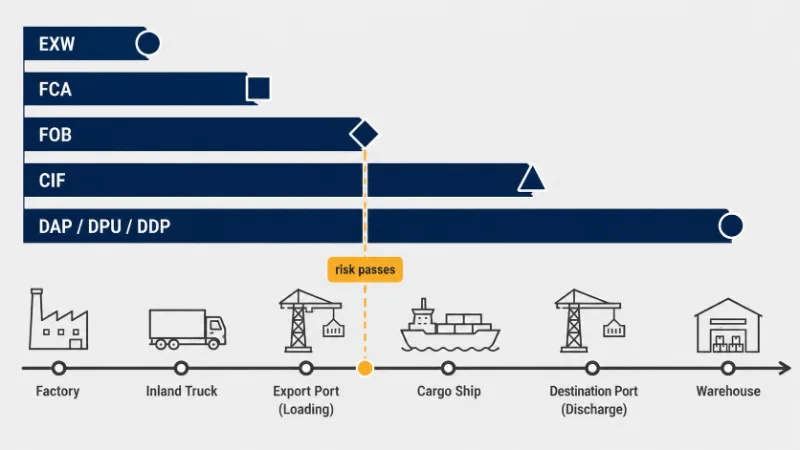
Comparison breaks down when neither offer states the rule. Setting one quotation against another without checking it usually produces a budget that reads as approved, then falls short at the port. Freight, terminal handling and clearance arrive there as separate invoices, weeks after the deposit. We ask for the rule, the named place, the edition and the currency in writing before putting two offers side by side. A comparison that mixes rules compares trade terms, not trucks.
Price Drivers That Move a HOWO Truck Quote Most
Four configuration decisions account for most of the spread between HOWO quotations: truck type and upper body, axle layout, engine and emission package, and cab or drive-side options. Which one dominates depends on the duty cycle you are buying for.
Truck Type and Upper Body
On body-equipped trucks the upper structure is often the single largest variable. On tractor units and high-specification chassis, the engine, gearbox, axles and emission package usually dominate instead. A tipper adds a hoist, hydraulics and a body whose steel grade and plate thickness change both price and service life. A mixer or tanker adds a specialty structure with its own compliance checks, while a tractor unit shifts that cost to the trailer you buy separately. Ask for plate grade and thickness on the spec sheet, not body volume alone: two 20 m³ bodies can differ widely in both.
Axle Layout and Payload
An extra axle adds permitted weight and tare weight at the same time, and only the difference between the two becomes usable payload. In most markets the legal gross limit rises with axle count, so an 8×4 unlocks capacity a 6×4 cannot legally use. Against that, the extra axle, the longer frame and the heavier body that normally accompanies it all raise unladen weight, which is where a 6×4 vs 8×4 dump truck comparison usually turns.
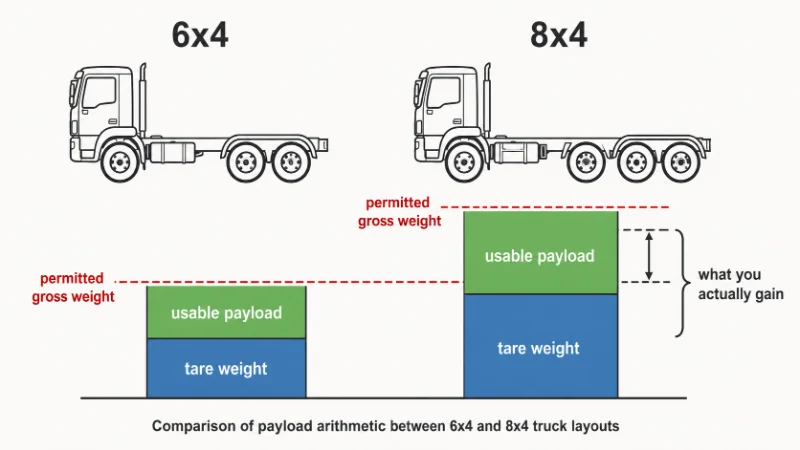
The premium pays back where the legal gross increase in your market exceeds the added tare, and where the cargo is dense enough to reach the higher limit before the body fills. Where the binding constraint is a per-axle rating, a bridge limit or a site restriction, the arithmetic changes again. Confirm the permitted gross weight for each layout in the destination market, and the kerb weight of the exact build offered, before the layout is fixed. After delivery it cannot be corrected.
Engine Output and Emission Package
Emission tier is a supply question as much as a specification. Which aftertreatment a build carries depends on the engine model and its calibration, not on the tier label. Some configurations use selective catalytic reduction and consume a urea solution meeting the applicable ISO 22241 quality requirements; others combine exhaust gas recirculation, oxidation catalysts and particulate filters differently. Where a build does use SCR, running cost depends on urea being available along your route, and sulfur in local diesel affects catalyst and filter durability.
Check in this order: the tier your registration authority requires, then the aftertreatment layout on the engine offered, then whether the fluid and fuel that layout needs exist where the truck will work.
Cab, Drive Side and Options
Cab and drive-side choices move a quotation within a band, not between bands, but two of them carry consequences beyond price. Factory right-hand drive and a converted right-hand-drive unit are not the same product for registration, warranty or resale. Acceptance of converted vehicles varies by country, so confirm it with the destination authority before ordering. Sleeper cab grade, air conditioning, tyre rating for unpaved routes and a spare parts package each belong on a separately priced line, which keeps the base vehicle comparable across suppliers.
How Far Configuration Moves a HOWO Quote
Configuration accounts for most of the gap between two HOWO quotations carrying the same model label, and which driver dominates depends on the duty cycle behind the order. The table ranks the drivers by how far each one moves the figure, and names what to settle before the number is fixed.
| Driver | How far it moves the quote | Why | Confirm before the figure is fixed |
|---|---|---|---|
| Truck type and upper body | Largest single step | Hoist, drum or tank are separate builds sharing a chassis | Whether the quote is chassis-only or a complete unit |
| Axle layout (4×2 / 6×4 / 8×4) | Large | An added axle changes permitted weight and tare weight together | Legal gross figure in your market, plus kerb weight of the build offered |
| All-wheel drive (6×6) | Large | Transfer case, driven front axle and site protection are added hardware | Whether the route needs traction or only ground clearance |
| Engine output and emission tier | Moderate to large | Higher tiers add aftertreatment hardware and a consumable | Registration requirement first, then the aftertreatment layout offered |
| Body steel grade and plate thickness | Moderate, and invisible on a spec line that gives only volume | Wear-resistant plate costs more per tonne of body | Grade and thickness in millimetres alongside the m³ figure |
| Cab grade and drive side | Within a band | Sleeper, air conditioning and factory RHD are option lines | Factory build or conversion |
| Tyres, spare parts, warranty scope | Within a band, but recurring | Priced at order, they cost less than an emergency order later | Whether each sits inside the quoted figure or outside it |
Published figures on this site cover tractor units: the SINOTRUK HOWO 6×4 tractor truck is listed at $32,900 and the HOWO T7H at $36,900, both marked negotiable. Tipper, mixer, tanker and chassis builds are quoted against a specification instead of listed, because the upper structure and duty grade move the figure too far for one number to carry meaning.
When a supplier does publish a range, both ends are real builds, not a list price and a discount. The low end is a standard-duty build on the lightest acceptable specification; the high end is the same layout with a heavier body, a higher emission tier and better tyres. Do not treat that spread as negotiating room by default. Before negotiating, separate how much of the gap between two offers comes from specification and how much from scope and commercial terms: validity, warranty, spare parts, payment schedule. Only what is left after that is margin.
Published figures from different exporters overlap without matching, and that gap is not evidence that one of them is padded. Two lists can differ on an identical model label because the builds behind the label differ, and because quotation date, trade term, warranty scope and payment terms all sit inside a published figure. Any number lifted from a list stays a planning reference until the specification behind it is written down.
Refurbished units belong in a separate budget line altogether, which the next section takes up.
New, Used, or Over-Specified: When the Cheaper Unit Costs More
A used or lower-specification HOWO unit is the cheaper purchase and sometimes the more expensive asset, depending on refurbishment scope, parts access on your route, and tolerable downtime. Ask for the refurbishment scope item by item (engine, gearbox, clutch, brakes, suspension, tyres, hoist) instead of accepting a discount percentage. A percentage tells you nothing about which of those the workshop actually touched.
| New factory build | New stock unit | Refurbished unit | |
|---|---|---|---|
| What you are buying | A specification you set | A specification someone else set | A history you have to verify |
| What sets the price | Type, axle layout, engine tier, body spec | What was already built, and how long it has stood | Depth of the refurbishment, not the year on the plate |
| Main risk | Locking a wrong spec you cannot change after shipment | Production year, storage period, emission version, destination certification | Undisclosed scope, early downtime, parts access on your route |
| Right call when | Configuration matters more than the start date | A project date drives the purchase and the built spec is close enough | Utilisation is proven and a workshop is reachable |
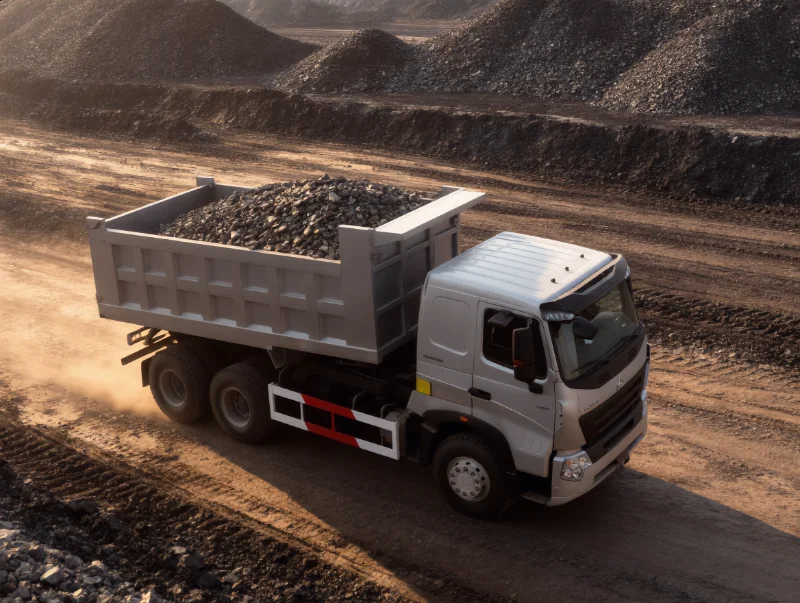
Over-specification is the mirror error and costs just as much. A heavy-duty body, a mining axle ratio and a higher power rating all raise purchase price and unladen weight. On surfaced routes with moderate density cargo, they return neither payload nor speed.
If your haulage is seasonal and runs a few loads a week, buying a heavy tipper at all, ours included, is usually the wrong call. Run one comparison before you order: annual ownership cost, including depreciation, financing, driver, insurance, maintenance, idle days and HOWO truck fuel consumption per km on your route, against the local contract-haulage rate per trip or per tonne.
How to Check a HOWO Truck Quotation Before You Pay
A quotation is checkable only when it states the vehicle, the trade term and the validity in writing. An offer missing any of the three cannot be set against another, whatever the figure at the bottom. Six items make quotations comparable:
- Chassis model, production year, plus engine model and rated output, not a horsepower number alone
- Gearbox model, rear axle model and axle ratio
- Upper body specification: volume or capacity, plate grade and thickness, or tank material
- Emission tier, aftertreatment layout and drive side, matched to your registration requirement
- Incoterms rule with named place and edition, and what is explicitly excluded
- Validity period, lead time, warranty scope and payment terms
Import duty, VAT treatment and clearance charges in your country are set by your customs authority, and no supplier quotation can fix them. A CIF figure plus your broker’s estimate is the realistic route to a landed number. We verify chassis and engine identifiers against the build sheet before the deposit stage, since a specification that shifts after payment is the most expensive variation there is.
Where to Start with HOWO Truck Pricing
Two inputs decide a HOWO truck price before the others matter. The duty cycle comes first because it is irreversible. Axle layout, engine output, body specification and tyre rating all follow from surface, gradient, load density and trips per day, and none can be corrected after the vehicle ships. The trade term comes second, because it decides whether the numbers in front of you are comparable at all. Unlike the truck, you can change it by asking. Cab grade, tyre brand and spare parts packages move the figure inside a band and can be settled last.
On unpaved haul roads with loaded turns and frequent tipping, suspension rating, tyre spec and hoist capacity are usually the first items to re-check against what was quoted. We compare HOWO truck offers only after aligning them onto one trade term and one specification sheet, so the lowest line is the cheapest truck, not the shortest scope.
Duty cycle and trade term are the two things no model name reveals. An enquiry carrying the following comes back as a scoped quotation instead of a range:
- Route and duty cycle: surface type, one-way distance, gradient, loads per day
- Payload target and cargo density, plus the load limit that binds on that route
- Truck type and upper body requirement: body volume, tank capacity and material, or the trailer to be pulled
- Emission tier required at registration, and drive side
- Destination country and port, with the Incoterms rule you want quoted
- Quantity, target delivery window, and whether a spare parts package is included
Related on this site: Shacman vs HOWO tractor, for buyers comparing the two brands on specification before comparing them on price.
FAQ
Does a HOWO truck price include a trailer?
No. A tractor unit is quoted without the trailer, specified separately according to the cargo you intend to pull.
Why is the price in my country different from a China export price?
An export figure and a price in your market are different numbers. Between the two sit ocean freight and insurance, destination terminal handling, import duty and any age-related levy, VAT or its local equivalent, clearing agent fees, conformity certification where required, registration, and inland delivery. Your customs authority and local providers set those rates, not the supplier. Several of them move with vessel schedule and season, so a landed figure worked out three months ago is not a benchmark for this quarter.
Is right-hand drive more expensive than left-hand drive?
Price follows demand, not the steering side. Where right-hand drive is the standard build, factory RHD units carry no premium; a converted unit adds conversion labour and parts on top of whatever base you started from. Ask whether the offer is a factory build or a conversion, since the two are priced from different starting points.
Does ordering several units lower the unit price?
Often, but not automatically. Identical configurations consolidate well in production scheduling and vessel booking. A mixed fleet, specialty upper bodies, staged deliveries or a short lead time can cancel the advantage.
Should a spare parts package be in the quotation?
Yes for routes far from a parts source. Wear items priced at order cost less than an air freight order after the truck is already standing.