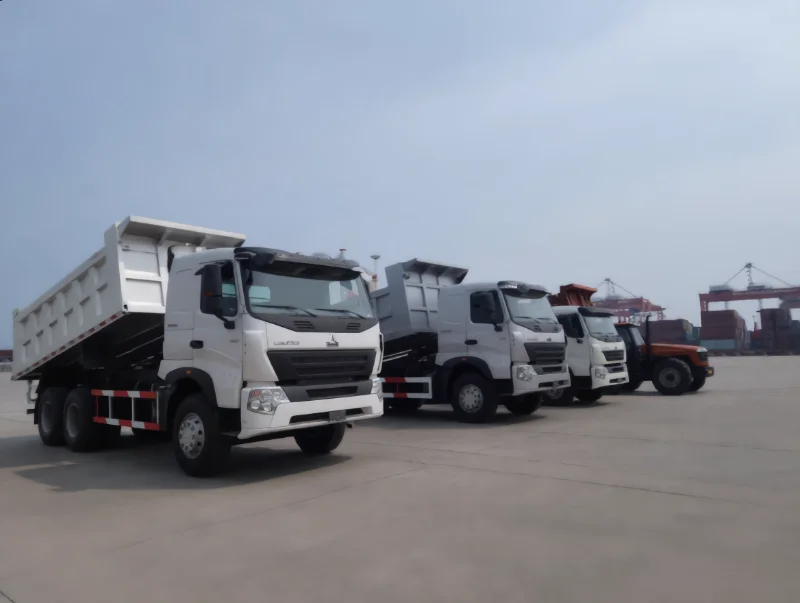
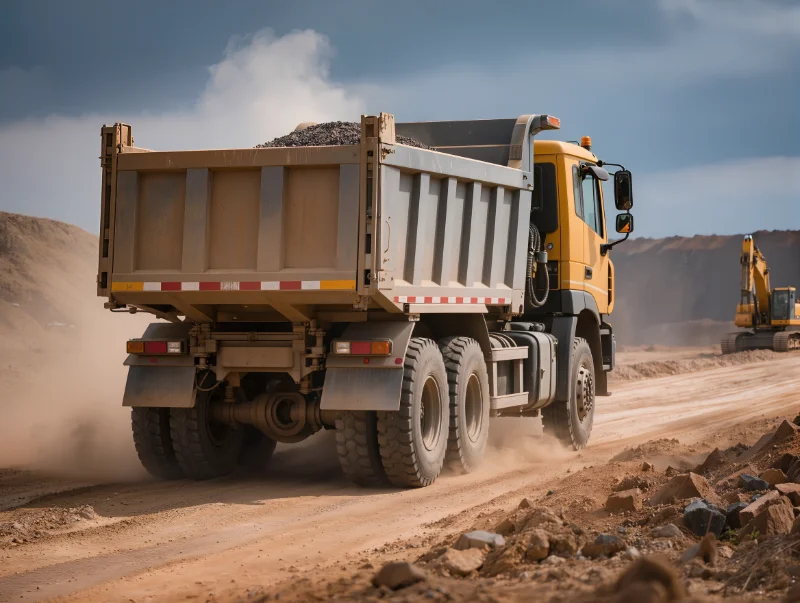
HOWO truck fuel consumption per km runs about 0.30–0.50 L for loaded 6×4 dump work. A fully loaded 6×4 tractor unit runs 0.34–0.37 L. Those are dealer-published figures: 30–50 and 34–37 L/100 km, or roughly 2.0–3.3 km per liter. Payload, terrain, and the share of the route run empty decide where a given truck lands. Dump and tractor figures do not swap. None of the published numbers name the load or the test route behind them. Use them to set a budget, then confirm the real figure with a full-tank test on your own route.
HOWO Truck Fuel Consumption per Km by Duty Cycle
Published HOWO fuel figures only become useful once you sort them by duty cycle and by source. A quarry tipper and a line-haul tractor burn diesel at very different rates, even with the same engine. The table below consolidates the ranges that recur across dealer and supplier listings.
| Duty cycle | Published range | Per km | Source type | How to use it |
|---|---|---|---|---|
| 6×4 tractor, empty / return leg | 13–15.5 L/100 km | 0.13–0.16 L | Dealer spec table | Round-trip math only |
| 6×4 tractor, part load | 23–26 L/100 km | 0.23–0.26 L | Dealer spec table | Light-freight line-haul |
| 6×4 tractor, fully loaded | 34–37 L/100 km | 0.34–0.37 L | Dealer spec table | Do not apply to site work |
| 6×4 dump, loaded, paved steady haul | 30–35 L/100 km | 0.30–0.35 L | Supplier listing | Best-case dump budgeting |
| 6×4 dump, mixed construction duty | 35–45 L/100 km | 0.35–0.45 L | Supplier + operator range | Default planning band |
| 6×4 dump, quarry / stop-start | 45–50+ L/100 km | 0.45–0.50+ L | Operator range | High-risk budget band |
Every figure above is published by dealers, suppliers, or operators under unstated test conditions. No load, route, or ambient specification comes with them, and none has been independently verified. They are planning ranges, not guarantees. An empty dump truck on rough site roads will exceed the empty-tractor band.
Read the table down a column, not across a row. The spread inside one configuration is wider than the spread between configurations. Operating conditions cost more than the badge on the door.
Look again at the empty-running row. It sits low enough that cutting empty kilometers out of a route saves more diesel than any driving technique will.
L/100 km, L/km and km per Liter Conversion
HOWO fuel figures travel in three units across export markets, and the unit changes what a number means to your cost model. L/100 km is standard in technical documents. L/km appears in per-kilometer costing. And km/L is how many buyers outside Europe ask the question.
| L/100 km | L/km | km/L | Typical duty |
|---|---|---|---|
| 15 | 0.15 | 6.67 | Empty or light running |
| 23 | 0.23 | 4.35 | Tractor, part load |
| 30 | 0.30 | 3.33 | Paved haul, moderate payload |
| 34 | 0.34 | 2.94 | Fully loaded tractor |
| 40 | 0.40 | 2.50 | Mixed construction duty |
| 50 | 0.50 | 2.00 | Quarry / stop-start duty |
Compare trucks in L/100 km. The number rises as efficiency falls, and the math stays linear. Report to drivers in km/L if that is the unit they think in. The catch is that km/L compresses at the efficient end, so two figures that look close may not be.
Why a Single Quoted Fuel Figure Misleads
A quoted figure like 40 L/100 km tells a HOWO buyer nothing until the load and the route behind it are stated. The same truck can produce anything from 14 to 50, depending on how the run was measured.
Picture two sellers quoting the same chassis. One ran it empty on a paved highway. The other ran it loaded through a quarry cycle. On paper the trucks look different. Only the test conditions were.
So fix the load condition first. Then fix the terrain profile. Only when both match do two numbers describe the same thing.
Engine spec sheets add a second layer of confusion. Dealer listings for the WD615.47 engine in the HOWO 371 quote minimum specific fuel consumption in the high-180s to mid-190s g/kWh, and the published values disagree with one another. Whatever the exact number, it is a bench measurement taken at the engine’s best operating point.
Do not convert g/kWh into L/100 km. g/kWh measures engine efficiency at one controlled point on a test bench. L/100 km measures a whole truck on a real route: payload, gradient, speed, idle time, tire condition, driver behavior. The first is an engineering credential for comparing engine variants. The second is the number you budget with. No arithmetic bridges them.
The Variables That Move HOWO Fuel Use Most
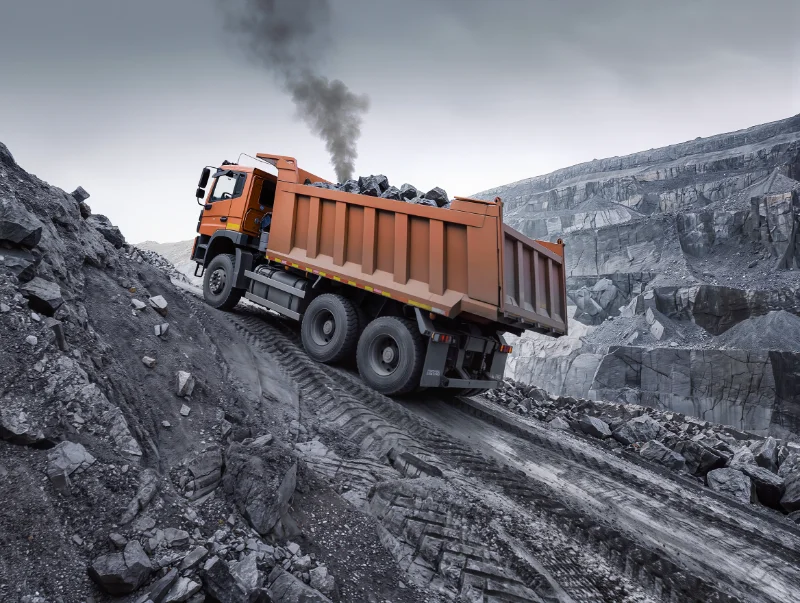
Payload discipline and route terrain move HOWO fuel use more than any other variable, and they rank in that order. Overloading is the biggest lever you control. Every tonne above rated payload adds rolling resistance and pushes the engine outside its efficient band. It is common enough in tipper work to explain most complaints that a truck drinks fuel.
Terrain ranks second. It is fixed but predictable. Gradients and unpaved surfaces always cost more, so build them into the budget rather than the problem list.
The rest are real but smaller. They can wait until a baseline exists:
- Driver behavior — harsh acceleration and late braking, against smooth and anticipated driving. Worth training for, but only measurable once payload and route are held constant.
- Tire pressure and alignment — under-inflation and dragging brakes add constant rolling resistance. A hot wheel hub after a run is the field check.
- Idle time — diesel burned at zero km inflates the per-km figure directly. Site queues are the usual culprit.
- Maintenance state — a clogged air filter or fouled injectors degrade combustion. The creep shows up in the fuel log well before any warning light.
If most of your runs are light urban deliveries, a 4×2 cargo truck covers them at a much lower fuel bill. The 6×4 dump spec earns its consumption only when payload and terrain demand it.
How to Measure Your Own Baseline per Km
A one-week full-tank test on your own routes beats any published range, and it needs no special equipment. Fill the tank completely. Zero the trip meter. Run a normal week of work. Refill to full, then divide liters added by kilometers driven.
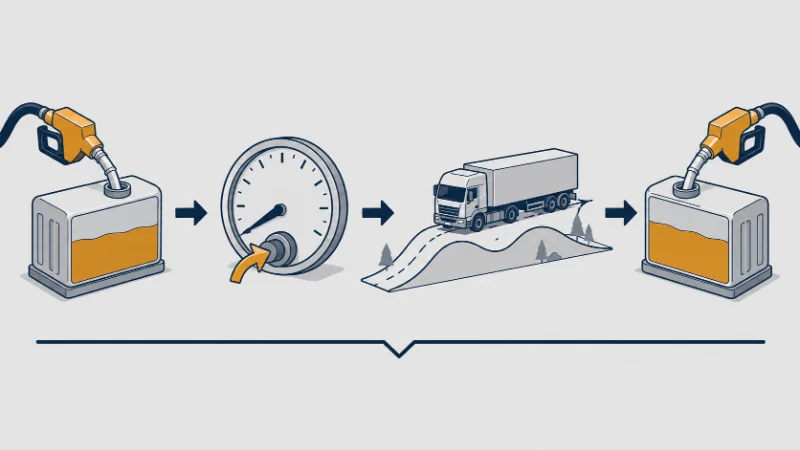
Log five fields per run, or the result is a number you cannot compare to anything:
- Kilometers driven, from the odometer rather than a route plan
- Liters added at refill, at the same fill point on the same pump
- Payload carried, from the weighbridge ticket where one exists
- Loaded versus empty kilometers, split out rather than totaled
- Idle hours, from the hour meter or telematics feed
Newer HOWO models with onboard fuel monitoring make this continuous instead of periodic. The order of checks stays the same either way. Establish the loaded baseline first. Then the empty-running figure. Only then judge drivers or maintenance against gaps from those two numbers. Reverse that order and a route change gets blamed on a driver.
That is the step people skip.
Cutting Fuel Consumption Without New Hardware
Most fuel savings on a HOWO fleet come from operating discipline rather than new parts. Every lever ties to a check you can run this month. Route planning that cuts empty kilometers attacks the largest structural waste, so track planned against actual empty-km ratio each month. A shutdown policy for site queues turns idle burn into zero burn, and idle hours are visible in any telematics report. Daily tire-pressure checks against the placard value remove a resistance penalty that costs nothing to fix.
Driver training pays back where the duty cycle allows it, but only against numbers. Compare per-driver L/100 km on the same route and payload class. Treat a gap above the fleet median as the training trigger. A general appeal for smooth throttle work moves nothing. Engine braking on descents and holding the economical speed band on haul roads shift that gap fastest.
Maintenance advice has to match the platform. This is where generic fuel-saving guidance goes wrong on HOWO fleets. Electronically controlled variants gain from an ECU calibration and fault-code check at an authorized Sinotruk service point, since fuel-map revisions get issued over time. Mechanical-pump Euro II units have no such calibration to update, and many WD615.47 trucks still in export service are exactly that. For those, injection timing, injector condition, air filtration, and fuel-filter intervals are the whole story. Apply ECU advice to a mechanical-pump truck and you waste a service visit while the real fuel penalty stays in place.
None of this needs new hardware. It needs a baseline.
Where to Start Before You Budget HOWO Fuel Costs
Two risks do the most damage to a fuel budget on a new HOWO purchase. The first is building the cost model on a quoted figure with no stated load or terrain behind it. Guard against it by demanding the test conditions with any number, or by budgeting from the duty-cycle band above and correcting against your own first-month logs. The second is letting overloading inflate consumption quietly until the truck takes the blame. A written payload policy, checked against weighbridge tickets, closes that gap before it opens.
Get those two controls in place, and HOWO truck fuel consumption per km becomes a number you manage rather than a number that surprises you. Payload and route decide most of the bill. Everything else is tuning.
We help buyers match a HOWO Truck configuration to their actual duty cycle before the order is placed. That is where most of the lifetime fuel bill is really decided. If you are shortlisting a configuration now, book a technical confirmation with our team and bring three inputs: your route profile with gradients, your planned payload per trip, and your expected annual mileage. With those, the fuel estimate stops being a range and becomes a plan.
FAQ
How many kilometers per liter does a HOWO 371 get?
A HOWO 371 tractor at its quoted full-load figure covers just under 3 km per liter, and dump duty on site can pull that below 2 km per liter. The number on its own is not the useful part. When a supplier quotes km/L, ask which load and which road surface produced it. A km/L figure with no load behind it is a best case, and best case is not what your site will run.
How much fuel does an empty HOWO truck use per km?
Dealer data puts empty 6×4 tractor running at roughly 0.13–0.16 liters per km, well under half the loaded rate. Do not average that with the loaded figure. Cost each leg separately: loaded kilometers at the loaded rate, empty kilometers at the empty rate, then add the two. A route that runs loaded out and empty back lands somewhere between them, and where it lands is set by your backhaul ratio.
How do I convert L/100 km into fuel cost per km?
Divide the L/100 km figure by 100, then multiply by your local diesel price per liter. A truck running 40 L/100 km with diesel at 1.00 USD/L costs 0.40 USD per km in fuel. The same route at 45 L/100 km costs 0.45 USD per km. Run the calculation separately at your loaded and empty rates.
Are HOWO trucks less fuel-efficient than European trucks?
Published figures cannot settle that comparison. Manufacturers quote consumption under different loads, routes, and test conditions. A valid comparison needs the same route, the same payload, and the same driver rotation across both trucks. HOWO engines are conventional turbocharged diesels, and their consumption responds to the same variables as any competitor’s, so operating discipline usually outweighs brand.
Does fuel consumption per km equal operating cost per km?
No. Fuel is the largest single line item, but not the whole cost. Tires, maintenance intervals, driver wages, and depreciation sit on top of it. Full cost-per-km modeling is a separate exercise that needs your fleet’s maintenance and utilization data, and it falls outside what this fuel-focused guide covers.