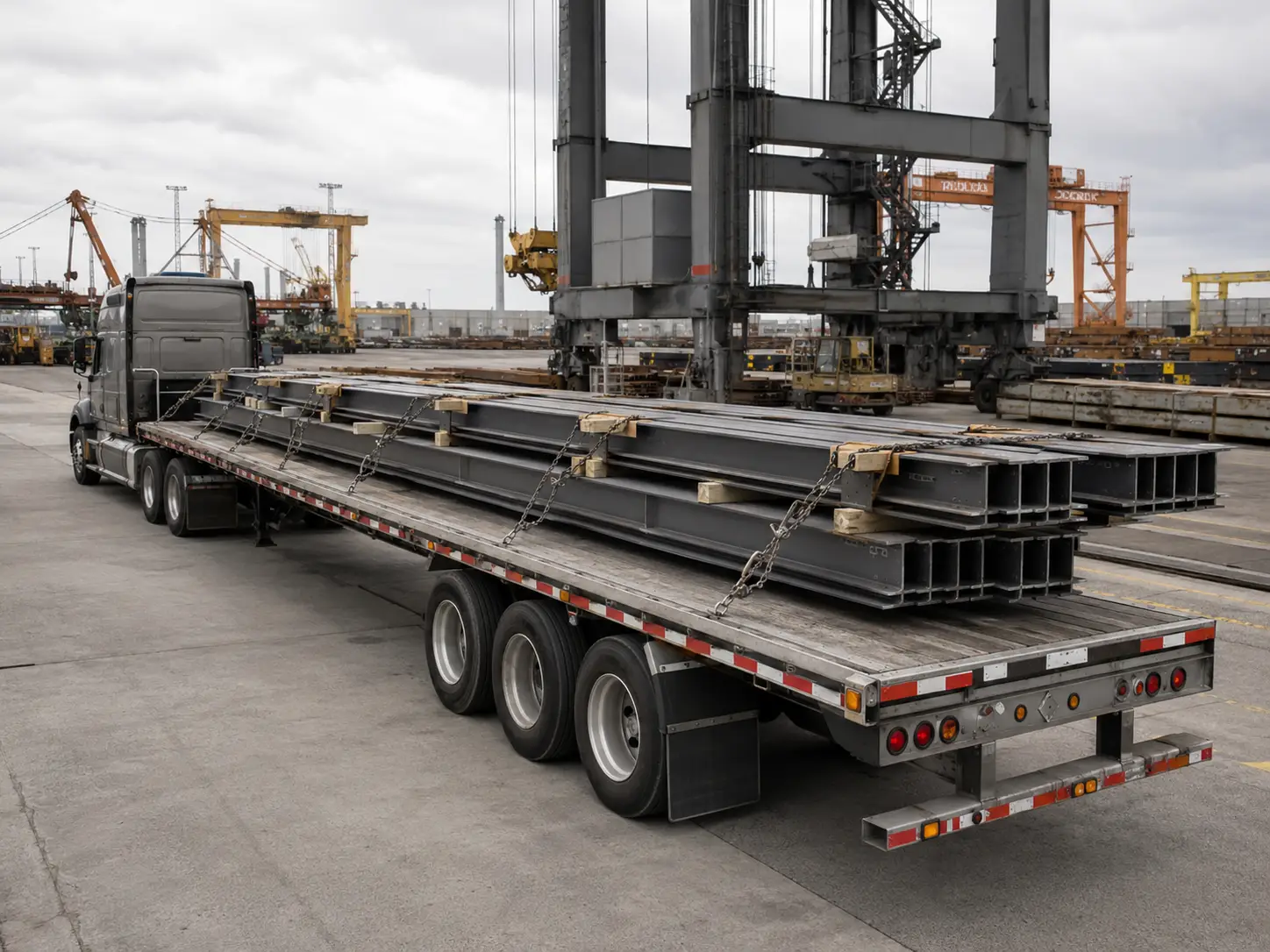
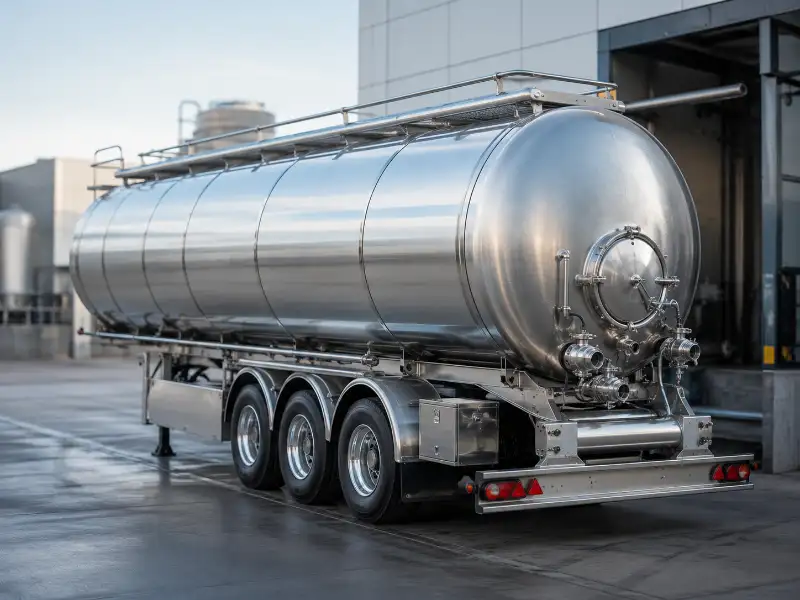
A food grade trailer is any trailer built and maintained to carry food or ingredients safely, without contaminating them. The label points to a sanitary condition and a construction standard, not one fixed body type. Depending on the cargo, the right choice might be a stainless tank, an insulated reefer, a clean dry van, or a sealed dry bulk trailer.
This guide covers trailers used to transport food, not to prepare or sell it. Mobile kitchens and concession trailers share the word “food,” but they are a separate category. They carry their own electrical, plumbing, and health-code rules, and the sanitary specs below do not transfer to them. The focus here is narrow: how cargo type, material grade, and certification decide whether a trailer is food grade.
What “Food Grade” Actually Means for a Trailer
A food grade trailer is defined by sanitary condition and food-contact-safe construction, not by body style, and the bar shifts with the cargo it carries. A dry van of canned goods and a stainless tank of liquid sugar are both food grade, for different reasons.
The most common misconception treats “food grade” as a single spec you can buy off one sheet. In practice it is three things at once: a body suited to the product, food-contact-safe interior surfaces, and proof the unit can be cleaned to a verifiable standard. Miss any one of the three, and the trailer fails for that load, no matter how good the other two look.
Some buyers assume a stainless interior alone makes a tank food grade. They skip the weld finish and the surface polish. The result is often a barrel that traps residue in its weld pits and fails a surface swab. That sends the unit back for rework before it can run sanitary loads. The contact surface, not just the material grade, is what to verify against the product’s standard.
Types of Food Grade Trailers and What Each One Hauls
Food grade trailers fall into four working categories, chosen by the cargo’s state: sanitary tank, refrigerated, dry van, and pneumatic dry bulk. Pick the body first, and every later material and certification choice gets easier.
| Trailer type | Typical cargo | Defining construction feature | Choose it when |
|---|---|---|---|
| Sanitary tank trailer | Bulk liquids: milk, juice, edible oils, liquid sugar | Food-contact stainless barrel with sanitary fittings | Cargo is unpackaged liquid in direct contact with the trailer |
| Refrigerated (reefer) | Meat, dairy, frozen food, produce | Insulated walls plus a refrigeration unit | Product must stay within a defined temperature band |
| Food-grade dry van | Packaged, canned, or bottled shelf-stable goods | Clean, odor-free, food-grade liner and floor | Product is sealed and stable at ambient temperature |
| Pneumatic dry bulk trailer | Flour, sugar, starch, grain, powdered ingredients | Sealed dry bulk tank, sanitary interior, moisture control | Cargo is a dry powder or granular ingredient loaded and discharged in bulk |
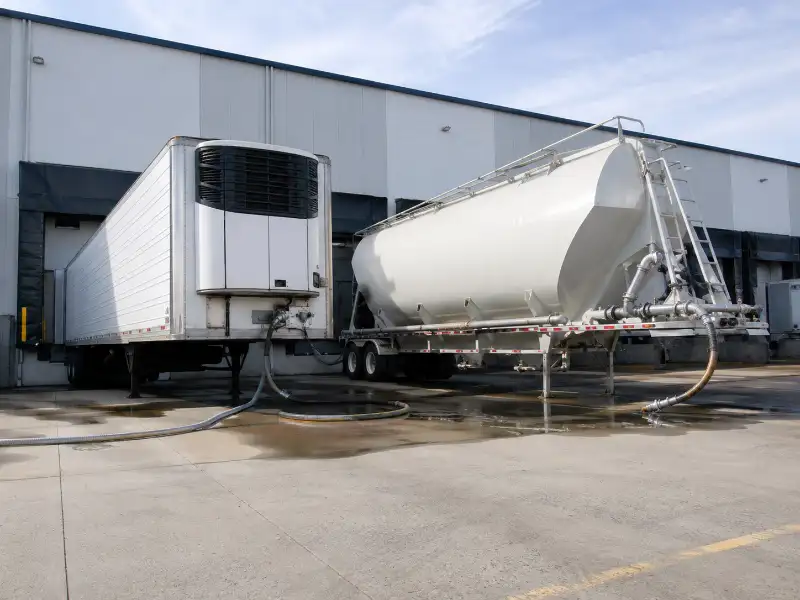
Classification matters because the body sets the cleaning method, the contact-surface rule, and the certifications that follow. A reefer that loses its temperature band can ruin a perishable load a dry van would never have carried. A sealed tank built for dry bulk cargo keeps flour or sugar dry, where a liquid tank would let it spoil. Matching the body to the cargo is the first gate, not a detail.
Materials and Construction Standards That Define Compliance
Material grade and surface finish decide whether a food grade trailer can be cleaned to a sanitary standard, and that bar rises once the cargo touches the surface directly. For liquid and dry bulk loads, this is where most of the cost and most of the compliance risk sit.
For sanitary tank trailers, 304L stainless steel suits many food liquids. 316L is the usual pick for more acidic, salty, or corrosive products, where its added resistance helps. The low-carbon “L” grades are preferred wherever welding is involved. Material grade alone, though, does not finish the spec. Surface finish and weld treatment decide how much residue the interior holds: a rough weld leaves micro-pits that trap contamination, while a finished surface cleans to a verifiable level. Sanitary standards often set a measurable roughness target, around 32 µin Ra or finer, where the standard calls for it.
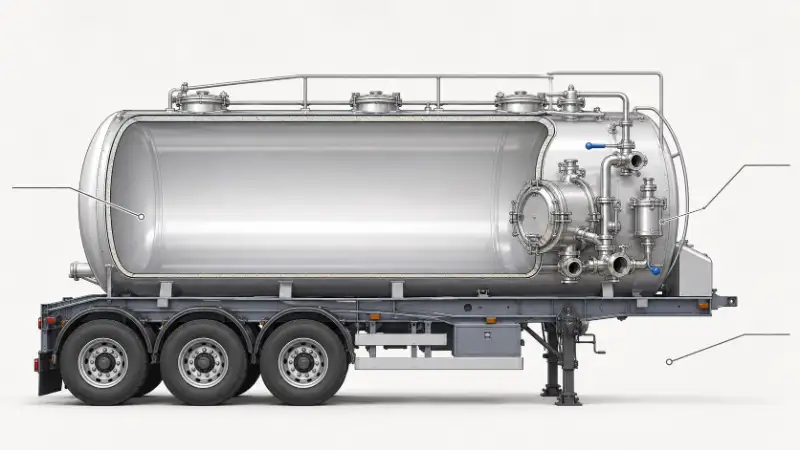
A good spec also reads the trailer in three zones and treats each one separately. Direct food-contact surfaces drive the grade, finish, weld quality, gasket material, and roughness target. Non-contact interior areas are judged on cleanability, corrosion resistance, and the absence of flaking coatings or odor. The loading and unloading fittings are where sanitary integrity is most often won or lost: valves, manways, pumps, hoses, and clean-in-place (CIP) access. Which grade and finish a load needs depends on its acidity, its temperature, and the sanitary standard your receiver enforces. Confirm those before you assume a baseline spec carries over.
Certifications and Regulatory Standards to Verify Before Buying
Food grade trailer compliance rests on several layers of standards, not one: sanitary transport, food-contact materials, and, separately, roadworthiness and any hazardous-material rules. Which layers apply depends on the cargo, the route, and the destination market. Treating them as one checkbox is where compliance gaps usually appear.
In the United States, the FDA’s Sanitary Transportation rule under FSMA governs how vehicles and equipment stay sanitary in transit. It requires that they be designed and maintained so food does not become unsafe on the road. Food-contact surfaces and coatings fall under separate FDA food-contact material rules in 21 CFR. DOT cargo-tank specifications such as DOT 407 are not food-grade sanitary standards. They apply only when the cargo or route triggers hazardous-material rules, which most ordinary food liquids do not. The broader compliance requirements for tank trailers are worth reviewing on their own. For ordinary food loads, the controlling factors are sanitary construction, food-contact materials, cleanability, and receiver documentation.
HACCP and ISO 22000 are a separate matter. They are food-safety management systems owned by the carrier, shipper, or receiver, not certificates stamped on the trailer. They also do not replace trailer-level evidence: material certificates, sanitary design, wash-out records, temperature logs, and inspection documents. Which standards apply also shifts by market and cargo:
| Market / cargo | Standards to verify against |
|---|---|
| U.S. | FSMA Sanitary Transportation rule, 21 CFR food-contact material rules |
| EU and cross-border | Regulation (EC) No 1935/2004 for food-contact materials; ATP where refrigerated cross-border transport applies |
| Dairy | PMO and sanitary design requirements where the receiver enforces them |
| Refrigerated food | Temperature-control records; ATP or local cold-chain rules in the destination market |
| Food cargo also regulated as hazardous | DOT / ADR cargo-tank rules, separate from food-grade sanitation |
This table is a starting point, not a clearance. The exact rules depend on the product and the destination. Confirm them before ordering, not after delivery.
How to Select a Food Grade Trailer for Your Cargo
Selecting a food grade trailer starts with the cargo’s physical state and ends with the receiver’s documentation. Skip either end, and that is where most spec errors begin. The build details matter, but only after those two boundaries are fixed.
- Cargo state and contact: Whether the cargo is liquid, powder, packaged, or chilled decides the body first. The trade-offs across tanker trailer types and van bodies follow from there.
- Temperature requirement: A fixed temperature band points to a reefer with proven insulation and temperature logging. An ambient-stable product does not justify the added cost.
- Material and finish: Match stainless grade, internal finish, gaskets, and fittings to the product’s acidity and to the sanitary standard your receiver enforces.
- Certification and documentation: Confirm which transport and food-contact standards the destination requires before you place an order.
- Cleaning and changeover: Dedicated food-only service versus shared use changes wash-out frequency, CIP needs, and the residue risk you carry between loads.
- Payload and configuration: Axle count and tare weight affect legal payload, which itself depends on regional weight limits.
Settle cargo state and certification first. Configuration and options follow from those two. A trailer specced backward, from a price target down to the cargo, is the one that fails at the receiver’s dock.
Conclusion
Specifying a food grade trailer comes down to three things, in order: the cargo’s physical state, the material and finish that touch it, and the certifications the destination enforces. Get those three right, and the body, configuration, and options follow without guesswork.
As Semi Trailer Manufacturers, we treat a food-grade spec as a chain that is only as strong as its weakest fitting. When we review specs for sanitary work, the valves, manways, and seams nearest the loading point are usually where it quietly falls short, long before the body does. Where a requirement turns on the product’s acidity, its temperature band, or the receiver’s standard, we flag it for project-level confirmation instead of assuming a baseline carries over.
If you are scoping a food grade trailer for a specific product, start by documenting the cargo state, the temperature needs, and the destination’s compliance requirements before you request a build. Send us those details, and we can check the specification against them and confirm what your load actually needs.
FAQ
Is a food grade trailer the same as a refrigerated trailer?
No. A refrigerated trailer is one type of food grade trailer, used when cargo must hold a temperature band. Dry vans, sanitary tanks, and dry bulk trailers are also food grade when they meet the sanitary and contact rules for their loads.
Can a regular dry van be used as a food grade trailer?
A dry van can qualify if its interior is food-grade, clean, odor-free, and free of residue from prior loads. The body alone does not make it food grade. Its condition and fit for the specific packaged product do.
What stainless steel is used for food grade tank trailers?
304L and 316L are the usual stainless grades for food-contact tank interiors. 316L is the common pick for more acidic or corrosive products. Surface finish and weld quality matter as much as the grade for cleanability.
Does a food grade trailer need FDA certification?
The FDA does not issue a single “food grade trailer certificate.” Compliance is shown another way: sanitary design, approved food-contact materials, cleaning and inspection records, temperature logs where required, and operating procedures that meet FSMA sanitary transport rules.
Can a food grade trailer haul dry ingredients like flour or sugar?
Dry powders and granular ingredients are usually carried in pneumatic dry bulk trailers with a sealed sanitary interior and moisture control, not in a liquid tank. The right body depends on whether the cargo is loaded and discharged as a bulk solid.