Fuel tanker trailer baffle design determines how safely liquid cargo behaves on every journey. When a partially filled tanker brakes or corners, the liquid inside does not move as a fixed mass. It shifts, builds momentum, and hits the tank walls with real force. That force can destabilize a vehicle within seconds. Baffles are the internal engineering solution. They interrupt liquid movement before it becomes a safety event.
This article covers road-going fuel tanker trailers for petroleum, chemical, and liquid waste transport. It does not apply to aircraft fuel tanks, stationary storage, or marine cargo systems. Use a baffled configuration when your tanker operates at partial fill levels between 20% and 80% of capacity, travels routes with frequent braking or directional changes, or falls under DOT, ADR, or GB regulations requiring surge control. Use a smoothbore configuration only for food-grade liquids, high-viscosity non-surging products, or cargo types where cleaning rules prohibit internal structures.
At TRUCKMAN AUTOMOBILE, we design and build fuel tanker trailers for demanding export markets. We engineer baffle specifications from each client’s declared operating profile. We do not apply a default configuration. Baffle design is one of several interdependent decisions in fuel tanker trailer design — tank geometry, material selection, and compartment layout all affect how baffle specifications are finalized.
What Baffles Are and Why Fuel Tanker Trailers Need Them
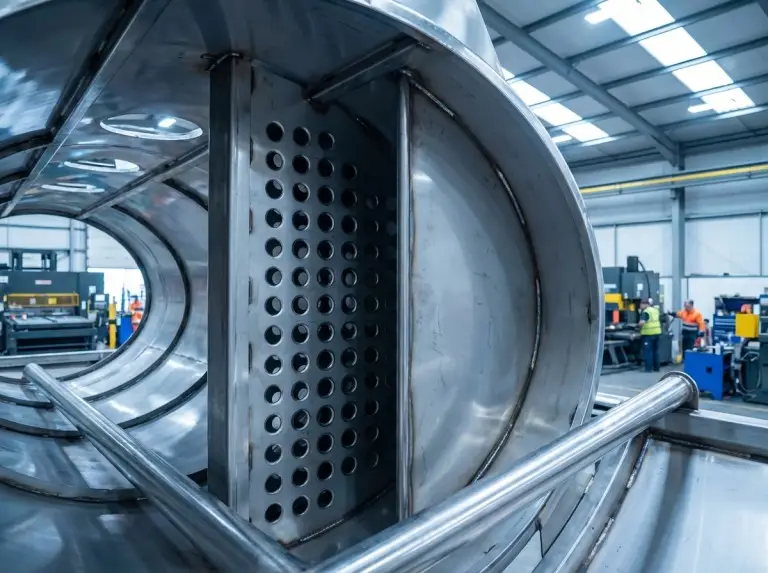
A baffle is an internal partition plate. It mounts at right angles to the tank’s long axis. Engineers perforate it with circular or slotted holes, then weld it to the tank shell at calculated intervals. Those holes let liquid pass through at a controlled rate. That is the key difference from a solid divider. Baffles do not stop liquid movement. They manage its speed, volume, and direction. This prevents destructive wave buildup.
When a tanker brakes hard, the liquid does not stop with the vehicle. It pushes forward under its own momentum and hits the front tank wall with considerable force. On acceleration, it lags and shifts toward the rear. In cornering, centrifugal force drives it toward the outer wall. This raises the vehicle’s center of gravity on the side already under lateral stress. These events are most severe at partial fill levels — between 20% and 80% of capacity. At that range, liquid has maximum space to build momentum. At full capacity, it has little room to surge. Near empty, the mass is too small to cause danger. The risk zone lies in between.
Liquid surge creates two compounding problems. First, dynamic load shift: the vehicle’s center of gravity moves away from the chassis centerline, raising rollover risk on curves and roundabouts. Second, surge impact: the liquid wave hits the tank end wall with force that can exceed the static weight of the cargo. Safety research across the US, EU, and Australia has identified liquid tanker rollover rates as above average for commercial vehicles. Partial-load surge is a cited factor in a significant share of reviewed incidents. Baffles reduce both risks by breaking the wave before it reaches full momentum. For a full overview of how baffle design fits within the broader safety features essential for fuel tanker trailers, including emergency shut-off valves and anti-spill systems, see our dedicated safety guide.
The value of baffles only holds when the right type is specified for the application.
The Critical Difference Between Baffles and Bulkheads
At TRUCKMAN, the baffle-bulkhead mix-up is the most common specification error we see from procurement teams across export markets. It has direct consequences for safety certification and operational suitability. Specifying one when the other is required creates either a performance failure or a compliance violation.
Baffles introduce controlled resistance to liquid movement. Each perforated plate allows between 30% and 50% of its face area as open flow space. This varies by tank geometry and cargo type. Liquid moves between sections gradually rather than freely. Energy dissipates across multiple small flow events instead of building into one destructive wave. The holes stay large enough to allow pump-driven extraction at normal flow rates. Surge control does not come at the cost of discharge efficiency.
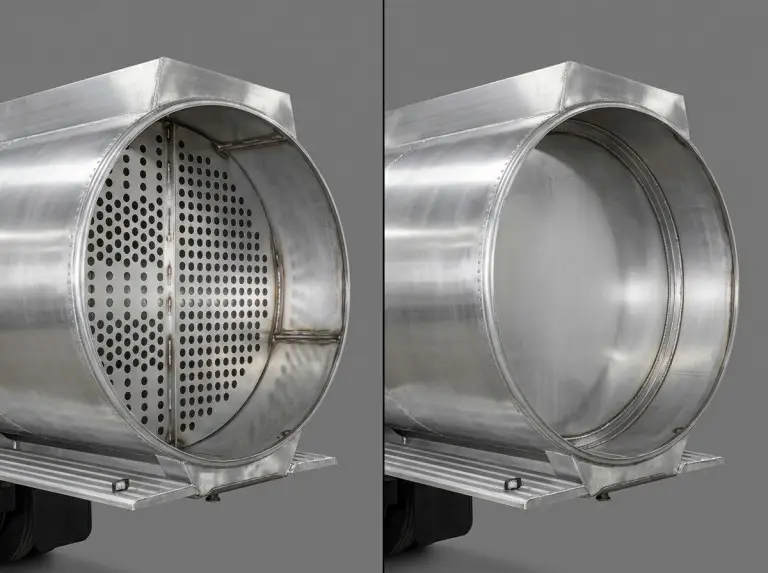
Bulkheads are solid, sealed partitions. They divide a tanker into fully isolated compartments with no fluid contact between sections. Each compartment has its own fill and discharge system. Operators use bulkhead tankers when a vehicle must carry different products on the same run — for example, gasoline to one site and diesel to another. Regulations may also require physical separation of cargo types. Bulkheads provide surge control within each compartment through isolation, not flow management.
| Design Feature | Baffles | Bulkheads |
|---|---|---|
| Fluid flow between sections | Yes — through holes | No — fully sealed |
| Primary function | Surge control and stability | Product separation and containment |
| Single-product loads | Yes — preferred | Over-engineered |
| Multi-product loads | No — cross-contamination risk | Yes — standard requirement |
| Effect on discharge speed | Minimal | Higher — separate discharge per compartment |
| Cleaning access | Moderate | Higher complexity per compartment |
| Regulatory trigger | DOT 406 for fuel, ADR for hazmat | Required when product separation is mandated |
| Weight impact on payload | Lower | Higher — solid plate mass |
The right choice resolves as soon as the cargo type and route profile are defined.
Four Engineering Functions Baffles Deliver on Every Run
Fuel tanker baffles deliver four measurable outcomes: surge control, dynamic weight distribution, pump supply consistency, and tank wall stress reduction. Our engineering team validates all four against each client’s declared tank volume and route profile before finalizing baffle spacing on every trailer we produce.
- Surge control is the primary function. Liquid moving under braking or cornering force hits the first baffle and must pass through the hole field rather than continuing at full pressure. Energy converts to turbulence in the downstream chamber. By the time the reduced wave reaches the next baffle, it loses energy again. The degree of surge reduction depends on hole area ratio, baffle spacing, and fill level at the time of the maneuver. Suppliers should provide calculated or test-validated reduction values for the declared operating conditions. Generic claims are not enough.
- Dynamic weight distribution works because baffles break the liquid mass into smaller volumes. Each volume is constrained by the baffle walls on either side. When cornering force is applied, each sub-volume shifts on its own. The maximum shift of any single sub-volume is limited to the spacing between baffles. This stops the total liquid mass from migrating to one side of the tank at once. It keeps the vehicle’s center of gravity closer to the chassis centerline and within the stability range the suspension and tires were designed for.
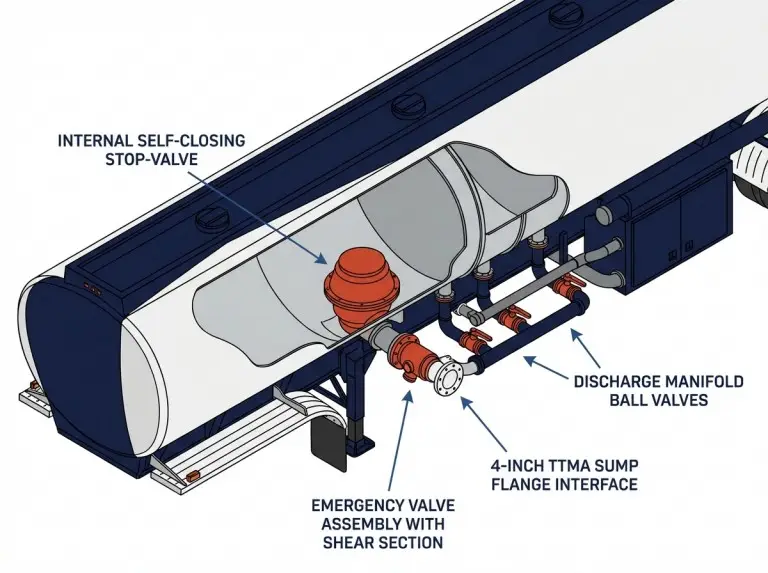
- Pump efficiency improves because baffles maintain a steady fluid head at the pump inlet. They stop remaining liquid from sloshing away from the discharge port during vehicle movement or pump suction. This reduces cavitation risk, maintains flow rate targets, and cuts total discharge time. An unbaffled tank lets liquid migrate away from the outlet, making discharge slower and less consistent. Valve layout and pump selection interact directly with baffle configuration — see our guide to fuel tanker discharge system setup for the full specification picture.
- Tank wall protection is the long-term benefit. Repeated surge impacts generate cyclical stress at welds, seams, and wall-to-baffle junctions. This accelerates metal fatigue over time. By reducing peak surge force, baffles cut the stress applied to the tank shell on every braking or acceleration event. This preserves weld integrity and delays fatigue-related maintenance across the vehicle’s working life.
These four functions make it straightforward to match baffle type to specific application demands.
The Four Main Baffle Types and When to Use Each
The right baffle type depends on tank volume, cargo density, route profile, and discharge method. Each type offers different trade-offs between surge control, maintenance access, and manufacturing cost. There is no universal default.
- Fixed transverse baffles are the most common type in global fuel tanker production. Workers weld them permanently to the tank shell, at right angles to the long axis, at calculated intervals. For cylindrical tanks between 20,000 and 40,000 litres, spacing between 1.2 and 2.0 metres is a common reference. Actual spacing must be validated against the specific tank geometry and operating profile. These baffles offer high structural rigidity, predictable surge control, and low maintenance overhead. They are the right choice for most petroleum fuel transport.
- Longitudinal baffles run parallel to the tank’s long axis, set vertically within the tank cross-section. Their main function is lateral stability. They resist side-to-side liquid migration during cornering and on cambered roads. Engineers often combine them with transverse baffles to create a two-axis system. They are most useful in elliptical tank cross-sections common in petroleum tanker designs, where the wider geometry raises the risk of lateral center-of-gravity shift.
- Flexible and adjustable baffles use semi-rigid materials — typically reinforced polymers or composite panels. They deflect under impact rather than transferring full force to the tank wall junction. Adjustable systems allow the hole area to be changed between loads. This optimizes for different fill levels or cargo viscosities. These suit operations where one tanker carries products with different flow characteristics.
- Baffle balls are spherical or ovoid inserts made of plastic or rubber. They partially fill a tank and interrupt wave formation through physical displacement. Engineers use them when tank geometry makes welded baffles impractical — curved or irregular cross-sections create this problem — or when the cargo type makes fixed internal structures a contamination risk. Baffle balls reduce effective tank capacity by their own volume. That is a real limitation for high-volume fuel transport. However, they suit tanks requiring frequent cleaning or carrying multiple cargo types in sequence.
| Selection Variable | Low-Demand Condition | High-Demand Condition | Design Response |
|---|---|---|---|
| Tank volume and geometry | Smaller tanks, simple cylindrical cross-section | Large volumes, elliptical or irregular cross-section | Larger or irregular tanks need more baffles or wider hole fields to maintain consistent surge control across all fill levels |
| Product density and viscosity | Low-density fuels such as gasoline | High-density or high-viscosity products such as heavy fuel oil | Higher density raises surge force; higher viscosity slows wave formation but increases pump load — both require hole area adjustment |
| Route profile and frequency | Mainly highway with gradual gradients | Mountain routes, urban multi-drop, frequent braking | Routes with frequent direction changes need closer baffle spacing to prevent cumulative wave buildup |
Those variables interact differently across each real-world transport scenario.

Baffle Requirements Across Five Transport Scenarios
- Bulk petroleum distribution creates a changing fill level throughout the day. A delivery truck starts full and empties across a sequence of service station stops. It spends significant time in the 20%–80% surge-risk range. Urban multi-drop routes add frequent braking at traffic signals, roundabouts, and delivery sites. Closer baffle spacing outperforms configurations optimized for a single fill level.
- Chemical and specialist liquid hauling adds two variables absent from standard petroleum transport. First, cargo compatibility — the baffle material must resist the specific product carried. This may rule out carbon steel and require stainless steel, aluminum, or polymer-coated alternatives. Second, regulatory classification — many chemical liquids fall under ADR or DOT hazardous material rules, triggering baffle design requirements that do not apply to standard fuel. Confirm both variables before finalizing internal configuration.
- Emergency response and fire suppression tankers travel fast on unprepared surfaces and must discharge on arrival. These conditions increase both the frequency and severity of surge events. Baffle configuration for emergency use prioritizes surge control over discharge speed. Slightly longer discharge times are acceptable in exchange for better vehicle stability and safer transit to the scene.
- Mountain route operations create sustained forward surge. On long descents, a partially filled tanker faces continuous forward pressure from the liquid mass while braking repeatedly to hold safe speed. Each braking event adds to the forward bias of the liquid position, building cumulative stress on the front baffle and front tank wall. Closer forward baffle spacing is required. Flat-route specifications are not adequate here.
- Waste liquid and residual fuel transport requires the tank interior to be cleanable between loads. Baffles must not trap residual product. Some waste categories allow baffled configurations with drainage holes at the baffle base. Others require smoothbore tanks, trading surge control for unrestricted cleaning access. The right choice depends on the waste type and the regulatory classification of the operation.
The correct configuration for each scenario follows from three regulatory frameworks that govern baffle specification across global markets.
Regulatory Standards That Govern Baffle Specification
DOT standards cover the North American market under 49 CFR Parts 178 and 180. DOT Specification 406 applies to tanks carrying flammable and combustible liquids — the standard for petroleum fuel tankers in the US. DOT Specification 407 applies to hazardous materials, including certain chemical liquids and corrosive fuels. Both address surge control requirements for tanks above a defined volume threshold and require baffle materials to be compatible with the cargo. Confirm which specification applies to your cargo before finalizing baffle design.
ADR governs hazardous materials transport across the EU and a number of non-EU signatory states. Baffle and bulkhead requirements for petroleum products under ADR Class 3 depend on three factors: tank capacity, cargo flash point, and transport temperature. ADR compliance is mandatory for cross-border operations in Europe. A post-sale change to the internal configuration invalidates the type approval certificate.
GB standards apply to tankers manufactured in China or configured for the Chinese domestic market. GB 18564 is the primary standard for fuel tanker trailers carrying dangerous goods. For export tankers made in China, GB governs production. The destination market governs the final specification. Some markets accept GB-compliant equipment directly. Others require dual compliance or destination-market type approval before the unit enters service.
At TRUCKMAN, we design to the most stringent applicable standard when clients operate across multiple regulatory jurisdictions. We do not default to the minimum threshold of any single standard. Before finalizing any purchase, request three documents: a material certification confirming baffle plate compatibility with the cargo under the relevant standard; an aperture area ratio calculation report; and a compliance declaration identifying the specific standard clause the baffle configuration satisfies.
Baffled vs. Smoothbore: Choosing the Right Configuration
Baffled configurations are the right choice for most fuel tanker applications. Any single-product petroleum or chemical transport operation should default to baffled. The same applies when partial fill levels are routine, routes include frequent braking, or regulations require surge control for the cargo type. Reduced rollover risk, longer equipment life, and lower total operating cost are the direct results.
Smoothbore configurations — tanks with no internal baffles — are appropriate in a narrow set of cases. Food-grade liquid transport is the main one, where hygiene rules prohibit internal structures that create hard-to-clean surfaces. Certain high-viscosity products that do not generate meaningful surge forces may also suit smoothbore transport. Outside these cases, a smoothbore tank used for fuel transport at partial fill levels on public roads is a safety deficiency — not a design simplification.
| Performance Dimension | Baffled | Smoothbore |
|---|---|---|
| Surge control at partial fill | High — multiple control points | None — liquid moves freely end to end |
| Dynamic stability on curves and braking | Significantly improved | Baseline — limited by cargo mass and geometry |
| Discharge speed | Marginally slower due to hole resistance | Maximum — no internal flow restriction |
| Cleaning access | Moderate | Maximum — unrestricted internal access |
| Regulatory compliance for fuel transport | Required in most jurisdictions above threshold volume | Not permitted for most fuel applications above threshold |
| Tank wall fatigue life | Extended | Reduced — full surge force on end walls |
| Suitable cargo types | Petroleum fuels, chemicals, most single-product liquids | Food products, high-viscosity non-surging products |
Conclusion
Baffle design is a foundational decision. It affects vehicle safety, regulatory compliance, cargo integrity, and equipment life on every run. The difference between baffles and bulkheads, between fixed and flexible types, and between baffled and smoothbore designs each has specific engineering rationale. None can be resolved by applying a default specification.
In our experience supplying fuel tanker trailers to export market operators, reliable procurement decisions follow five steps. Step 1: Confirm the applicable standard for your destination market and cargo — if baffles are mandated or prohibited, the decision ends here. Step 2: If your tanker will run at 20%–80% capacity during transit, specify a baffled configuration unless a specific exception applies. Step 3: If your route includes mountain gradients or urban multi-drop delivery, specify closer forward baffle spacing — flat-route defaults are not adequate. Step 4: Confirm baffle material compatibility against the specific cargo product, not just the cargo category. Step 5: Request an aperture area ratio report, a material certification, and a compliance declaration before accepting any unit into service.
At TRUCKMAN AUTOMOBILE, every baffle specification we produce is validated against the client’s declared tank volume, cargo type, and route profile before production begins. That process — applied from inquiry through certification — is the standard our clients rely on across export markets.
FAQ
How often should fuel tanker baffles be inspected, and what are the warning signs?
Inspect at every scheduled tank inspection interval. Focus on the weld junction between the baffle plate and the tank shell — this is the highest-stress point and the most common site of fatigue damage. Three warning signs require immediate attention: an audible change in liquid movement sound during operation, visible corrosion at weld lines on internal inspection, and any deformation of the baffle plate that changes the hole geometry. Do not run another loaded journey before a certified tank inspection if any of these appear. Retain inspection records across the full service life — cumulative history is the primary input for advising on refurbishment intervals or replacement specifications on high-mileage units. For the full inspection schedule covering valves, tires, and tank shell integrity, see our fuel tanker trailer maintenance guide.
Can baffles be retrofitted to an existing smoothbore tanker?
Retrofitting is possible but involves significant structural work. Workers must weld baffle plates to an existing tank shell, requiring internal access, precise positioning, and weld quality that meets the applicable construction standard. The economics depend on the tank’s current certification status, remaining service life, and the regulatory requirements of the new application. Have a certified tank engineer assess the project before any work begins. Internal welding on an existing shell carries structural implications that must be checked against the original design specification.
What happens to surge risk when a tanker is loaded above 95% of capacity?
Above 95%, the liquid has almost no room to absorb its own energy. Any braking or cornering force transfers directly to the tank walls and trailer frame with no buffer. This is why the 95% fill rule under DOT § 393.67 exists as a mandatory ceiling, not a guideline. An overfilled tanker also loses the thermal headspace that prevents pressure buildup on hot routes. Surge risk and pressure risk compound at the same time. Baffles reduce surge force at any fill level, but they cannot compensate for the absence of headspace that overfilling creates.