Fuel tanker safety standards cover how a fuel tanker semi-trailer is designed, built, inspected, and operated. They set requirements for tank shell material, pressure ratings, valve specs, static control, and driver certification. The standards that apply to any tanker depend on three variables: the fuel type, the operating jurisdiction, and the tank classification set at the design stage. Most compliance gaps start when one of these three is not confirmed before ordering. If you are still working through the basics of tanker types and configurations, the fuel tanker trailer guide covers the full range before you commit to a specification.
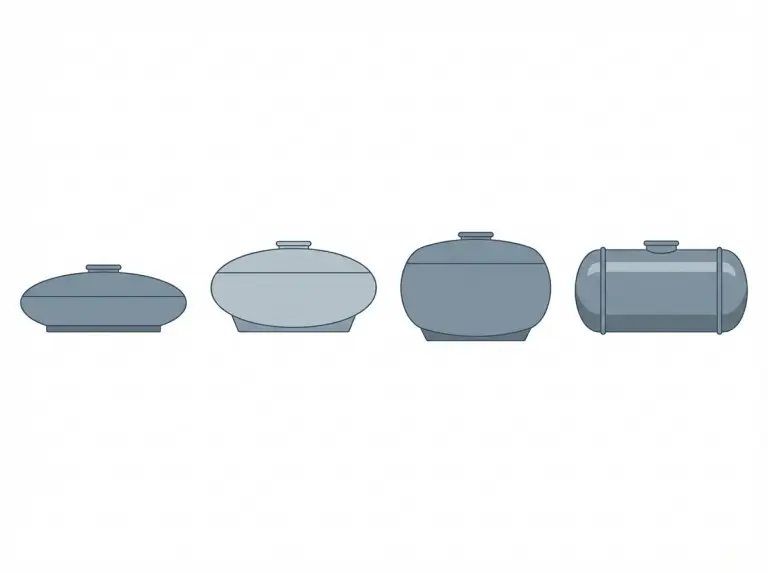
Why Tank Classification Determines Which Standards Apply
Fuel tanker safety has no single universal standard. In the United States, the DOT assigns cargo tank classifications based on liquid type, pressure, and construction method. Each classification sets its own design, material, testing, and operational requirements. Applying the wrong classification to a fuel type cannot be fixed by retrofitting. It requires a full redesign.
The most common classification for road fuel transport is DOT-406 / MC-306. It covers flammable liquids — gasoline, diesel, and jet fuel. Under 49 CFR 178.346-1, these tanks operate at a MAWP of 2.65–4 psig. They use aluminum with an elliptical cross-section. Vacuum loading is not allowed. Multiple compartments, each with its own manlid and emergency internal valve, allow multi-product or multi-stop deliveries.
DOT-407 / MC-307 covers higher-pressure liquids and certain chemicals (MAWP up to 35–40 psig). DOT-412 / MC-312 applies to corrosive materials and requires stainless steel or lined carbon steel. MC-331 covers liquefied gases under high pressure. Classification is set at manufacture. It cannot be changed between fuel types without full re-certification.
Outside the United States, ADR 2025 classifies petroleum fuels under Class 3 (flammable liquids). It defines tank codes, pressure ratings, material requirements, and safety equipment for each product type. Markets across Africa, Southeast Asia, and the Middle East reference ADR, national equivalents, or both.
Structural Design and Material Requirements
Tank shell integrity is the foundation of fuel tanker safety. Shell failure — from corrosion, fatigue cracking, weld defects, or impact — creates a direct path to fuel release, fire, and environmental damage.
DOT-406 tanks use aluminum as standard. It offers a good strength-to-weight ratio and resists corrosion from petroleum fuels. For a detailed look at how aluminum construction affects tanker performance and specification options, see our overview of aluminum tanker trailers. In export markets where mild steel with internal coatings is used, the coating spec must match the cargo. Fuel blends with ethanol content attack coating materials differently than pure hydrocarbon fuels.
Wall thickness must meet minimum values based on the tank’s MAWP, diameter, and material tensile strength. Weld joints require radiographic or ultrasonic non-destructive testing. Visual inspection alone is not sufficient.
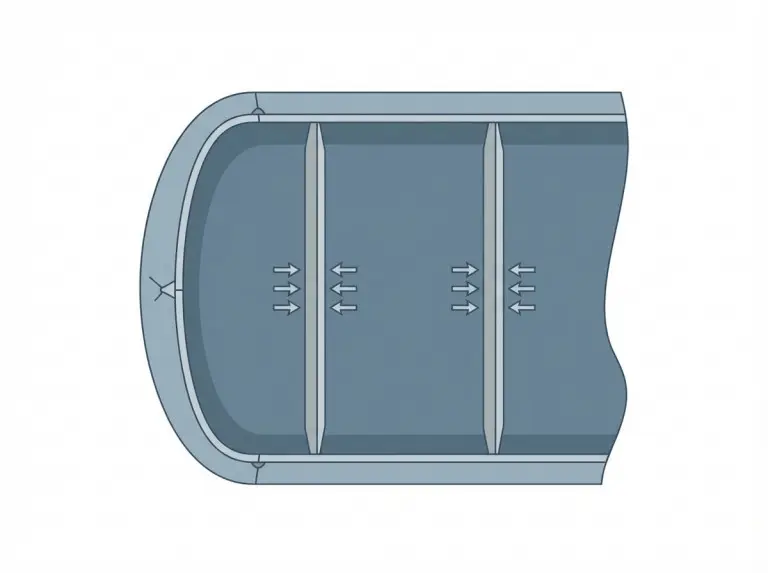
Baffle and surge suppression plates are a regulatory requirement under 49 CFR 178.346-3 for DOT-406 tanks — not a design option. They reduce surge forces during braking and limit liquid transfer between compartments in a rollover. Tanks without correctly placed baffles put more dynamic load on the suspension during braking and raise rollover risk at partial fill.
Mandatory Safety Systems and Verification Points
Pressure-vacuum vents control internal tank pressure during loading, transit, and unloading. Vent settings must match the tank’s MAWP and the vapor pressure of the fuel. A vent sized for diesel may not provide adequate relief for gasoline or aviation fuel.
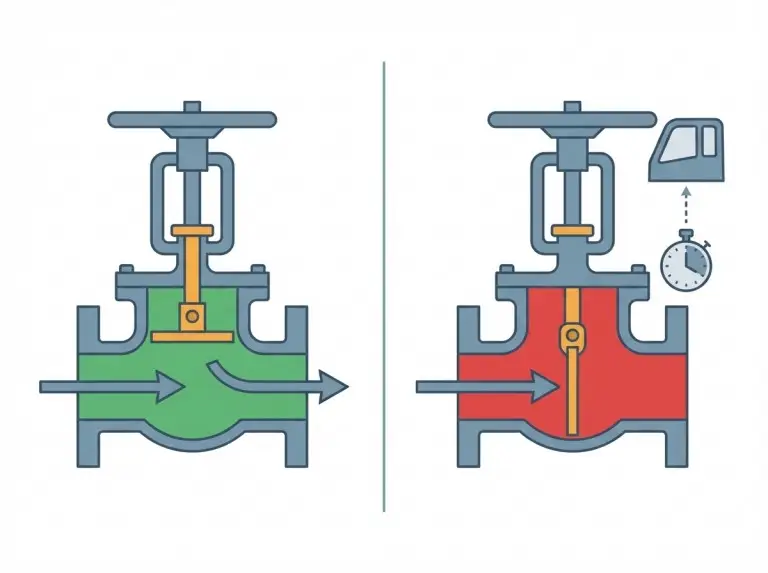
Emergency internal valves (EIVs) prevent uncontrolled fuel discharge in a rollover or major impact. Under 49 CFR 178.345-11, self-closing stop valves must fully close within 30 seconds of remote closure activation. This 30-second closure time is the regulatory acceptance criterion. Confirm it against valve manufacturer documentation — do not assume compliance from the model number alone.
Overfill protection keeps each compartment within rated liquid capacity. Each compartment’s interlock must be verified independently before the tanker enters service. A single failed interlock is sufficient to produce a regulatory violation.
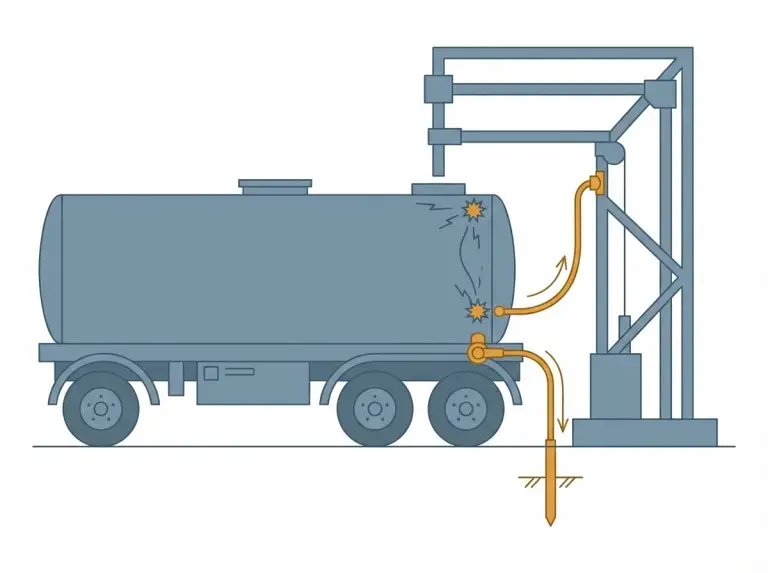
Bonding and grounding systems remove static charge built up during fuel transfer. API RP 2003 covers static electricity, lightning, and stray current ignition risk. It distinguishes between conductive and non-conductive liquids. For low-conductivity fuels — certain specialty fuels and blends — grounding alone may not dissipate charge. Bonding and grounding points should be specified at the design stage, not added in the field.
Vapor recovery under EPA 40 CFR Part 63 Subpart R applies to gasoline cargo tanks loading at covered bulk terminals in the United States. It does not apply to all fuel types or all facilities. Diesel and aviation fuel tankers at non-covered terminals are not subject to the same rule. In the EU, Directive 94/63/EC and successor regulations apply to volatile liquid fuels at terminals above defined throughput thresholds. Confirm applicability for the specific fuel, terminal type, and jurisdiction.
API RP 1004 sets the interface compliance standard for DOT-406 / MC-306 bottom-loading tankers. A tanker not built to these specifications will not be operationally compatible with compliant loading terminals. Confirm API RP 1004 conformance at the design stage — it cannot be retrofitted cost-effectively after manufacture. For a broader overview of the safety systems a compliant tanker requires, see our article on fuel tanker safety features.
Inspection and Testing Requirements by Interval
In the United States, 49 CFR Part 180 sets the cargo tank inspection schedule. For standard DOT-406 petroleum fuel tankers:
- Annual: External visual inspection (V) and leakage test (K).
- Every 5 years: Internal visual inspection (I) and pressure test (P).
- Thickness testing (T): Every 2 years for unlined tanks carrying liquids corrosive to the tank material only. This is not a universal 2-year requirement for petroleum fuel tankers.
- Upper coupler area: Checked during external visual inspection. For tanks carrying corrosive products, the area under the fifth wheel requires inspection with the coupler removed at least every 2 years.
- Additional triggers: Required after damage, repairs, or non-use exceeding 12 months.
In ADR 2025 markets, Part 6 of the ADR framework sets equivalent intervals. Inspection must be done by a body approved by the competent authority. A US-issued certificate under 49 CFR Part 180 is not valid in ADR markets. These are separate systems with no mutual recognition. Tankers going to ADR markets must be inspected and certified by an ADR-approved body.
Driver Certification and Operational Compliance
Under 49 CFR 383.5, a tank vehicle is defined as a commercial motor vehicle with tanks having an individual capacity above 119 gallons and an aggregate capacity of 1,000 gallons or more. A Tanker (N) endorsement is required to operate such a vehicle. A Hazardous Materials (H) endorsement is required for regulated cargo, including all Class 3 flammable liquids. The combined X endorsement applies to most fuel tanker operations. New hazmat employees must complete DOT training within 90 days of hire. Recurrent training is required every three years.
In ADR 2025 markets, drivers carrying Class 3 goods must hold an ADR vocational training certificate for the cargo class and tank type. It must be renewed every five years.
FMCSA research identifies partial fill — typically 50–70% — as the highest rollover risk range. Liquid moves more freely at these levels and creates greater surge forces than at full or near-empty loads. ESC systems apply automatic brake intervention but do not replace driver training on surge dynamics and curve speed management. For a full breakdown of safe operating procedures beyond certification requirements, see our guide on how to safely operate a fuel tanker.
Applicable Standards and Regulatory References
United States:
- 49 CFR Parts 178–180 — cargo tank design, construction, inspection, and testing
- 49 CFR Part 173 — hazardous materials classification and packaging
- 49 CFR 383.5 — tank vehicle definition and CDL endorsement requirements
- DOT-406 / MC-306, DOT-407 / MC-307, DOT-412 / MC-312, MC-331 — tank classification codes
- EPA 40 CFR Part 63 Subpart R — vapor recovery for gasoline cargo tanks at covered bulk terminals
- API RP 1004 — bottom loading and vapor recovery for MC-306 / DOT-406 tanks
- API RP 2003 — ignition protection from static electricity, lightning, and stray currents
- NFPA 385 — tank vehicles for flammable and combustible liquids
Europe / International:
- ADR 2025 — tank codes, classification, equipment, inspection, driver certification
- EN 13094:2020+A1:2022 — tanks for transport of dangerous liquids
- Directive 94/63/EC and successor regulations — vapor recovery at loading terminals
Note: Requirements across Africa, Southeast Asia, and the Middle East vary by country. Many markets use ADR as a baseline with local modifications. Confirm local transport authority requirements for each jurisdiction.
Specifying a Compliant Fuel Tanker with Truckman Automobile
Fuel tanker compliance runs from tank classification through design, manufacture, inspection, and operational certification. A correctly classified tanker that is not matched to the loading terminal’s interface specs still creates field problems.
At Truckman Automobile, we review the operating jurisdiction, cargo type, and loading infrastructure before confirming any fuel tanker specification. For export markets across Africa, Southeast Asia, and the Middle East, we confirm local requirements before finalizing tank code, material spec, and safety system configuration. The compliance issues we see most often are in the interface details: vapor recovery fitting compatibility, overfill interlock integration, API RP 1004 adaptor conformance, and inspection certificate recognition in the destination country.
To start, share three inputs with our team: the fuel type being transported, the target market’s regulatory framework, and the loading and unloading setup at your primary depots.
FAQ
What is the difference between DOT-406 and DOT-407 for fuel transport?
DOT-406 covers gasoline, diesel, and aviation fuel at MAWP 2.65–4 psig with aluminum construction. Vacuum loading is not allowed. DOT-407 covers higher-pressure liquids at MAWP up to 35–40 psig. For standard petroleum fuel transport, DOT-406 is correct. Using a DOT-406 tank for a product that needs higher-pressure containment is both a safety risk and a compliance violation.
How often does a DOT fuel tanker need inspection?
For standard DOT-406 petroleum tankers: external visual inspection and leakage test every year; internal visual inspection and pressure test every five years. Thickness testing every two years applies only to unlined tanks carrying corrosive liquids — not petroleum fuel tankers as a standard rule. Additional inspections are required after damage, repairs, or non-use beyond 12 months.
Does every fuel tanker need vapor recovery equipment?
No. US EPA rules apply to gasoline cargo tanks at covered bulk terminals only. Diesel and aviation fuel tankers at non-covered facilities are not subject to the same federal rule. In the EU, rules apply to volatile liquid fuels at terminals above defined throughput thresholds. Confirm applicability for the specific fuel type, terminal, and jurisdiction before specifying the system.
Can a DOT-certified tanker operate in ADR markets?
Not without verification. DOT and ADR are separate systems. US inspection certificates are not recognized in ADR markets. Tankers for ADR markets need an ADR-compliant tank code and must be certified by an ADR-approved inspection body. Resolve this at the design stage.
What happens if a fuel tanker is non-compliant?
In the US: civil penalties up to tens of thousands of dollars per violation, immediate out-of-service orders, loss of operating authority, and potential criminal charges. In ADR markets: immediate roadside immobilization. In both cases, non-compliance found after a spill or fire increases liability significantly and may void insurance coverage.
What causes most fuel tanker rollovers?
Partial fill conditions in the 50–70% range are the highest-risk scenario according to FMCSA research. Liquid moves freely at these levels and generates high surge forces. Key prevention measures: correct baffle placement per 49 CFR 178.346-3, ESC on the tractor, and driver training on surge and curve speed. ESC helps but does not remove the risk on its own.