Fuel tank shape affects rollover risk, regulatory compliance, and fleet safety. This is not an aesthetic decision. It is an engineering choice with real consequences for every route and cargo type.
This article covers road fuel transport under DOT 406 and equivalent international standards. It does not apply to stationary storage, underground installations, or non-highway transport.
At TRUCKMAN AUTOMOBILE, we build fuel tanker trailers for export markets across Southeast Asia, Africa, and the Middle East. Shape selection is one of the first decisions we work through with procurement teams — because getting it wrong creates problems no baffle system or driver training can fix.
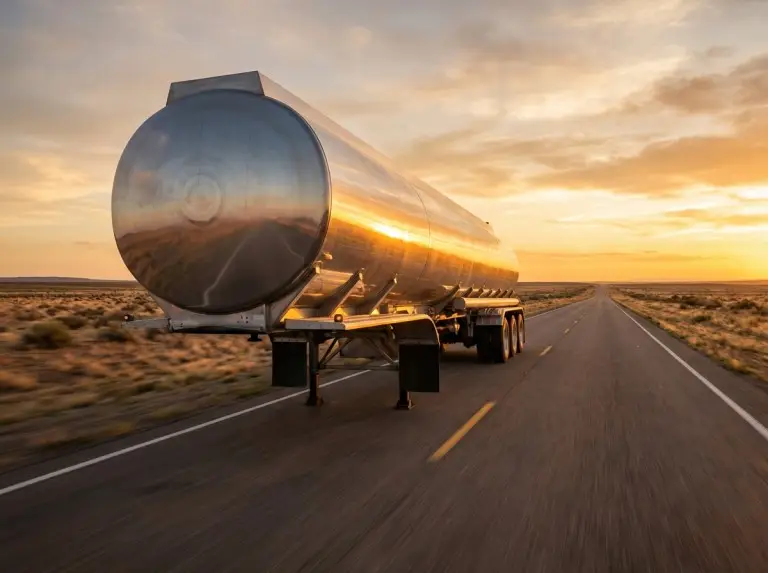
Which Tank Shape Is Safer?
For most atmospheric liquid fuel transport under DOT 406, elliptical tanks deliver better rollover resistance than circular ones. The reason is geometry. Elliptical cross-sections sit lower on the trailer frame. This reduces the loaded center of gravity. It raises the tipping angle before rollover occurs.
Circular tanks distribute internal pressure more evenly — a structural advantage under high static pressure. But on a standard trailer frame, circular tanks sit taller at equivalent capacity. That raises the center of gravity and reduces dynamic stability during cornering, braking, and lane changes.
How We Define “Safer”
Safety in fuel transport covers three risk areas: rollover risk during vehicle operation, structural failure under pressure or impact, and leak or rupture risk over the tank’s service life.
For road transport of flammable liquids, rollover is the dominant risk. NTSB cargo tank safety studies consistently identify high center of gravity as a primary factor in liquid tanker rollovers. That is why elliptical geometry is the starting point for most fleet applications.
When Circular Tanks Perform Better
Circular tanks match or exceed elliptical safety in high-pressure applications — compressed or liquefied gas transport under MC-331 and equivalent standards. Uniform hoop stress distribution prevents the stress concentrations that would occur in an elliptical shell at comparable design pressures.
For flammable liquid transport at atmospheric pressure, that pressure advantage does not apply. The center-of-gravity disadvantage of circular geometry remains fully in effect.
How Shape Affects Pressure and Structural Integrity
Circular and elliptical shells behave differently under internal pressure.
Circular cross-sections produce uniform hoop stress around the entire shell wall. No single point carries disproportionate tensile load. This lets circular tanks meet pressure ratings at minimum wall thickness for a given material grade. When design pressures require ASME BPVC Section VIII classification, this efficiency determines regulatory approval pathways and material requirements.
Elliptical cross-sections have variable curvature. The radius changes continuously from the minor axis to the major axis. This creates higher bending stress at the transition zones between flatter and more curved shell sections. Good elliptical tank design addresses this in three ways: thicker walls at high-stress zones, welds placed away from peak-stress locations, and higher-yield steel at critical shell sections.
At the pressures typical of atmospheric liquid fuel service, these stress concentrations stay within DOT 406 and ADR safety margins. They are a design constraint — not a structural weakness.
Material use follows the same logic. Circular tanks require less wall material at equivalent pressure ratings. For atmospheric-pressure fuel tankers, elliptical designs require additional shell material at stress transition zones. The exact differential depends on wall thickness specification and alloy grade — one of several interdependent variables in fuel tanker trailer design where geometry, material selection, and compartment layout all affect each other.
Why Elliptical Tanks Work Better for Road Fuel Delivery
Elliptical tanks lower the center of gravity, widen the liquid footprint, and stay within legal height limits. These three factors reduce rollover risk on standard delivery routes.
A lower center of gravity means more resistance to tipping. NTSB cargo tank studies consistently flag high center of gravity as a primary cause of tanker rollovers — particularly on highway on-ramps and curved interchange sections.
Height compliance matters on restricted routes. US federal clearances cap vehicle height at 13 feet 6 inches on most Interstate highways, with lower limits on some state and local roads. Circular tanks need larger diameters to match elliptical capacity, which increases total vehicle height. Elliptical tanks achieve the same volume in a shorter vertical profile.
Partial-load conditions — tanks between 30% and 70% full — carry the highest rollover exposure. At 50% fill, an elliptical tank spreads the free liquid surface across the full width of the major axis. A circular tank lets liquid shift across the full interior diameter in any direction. On multi-drop routes where tanks cycle through partial-load states all day, that difference in surge distance matters. Tank shape sets the boundary conditions — baffle design determines how surge energy is managed within those boundaries.
At TRUCKMAN, we use finite element analysis during design to identify and compensate for stress concentration zones at curvature transition points. Stability gains do not come at the cost of structural integrity.
Where Circular Tanks Have the Advantage
Circular tanks offer three genuine advantages: uniform pressure containment, better volumetric efficiency per unit of shell weight, and simpler fabrication.
For MC-331 compressed gas service — LPG, anhydrous ammonia, chlorine, and similar cargoes — design pressures can reach several hundred PSI depending on the commodity. Procurement teams should confirm specific pressure ratings with a DOT-certified manufacturer for their cargo. At these levels, uniform hoop stress distribution reduces required wall thickness versus an elliptical shell at equivalent ratings. The engineering constraints of MC-331 make circular geometry effectively required in practice.
Circular shells also form by rolling flat plate to a consistent radius. This is simpler and faster than variable-curvature forming for elliptical cross-sections. The result is lower tooling cost, shorter lead time, and a lower per-unit acquisition price.
Safety Comparison by Risk Category
| Category | Elliptical | Circular |
|---|---|---|
| Rollover risk | Typically lower — reduced center of gravity | Typically higher on standard trailer frames |
| Pressure resistance | Adequate for DOT 406 atmospheric service | Superior for MC-331 high-pressure gas |
| Liquid surge at partial load | More controlled — wider base limits lateral shift | Greater surge distance across full interior diameter |
| Road height compliance | Easier to meet at equivalent capacity | Risk of exceeding limits on restricted routes |
| Shell stress distribution | Variable — managed at curvature transition zones | Uniform hoop stress throughout |
| Interior cleaning access | More complex — flatter zones need extended-reach tools | Simpler — consistent radius suits standard equipment |
| Acquisition cost | Moderate premium due to fabrication complexity | Lower unit cost — simpler forming process |
| Regulatory standard | DOT 406, ADR for atmospheric liquid fuel | MC-331 for compressed or liquefied gas |
For most atmospheric-pressure road fuel transport, elliptical tanks outperform circular ones on the factors that matter most: rollover resistance, height compliance, and partial-load stability. Where MC-331 pressure ratings apply, circular geometry is the correct choice regardless of route profile.
Regulatory Compliance and Shape Selection
DOT 406 covers flammable liquid transport — gasoline, diesel, ethanol, and similar fuels. It sets material grades, weld requirements, pressure relief specifications, and rollover protection rules. A full breakdown of inspection cycles, hazmat classification, and enforcement requirements is covered under fuel tanker safety standards. The regulation does not mandate a specific cross-section shape. Shape selection under DOT 406 is driven by stability requirements, route profiles, and height envelope constraints.
MC-331 governs liquefied compressed gas. No commercial MC-331 tank uses elliptical geometry in practice. Pressure containment demands make circular cross-sections the engineering standard for this category.
For export markets, ADR codes for atmospheric liquids and high-pressure gas do not mandate cross-section shape, but pressure ratings and inspection intervals interact with shape-dependent design choices. Markets in China, India, and Southeast Asia may impose height envelope restrictions that favor elliptical geometry on routes with low-clearance infrastructure. We provide specification documentation aligned to destination-country requirements and recommend engaging local regulatory authorities before finalizing procurement.
Conclusion — Four Steps to the Right Shape
Step 1 — Confirm your cargo and pressure class. Atmospheric flammable liquid under DOT 406 or ADR: start with elliptical. Liquefied compressed gas under MC-331: circular is required.
Step 2 — Assess your route profile. Routes with curves, grades, interchange ramps, or low-clearance bridges favor elliptical. Flat, high-volume routes with consistent clearance and low rollover exposure narrow the gap.
Step 3 — Account for partial-load frequency. Multi-drop delivery means frequent operation in the 30–70% fill range. Elliptical geometry limits lateral surge in this window. If your fleet runs partial loads most of the day, this factor alone justifies the shape decision.
Step 4 — Request OEM verification data. Center-of-gravity calculations, FEA stress analysis, drain placement documentation, and weld layout drawings should be standard deliverables from any DOT-certified manufacturer. Verify registration through PHMSA at phmsa.dot.gov. Review NTSB incident data at ntsb.gov to check performance claims independently. Shape is one variable in a broader set of safety features essential for fuel tanker trailers — rollover protection, emergency shutoffs, and vapor recovery all interact with tank geometry in ways that affect real-world risk.
Since 2018, we have delivered fuel tanker configurations across more than 12 export markets in Africa, Southeast Asia, and the Middle East — elliptical DOT 406 builds, MC-331 circular configurations, and mixed fleet specifications across varied regulatory environments. Shape selection is one input into a broader procurement decision — choosing the right fuel tanker trailer for your operation also involves capacity, axle configuration, discharge system, and regional compliance requirements. If you are specifying tanks for a new fleet or replacement order, we can provide shape-specific engineering input, FEA validation data, and compliance packages for your destination market.
FAQ
Is an elliptical tank safer than a circular one?
For standard fuel delivery under DOT 406, yes — lower center of gravity means better rollover resistance. For high-pressure gas under MC-331, circular tanks are safer due to uniform hoop stress distribution.
When should I choose a circular tank?
When your cargo requires MC-331 certification — LPG, anhydrous ammonia, chlorine, or similar compressed gases. At those design pressures, circular geometry is effectively required.
Why does partial-load operation matter for shape selection?
Between 30–70% fill, liquid surge is at its worst. Elliptical tanks limit how far liquid can shift sideways. Circular tanks allow movement across the full interior diameter. On multi-drop routes, that difference shows up in handling every day.
Does DOT 406 require a specific tank shape?
No. DOT 406 permits both elliptical and circular shapes for flammable liquid transport. Shape is driven by stability requirements and route constraints, not the regulation itself.
What is the acquisition cost difference?
Elliptical tanks carry a moderate premium due to more complex fabrication. The exact figure varies by specification — request a direct comparison from your manufacturer alongside a lifecycle cost estimate, not acquisition cost alone.