The wrong dump truck for your terrain can drain production time, fuel budget, and haul road maintenance costs. This guide helps project managers and procurement engineers choose between an articulated dump truck (ADT) and a rigid dump truck (RDT) based on site conditions. Both machine types are purpose-built for off-highway work — construction, mining, quarrying, and earthmoving. Neither is a road freight vehicle.
The short answer: Soft ground, steep grades, and poor haul roads favour ADTs. Hard, stable haul roads with high tonnage demands favour RDTs.
This article covers off-highway ADTs and RDTs in the 20–100 tonne payload class. It does not cover on-highway tippers, articulated road haulage vehicles, or underground mining machines. Those operate under different selection criteria.
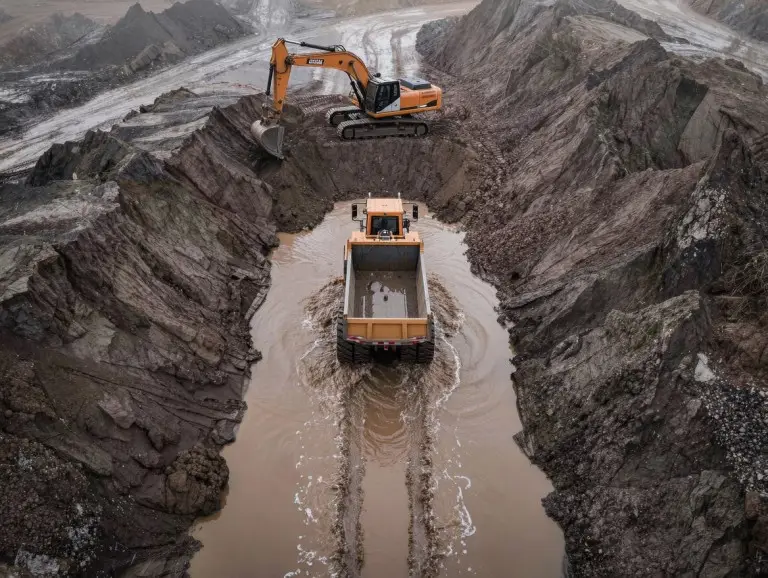
How Each Machine Is Built?
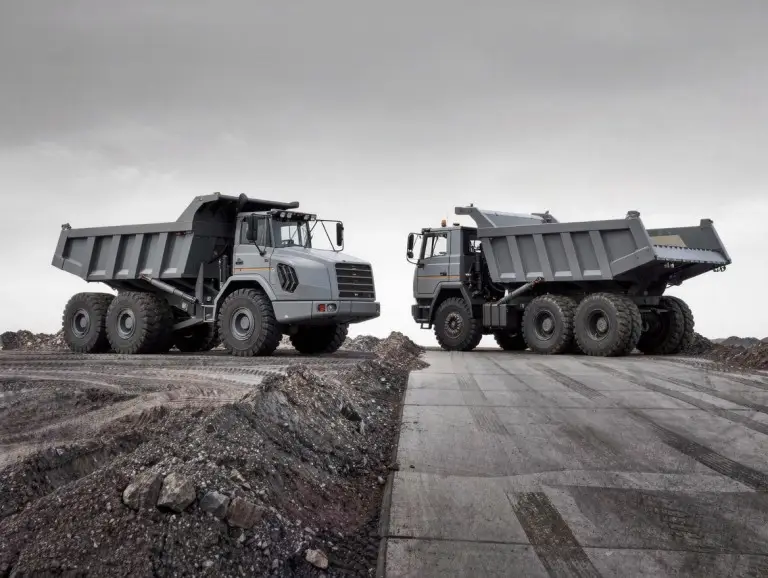
The structural difference between these two machines drives every performance gap that follows. An ADT connects the cab and load body through a pivot joint. This lets the front and rear sections move independently. An RDT uses a single fixed chassis — the cab and dump body are rigidly joined. Most ADT models add an oscillating rear axle and six-wheel-drive traction to that pivot joint. Together, these features produce the soft-ground and steep-grade capability ADTs are known for. The rigid chassis of an RDT, by contrast, supports the higher payload ratings and structural durability that make it efficient on engineered, high-volume haul roads.
The Terrain Condition That Decides Everything First
Terrain type is the primary ADT vs RDT filter. The three variables that matter are haul road gradient, ground bearing capacity, and surface consistency across the active haul route. Check these before reviewing payload or cost data. If your site fails the terrain test for one machine type, no payload advantage justifies selecting it.
ADTs hold a clear mobility edge on grades and soft ground. This comes from the articulation joint, oscillating rear axle, and six-wheel-drive traction. When grades push past roughly 10–15% — the threshold most rigid chassis handle comfortably, based on typical OEM grade ability specifications — ADTs hold stable loaded cycle speeds. RDTs at those grades require significant payload reduction or risk road damage.
Use an ADT when any of the following apply:
- Haul road gradients exceed approximately 10–15% on sustained sections. Confirm with OEM grade ability data for your specific model class.
- Ground bearing capacity is poor or inconsistent — soft clay, waterlogged fill, or loose granular material.
- Haul roads are unmaintained, narrow, or cambered.
- The site footprint changes frequently, requiring the truck to move across unformed ground.
Use an RDT when all of the following apply:
- Haul roads are engineered, compacted, and maintained to a stable standard.
- Sustained gradients stay below approximately 8–10%. Verify this against site survey and OEM grade ability data.
- The haul distance is long enough to support a consistent, high-speed cycle.
- Material density is high and maximum payload per cycle is the production priority.
On engineered haul roads where all four conditions are met, RDTs produce better cycle times and lower fuel consumption per tonne than ADTs on the same route. This reflects typical OEM performance benchmarks.
Turning radius adds another dimension on constrained sites. ADTs carry a turning radius roughly 10–15% smaller than comparable RDTs. This matters wherever working faces are tight, routes include switchbacks, or the site footprint shifts during earthmoving. On constrained sites, dump truck dimensions and turning radius often become the deciding factor before payload or cost enter the conversation. RDTs need wide roads with adequate turning loops. ADTs can operate across narrower corridors and adapt when haul alignments change.
Payload and Cycle Efficiency: How Site Conditions Change the Numbers
On sites still in haul road planning, the most common specification error is choosing machine class on nameplate payload alone. The problem: haul road condition reduces effective payload on the worst segment of the active route. Ignoring that segment routinely overstates RDT productivity on sites that have not yet finished haul road engineering.
The table below shows directional differences. All ranges are indicative of typical machine classes. Validate against OEM specifications for the exact models under evaluation.
| Factor | ADT (typical range) | RDT (typical range) |
|---|---|---|
| Payload range | ~20–60 tonnes (varies by model) | ~40–700+ tonnes (varies by model) |
| Optimal haul distance | Typically under 2 km (subject to cycle time targets and site layout) | Typically 1–5+ km (subject to haul road engineering and cycle targets) |
| Grade performance | Strong above ~10–15% (indicative) | Reduced above ~8–10% (indicative) |
| Soft ground performance | High — designed for poor bearing capacity | Low — requires stable, compacted surface |
| Fuel burn per tonne | Higher on good roads | Lower on good roads; higher on poor roads |
| Tyre wear | Lower per cycle on soft ground | Higher on poor roads; lower on prepared surfaces |
Rated payload does not equal effective payload. On soft or poorly maintained haul roads, an RDT running at reduced payload to avoid bogging or road damage often delivers lower tonne-per-hour output than a lower-rated ADT on the same route — a gap that widens significantly once you account for how dump truck payload capacity varies across machine classes and ground conditions.
That gap is where the five-variable check in the next section begins.
Project Decision Framework: Five Variables to Check
Run through these five variables before committing to either machine type. Each one has site-specific conditions that govern the outcome.
- Haul distance: Under 2 km on poor ground → ADT. Over 2 km on engineered roads → RDT.
- Project duration: Short or mobilisation-sensitive projects → ADT. Long-duration, high-volume projects with capital for road construction → RDT.
- Material type: Wet, cohesive, or variable-density materials on soft subgrade → ADT. Dense, dry, consistent material on stable roads → RDT.
- Site scale: Smaller sites with tight turning radii or variable working faces → ADT. Large open-cut operations with fixed, purpose-built haul roads → RDT.
- Budget structure: Lower infrastructure spend with higher unit operating cost tolerance → ADT. Higher upfront road investment targeting lower per-tonne operating cost on long hauls → RDT.
Score ADT on three or more variables → articulated fleet is the lower-risk choice. Score RDT on four or five, with haul road budget confirmed → RDT fleet is likely the higher-efficiency solution.
In our work on demanding earthmoving and mining projects across export markets, the costliest specification errors come from committing to an RDT fleet before haul road design is finalised — where the road standard the project budget later cannot sustain. The same logic applies when selecting dump trailer types for off-highway projects: equipment committed ahead of site infrastructure rarely performs to its rated specification.
When to Consult Truckman
If your project sits at the boundary of this framework — mixed terrain, non-standard gradients, or haul road design still in progress — contact Truckman with your site gradient survey, haul distance, material type, and target production rate. Our engineering team provides specification-grounded recommendations and reviews all fleet selection outputs before final procurement decisions are made. The projects that benefit most from early consultation are those where haul road construction is still in planning — and where the full range of End Dump Trailers and off-highway haulage options can still be evaluated against road specification, rather than after it is fixed.

FAQ
Which type has a lower total operating cost (TCO)?
Neither type is cheaper by default. On poor haul roads, RDTs generate more tyre wear, more road repair, and lower utilisation — raising TCO per tonne. On engineered roads, they recover that advantage through lower fuel burn and longer tyre life, cutting maintenance costs by as much as 20–25% in some cases. Always compare TCO per tonne on your specific route.
My site has mixed terrain — soft in some areas, compacted in others. Which takes priority?
The worst segment on the active haul cycle governs the choice. If soft-ground sections cannot be bypassed, a split fleet is often the practical answer — ADTs on variable ground, RDTs on engineered roads. The cost of running two machine types needs to be weighed against the penalty of forcing one type across incompatible terrain.
Can an ADT cover for an RDT if haul road construction is delayed?
Yes. ADTs maintain production on unprepared ground where an RDT would bog or cause road damage. The trade-off is lower payload per cycle and higher fuel cost per tonne on any finished sections. Projects that stage road construction often start with ADTs and transition to RDTs once the road standard is met.
How does material density affect the choice?
Dense, high-impact loads — blasted rock, iron ore — favour RDTs. Their rigid frame handles repeated heavy bucket loading better than an ADT chassis. For wet, cohesive, or variable-density material on soft ground, ADTs are the safer choice. Wider tyres reduce ground disturbance and protect effective payload on subsequent passes.