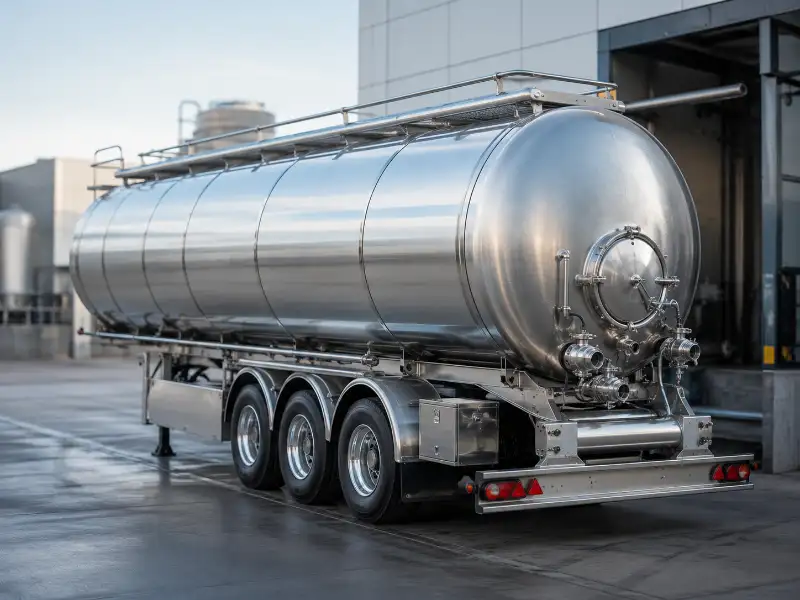
A trailer ABS light signals that the trailer’s anti-lock braking system has found a fault and switched itself off, while the service brakes keep working normally. As a semi-trailer manufacturer, we wire these ABS circuits during build, so we see the warning trace back to a short, predictable list of points. This guide explains what the light means and whether you can keep driving. It also covers how U.S. rules treat it, how to tell a trailer-side fault from a tractor-side one, and how to clear it without guessing. It covers diagnosing the warning light, not designing or installing a trailer ABS harness from scratch, which is a separate build-stage job.
What the trailer ABS light is telling you
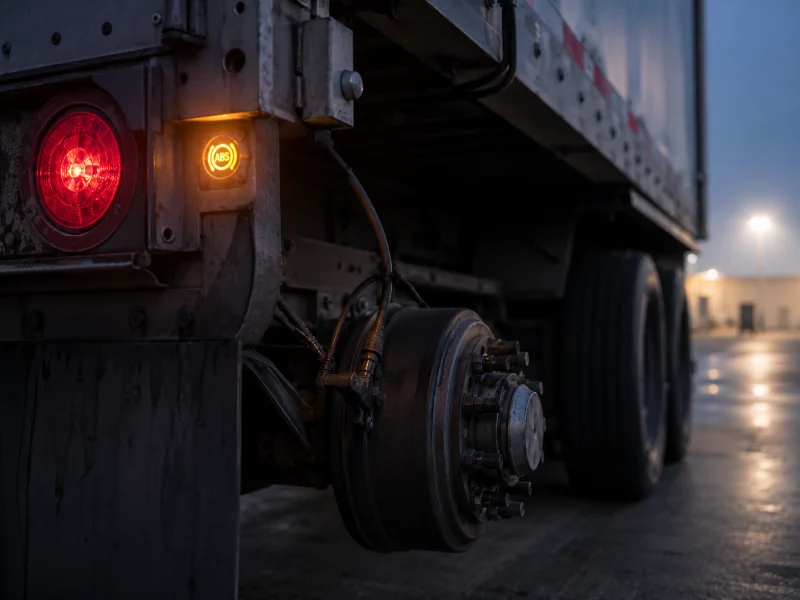
The trailer ABS light reports a fault in the anti-lock system on that specific trailer, with its meaning depending on where the lamp is mounted. A dash lamp tied to the trailer reflects the towed unit, while the lamp on the trailer reports the trailer’s own system directly.
On U.S. trailers, that external lamp is amber and marked as an ABS indicator. It sits on the left side of the trailer as viewed from the rear, near the rear side marker lamp, with its exact position set by FMVSS 121. Knowing where it is matters. A driver who never checks that lamp can miss a fault until a dash warning or an inspector catches it.
The most common misread is treating the light as a total brake failure. The anti-lock function is what shuts off; the service brakes that stop the trailer stay live. What you lose is wheel-lockup protection during a hard stop on a wet or loose surface, which is exactly the moment you most want it. We clarify this distinction up front, because the wrong assumption sends people chasing a brake problem the light is not reporting.
Is it safe — and legal — to drive with the trailer ABS light on?
You can usually drive with the trailer ABS light on, because the service brakes still work. Whether it is wise or legal depends on the unit’s build date and the inspecting authority. The light is a repair item, not a reason to stop on the shoulder immediately.
With the anti-lock system disabled, a panic stop on ice, gravel, or rain can let the trailer wheels lock and the unit push or swing. The brakes still stop the trailer. What shrinks is the margin that keeps a loaded unit tracking straight, the margin that advanced brake systems are built to protect.
On the compliance side, U.S. rules are specific. Under 49 CFR 393.55, air-braked semitrailers, converter dollies, and full trailers manufactured on or after March 1, 1998 generally must have ABS meeting FMVSS 121. Trailers built on or after that date must also carry an exterior ABS malfunction lamp. Trailers built on or after March 1, 2001 need an added circuit that signals a trailer ABS fault to the towing vehicle. A lamp that never comes on with power, or that comes on and stays on, is generally treated as a defect you must repair before highway operation. Whether roadside enforcement records it as out-of-service can vary by combination and jurisdiction. We verify the lamp-cycle behavior on every trailer before it ships, since that one check shows whether a unit is inspection-ready.
Trailer-side or tractor-side: isolating the fault
A trailer ABS fault and a tractor ABS fault throw a similar dash warning, so the first move is to find which unit owns the problem. Disconnect the trailer and watch the lamp. This one test saves more diagnostic time than any component check.
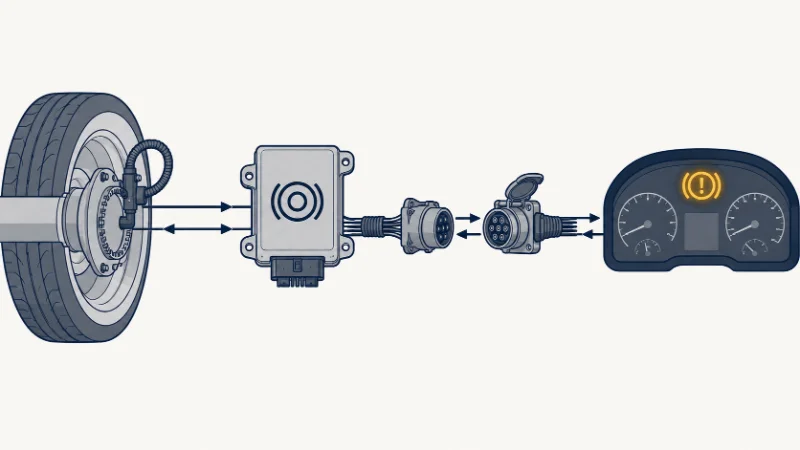
If the dash light goes out once the trailer is unhooked, the fault lives in the trailer or the connection between the two. If it stays on with no trailer attached, the tractor’s own ABS or wiring is the suspect, which points you toward tractor-side maintenance. This isolation check is not the only lamp test, though. Some power units only cycle the trailer ABS lamp when a trailer is connected. Some inspections also call for watching the lamp as you reconnect the seven-way cable. We compare both outcomes before touching parts, because chasing the tractor side for a trailer-side fault is where most wasted hours go.
The link between tractor and trailer is the most common crossover point. Corrosion in the seven-way plug, loose pins, or a worn pigtail can interrupt power to the trailer ABS module. The lamp then comes on even when every component on the trailer is healthy. On many modern systems, the trailer’s ABS status reaches the cab through power-line carrier signaling over the ABS power line. That line is commonly the blue wire of the SAE J560 seven-way connector, so a weak power circuit can degrade both ABS operation and the in-cab warning at once.
What makes the trailer ABS light come on
Most trailer ABS lights trace back to a short list of electrical and wheel-end faults, listed here roughly in the order worth checking before replacing major parts:
- Wheel speed sensors: contamination, a widened air gap, or physical damage stops the sensor reading the wheel.
- Tone (exciter) rings: missing teeth, corrosion, or grease from a leaking wheel seal blur the signal the sensor needs.
- Seven-way connector and pigtail: corroded or loose contacts interrupt power and data between tractor and trailer.
- Ground and power supply: a weak ground or inconsistent trailer power can disable the module even when sensors are fine.
- ABS fuse: a blown trailer-ABS fuse, often from a wiring short, cuts the system entirely.
- ABS module or modulator valve: less common, but a failed control unit or valve usually lights the lamp steadily and will not clear without repair.
In field service, a few items are worth checking before you condemn the ABS ECU or modulator valve: wheel-speed sensor faults, widened gaps, contaminated tone rings, connector corrosion, and weak grounds. During build, we route and protect the sensor mounts, tone-ring fit, and harness grounds, the same wheel-end and trailer suspension systems we engineer for durability. We also order our maintenance notes the same way, so owners check the high-probability items first.
Steady, flashing, or only when braking
How the trailer ABS light behaves narrows the cause faster than any single component check. A steady lamp, an intermittent one, and a brake-only one each point to a different class of fault.
| Light behavior | Likely fault class | First check |
|---|---|---|
| Steady, stays on | Active or stored component fault | Read the fault/blink code before replacing parts |
| Intermittent, comes and goes | Connector, harness, ground, or water intrusion | Wiggle-test the seven-way and inspect grounds |
| Only when braking | ABS power-supply issue or stop-lamp backup power | Check the ABS power circuit, fuse, and build-date exceptions |
The brake-only case has a specific cause worth naming, since drivers ask about it often. Many trailers built before March 1, 1998, or built outside the U.S., may draw ABS power from either the stop-lamp circuit or a constant-power circuit. U.S. trailers built on or after that date have constant-power capability under FMVSS 121. When the lamp appears only as you press the brake, the trailer ABS may be running on stop-lamp backup power instead of a steady supply. Check the ABS power circuit, the fuse, and the J560 wiring, and confirm the tractor, trailer, and dolly build dates before calling it a violation. An intermittent or brake-only light is the one drivers most often ignore. It is also the one most likely to harden into a constant fault as corrosion spreads. We trace each behavior pattern against the trailer’s power and ground layout, because the brake-only case comes back to how the module gets constant power.
Diagnosing and clearing the trailer ABS light correctly
Clearing a trailer ABS light correctly means fixing the fault that triggered it, not resetting the lamp. A reset without a repair brings the light straight back on the next power cycle. Before any diagnosis, set up safely:
- Park on level ground and set the parking brake.
- Chock the wheels.
- Do not crawl under the trailer unless it is securely supported.
- Do not cut, tape over, or unplug the ABS lamp to hide the fault.
- Follow the procedure for your specific ABS supplier (Bendix, WABCO/ZF, Haldex, Meritor, or other).
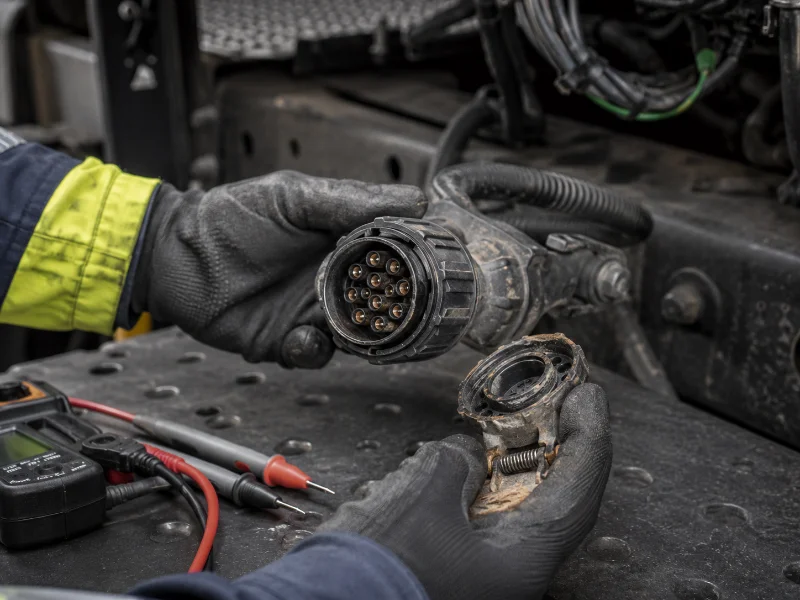
Then work the fault from the cheapest checks to the most involved. Start by isolating the unit: disconnect the trailer, then clean and reseat the seven-way plug and pigtail. Next, confirm steady power, a solid ground, and a good ABS fuse. Then inspect the wheel ends for sensor damage, air-gap problems, contaminated tone rings, or a leaking seal. Confirm the brakes themselves are correctly set, since adjusting trailer brakes and wheel-end condition affect sensor readings. Finally, retrieve the stored fault or blink code to point at the exact wheel or circuit. Restore power, then watch the malfunction lamp cycle on and off to confirm the repair.
Blink-code retrieval differs by supplier. Some systems flash a code through the trailer lamp after a set power-cycle or brake sequence; others need a button on the module or a diagnostic tool. Map any flash count to a specific wheel or circuit only against that system’s own documentation. We use the lamp-cycle test as the final acceptance step, because a clean on-then-off cycle is the simplest proof the circuit is whole. Clearing a light by cutting the lamp wire, or by just unplugging and reconnecting, almost always brings the same warning back if you leave the connector or ground unfixed. And the second fault is harder to trace than the first.
Treating the trailer ABS light as a diagnostic signal
A trailer ABS light comes down to three decisions: where the fault sits, what its steady-or-intermittent behavior is telling you, and how you verify the repair. Get those right, and most ABS lights turn out to be connector, sensor, or ground problems rather than failed modules.
In our own build and service work, these faults concentrate at the trailer-side connector, the wheel-end sensors, and the grounds. That is why we route and protect those points deliberately, and verify the lamp-cycle test before a trailer ships. The exact fix depends on your specific trailer, its ABS supplier, and how the circuit was wired. Whether a code points to a sensor, a valve, or the module, the final call belongs with the unit in front of you.
If you are diagnosing a recurring trailer ABS light, start with the basics: whether the light clears when the trailer is disconnected, how it behaves, and any stored fault code. And if you are speccing a new Semi Trailer, you can have its ABS wiring, sensor mounts, and grounds built to inspect cleanly from day one. Send us your configuration and we will review it with you.
FAQ
Does a trailer ABS light mean the trailer has no brakes?
No. The service brakes still work and will stop the trailer. The light only means the anti-lock function has switched off, so you keep braking but lose lockup protection on slick surfaces.
Can a trailer ABS light fail a DOT inspection?
A trailer ABS light can fail an inspection. A lamp that stays on or fails to cycle is generally a defect to repair before highway use under 49 CFR 393.55(e). Whether it counts as out-of-service depends on the combination, build dates, and inspector, so confirm your unit’s status.
Why does the trailer ABS light come on only when I brake?
A brake-only light usually means the trailer ABS is running on stop-lamp backup power instead of a steady supply. Trace it to the ABS power circuit and fuse rather than to a wheel sensor.
Why does my trailer ABS light come on right after hooking up?
A light that appears right after you connect the trailer points to the seven-way connection or trailer-side wiring, not a deep component. Inspect the plug and pigtail for corrosion, loose pins, or play, and confirm clean power and ground.
Will disconnecting and reconnecting the trailer clear the light?
Sometimes, but only for a loose or dirty connection, and the warning returns if a real fault remains. Treat the reconnect as a clue about where the fault sits, not as the repair.
Where is the trailer ABS fuse?
Most trucks carry separate fuses for tractor ABS and trailer ABS in the cab fuse panel, though the exact spot varies by model. Check both, since a blown trailer-ABS fuse can disable the system on its own.